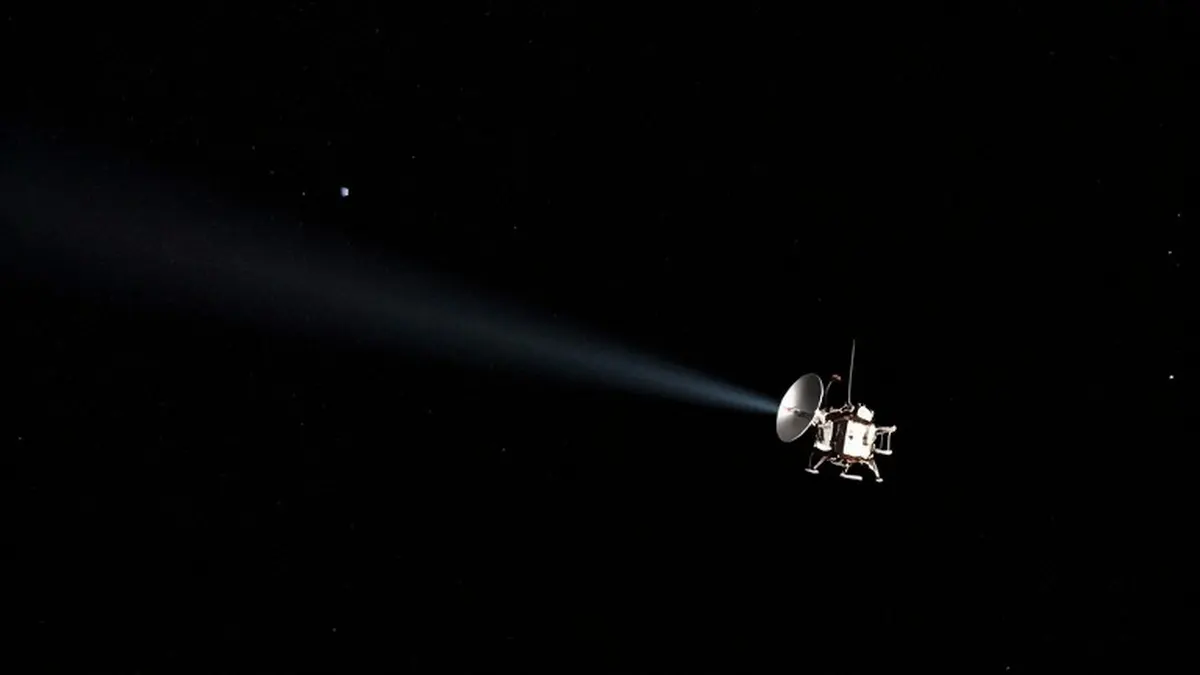
NASA has confirmed that its Voyager 1 spacecraft has achieved a new distance record by reaching a point one light day from Earth. This milestone places the probe at a distance of more than 26 billion kilometers, or 16 billion miles, from our planet. It is the farthest any human artifact has ever traveled into the cosmos.
The space agency received a signal from the spacecraft on Thursday. This reception occurred exactly 24 hours after the signal was transmitted. The time delay corresponds to the duration required for radio waves to travel the vast distance at the speed of light.
Joe Westlake, the heliophysics division director at NASA, described the achievement in a statement. He noted that traveling a light day is a singular feat for a spacecraft. However, he emphasized that Voyager is much more than just a distant traveler.
Voyager 1 was launched in 1977. Over its nearly 50-year journey, it has accomplished several historic firsts. It flew past Jupiter in 1979 and Saturn in 1980. In 1990, it captured the famous image of Earth known as the Pale Blue Dot. It became the most distant human-made object in 1998 and crossed the boundary of the sun’s sphere of influence into interstellar space in 2012.
NASA was unable to officially confirm the new distance record until the signal reached the control team at the Jet Propulsion Laboratory in California. Despite the wait, the agency celebrated the occasion on social media the day prior. Dave Gallagher, the director of JPL, stated that crossing the light-day threshold is another historic feat in an extraordinary voyage of discovery.
The Voyager 1 and Voyager 2 missions are currently the longest-operating space missions in NASA’s history. Both spacecraft continue to generate data despite powering down most of their instruments to conserve energy. Voyager 2 reached space two weeks before its twin, but its longer route to the outer planets meant it did not enter interstellar space until 2018.
Voyager 2 will not reach the one-light-day mark until 2035. Both spacecraft are still functioning well after 49 years of operation. They are moving through space at a speed of 38,000 miles per hour, or 61,000 kilometers per hour, powered by plutonium.
Although the probes no longer take pictures, they typically transmit small amounts of data regarding their environment almost every day. According to NASA, no science or engineering data has been received from Voyager 1 since Saturday. However, the carrier signal continued to arrive, allowing the team to verify the milestone.
Controllers are currently investigating why the flow of specific data stopped. Each spacecraft carries a Golden Record containing sounds from Earth. This project was led by the late Carl Sagan, an astronomer at Cornell University who also coined the term Pale Blue Dot.
NASA expects these gold-plated records to last for more than one billion years. They serve as time capsules for any potential future discoverers in the cosmos.