
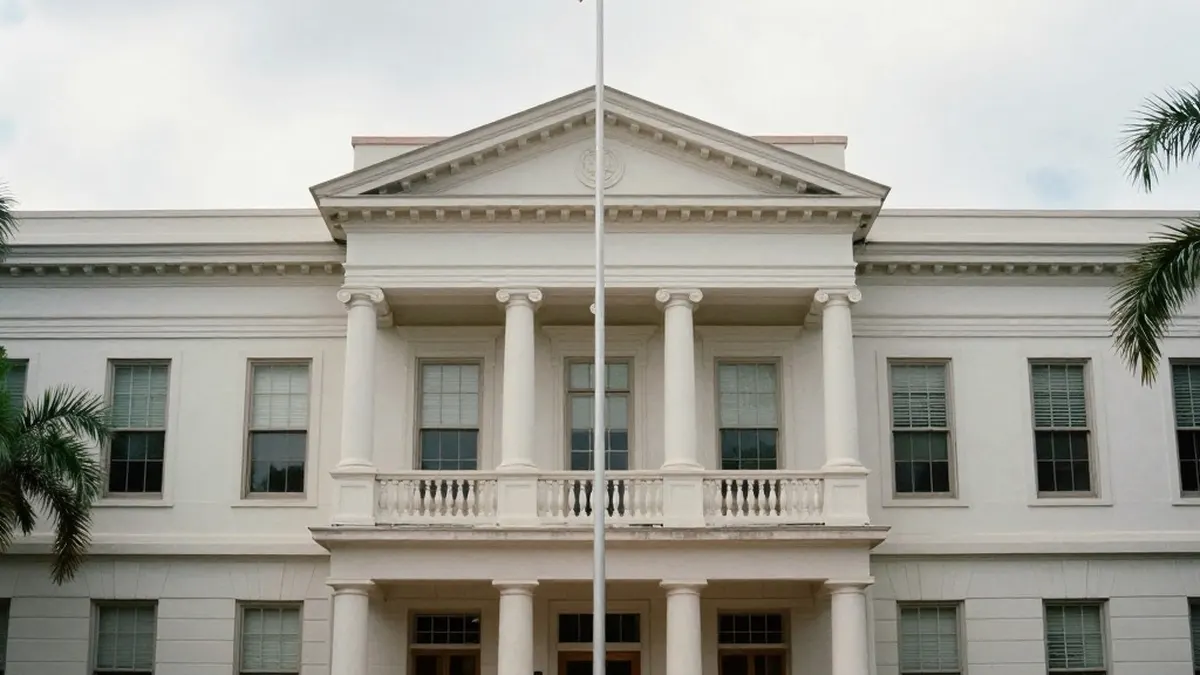
New College of Florida will ask the state Board of Governors on Friday to approve up to $47.5 million in lending, covering both the dormitory debt it inherited with the University of South Florida Sarasota-Manatee campus and a refinance of its existing obligations. The deal goes beyond what is typically allowed in the state university system, with interest-only payments up front that double in the next several years, plus up to $7.5 million from a private investor the college has declined to name.
"The investor information will be made public in the next few weeks once the finalized loan agreement is available," said deputy chief of staff Virginia Zimmerman.
President Richard Corcoran told trustees on Nov. 3 that the 32-acre campus, acquired through the state budget passed in 2026, "is somewhere between 200 and 250 million dollars" in value and was "turnkey ready." Finalizing the deal required taking over the $28.5 million left on the dormitory, Atala Hall, an amount trustee Matthew Spalding, who teaches at Hillsdale College in Michigan, called "small in the scheme of things."
The proposed package combines the $28.5 million in outstanding USF debt on Atala Hall with a refinance of roughly $15.8 million in older New College debt, about $44.3 million in all. The entire package must be refinanced or paid off in 2032, while the private lender's loan runs 10 years, to 2036. The Atala Hall portion stretches to 2056, when payments on the $28.5 million principal will include $39.6 million in interest, a total cost of $68 million, according to the college's own debt table. USF's communications department said the total, with projected interest, was about $53 million when the university held the bill.
Critics have pounced on the structure. Former New College vice president Nathan Allen wrote in a Substack post that "the deal structure creates a debt bomb and kicks it down the road," calculating that the new borrowing adds about $72 million in total cost and that the college will pay $89.6 million in housing system service over the 30-year term. J. Ben Watkins III, director of Florida's Division of Bond Finance, noted in a Nov. 4 memo that as "a small liberal arts college in transition with a limited operating history, New College does not have a credit rating or access to the public markets," and that the financing's viability depends heavily on the college's continued success and its extraordinary legislative support.
Questions also surround the revenue side. Trustees highlighted a debt service coverage ratio of 1.1, meaning the housing system is expected to generate $1.10 for every dollar of debt service. But Eric Croak, an Ohio-based certified financial planner with no affiliation to the college, said that 10% buffer "can be wiped out very quickly with lower occupancy or a surprise repair," and noted the state's guideline is 1.2. New College's own documents acknowledge operating income will not fully cover debt service until 2037. Allen added that the college projects enrollment of 1,360 students by 2029, adding about 500 in three years, something it has never done, and that the campus acquisition adds only 14 beds. The alumni group Novo Collegian Alliance said the college projected 978 degree-seeking undergraduates but actually enrolled 902, a gain of just 37 from Fall 2025 to Fall 2026.
The unnamed investor has drawn particular scrutiny. Documents presented to trustees on Nov. 3 showed the investor's rate at 6.19%, compared with 5.4% on the rest of the refinance and 6.84% on the Atala Hall debt; an updated Nov. 4 schedule shows the private rate rising to 7%. Using a private investor runs counter to state university system guidelines, and the Novo Collegian Alliance said it "leads to serious questions of conflict of interest," urging confirmation the investor is not a relative or business associate of decision makers. Watkins wrote that the private individual helps limit "the risk of adverse consequences of a default," but that the investor, foundation reserves and planned housing rate increases "strengthen but do not eliminate the credit risk of the financing."
Watkins said the requested deviations, including taxable debt, a senior and subordinate lien structure, deferred principal and projected coverage below 1.20x, "appear reasonably necessary to satisfy the statutory conditions mandated by the legislature" to carry out the campus transfer. Croak saw one bright spot: a bank's willingness to lend $40 million suggests it found the housing revenue projections credible, though he compared the arrangement to a family buying a house on an interest-only mortgage with a second loan and a plan to refinance in six years. Allen warned approval would make New College potentially rank "in the top 1% of all small colleges for debt-to-revenue ratio," and that "in the final analysis, Florida taxpayers will have to pick up the pieces."
The Board of Governors is expected to take up the proposal at its Friday meeting.