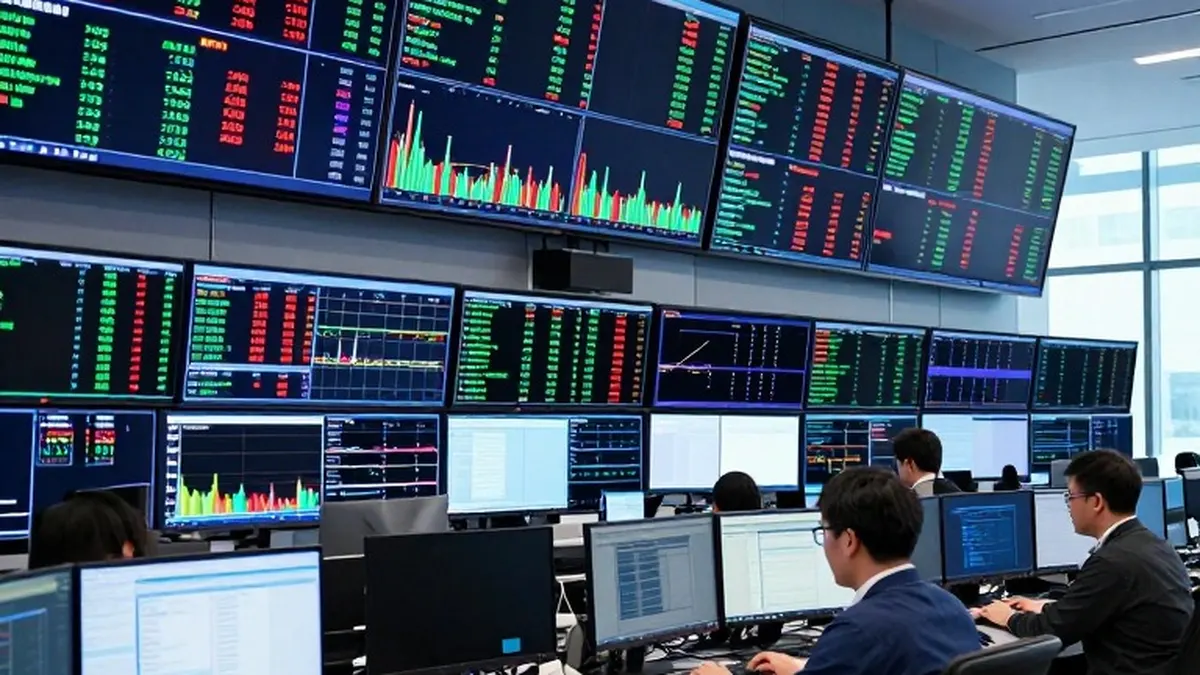
U.S. stock markets moved in different directions on Tuesday as a strong performance by major technology firms helped lift the overall index. The S&P 500 rose by 0.6 percent, even though a greater number of individual stocks within the index closed lower than higher. The Dow Jones Industrial Average was down 87 points, or 0.2 percent, as of 11 a.m. Eastern time, while the Nasdaq composite gained 1.1 percent.
The market has experienced significant volatility recently, driven by concerns that valuations for technology and artificial intelligence stocks have risen too quickly. On Monday, several key AI related shares flipped from gains to losses during the afternoon session. In contrast, these influential stocks held firmer on Tuesday, providing support to the broader market.
Nvidia was the primary driver of the upward movement in the S&P 500, with its stock climbing 2.9 percent. Other major chipmakers also posted strong gains, with Broadcom rising 3.8 percent, Advanced Micro Devices up 5.5 percent, and Micron Technology adding 3 percent.
Apple, which has traditionally been viewed as less dependent on the AI boom, saw its stock drop 2.7 percent. The company reported stronger profit and revenue than analysts had expected for the latest quarter. However, the decline was attributed to increased costs for memory chips, a result of high demand from the construction of AI data centers. Apple indicated that it expects to earn less profit from each dollar of revenue in the final three months of the year due to these expenses.
Palantir Technologies also saw its shares fall by 1.5 percent despite reporting better than expected profits. The software company noted that revenue from U.S. commercial clients surpassed that from the U.S. government for the first time. Commercial revenue increased by 148 percent compared to the same period last year.
The upcoming midterm elections are contributing to market uncertainty. Brock Weimer, an analyst at Edward Jones, noted that since 1970, the S&P 500 has always posted a positive return in the six months following a midterm election. While some speculate that a Democratic sweep of Congress could lead to stricter AI regulations, President Donald Trump would retain the power to veto legislation. Wall Street generally favors split control of Washington, as it reduces the risk of transformative policies that could reshape the economy.
Several other companies benefited from strong earnings reports. Celanese stock climbed 3.7 percent, while DuPont rose 6.9 percent. Revvity posted one of the largest gains in the S&P 500, jumping 12 percent after beating analyst expectations. CEO Prahlad Singh stated that end market conditions continue to improve.
Investor expectations remain high for corporate profits as the U.S. economy continues to grow, despite high inflation and elevated interest rates. This optimism helped push the S&P 500 to a record high last month. An encouraging report on the job market released Tuesday showed that employers were advertising more job openings at the end of September than economists had predicted. This data helped push the yield on the 10-year Treasury up to 4.93 percent from 4.91 percent late Monday.
In the oil market, prices remained volatile. Brent crude climbed above $107 per barrel overnight before briefly dropping below $101 in the morning amid uncertainty regarding the war with Iran. The price was most recently down 1.6 percent at $103.13.
International markets showed mixed results. In South Korea, the Kospi index dropped 3.6 percent, one of the sharpest declines globally, following losses for tech giants Samsung Electronics and SK Hynix. In Australia, stocks rose 0.3 percent after the country’s central bank raised its benchmark interest rate for the fifth time this year.