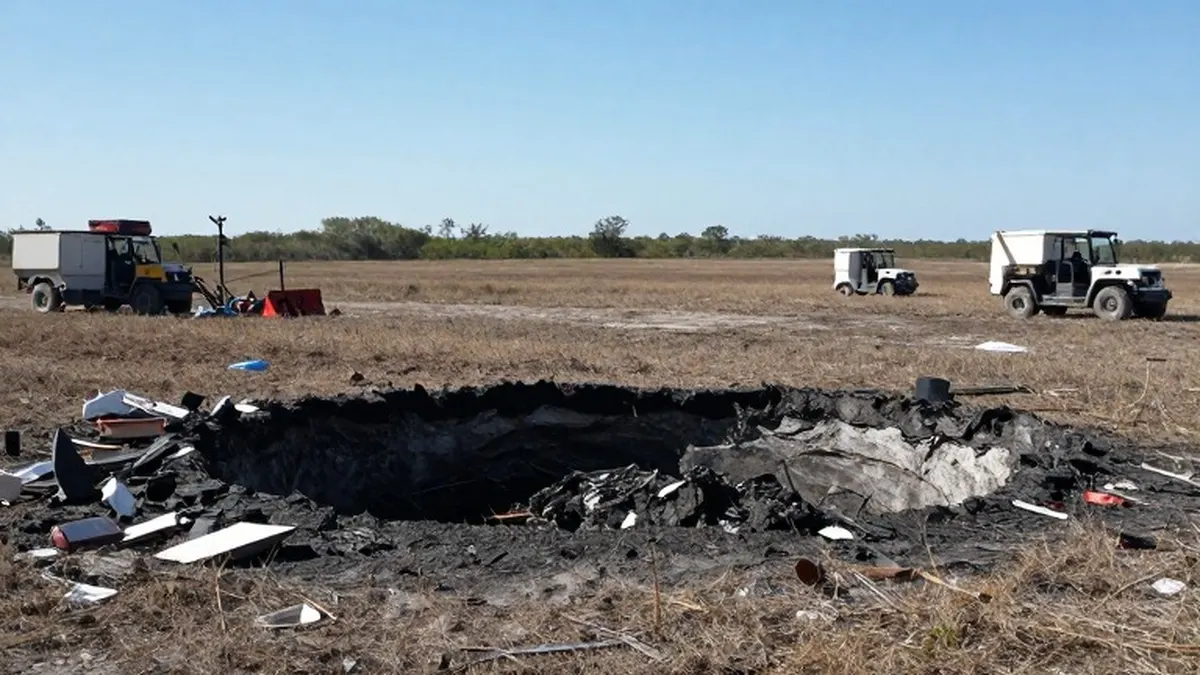
Federal investigators have recovered a critical component of the private jet that crashed in Florida on Sunday, finding it broken into three separate pieces scattered miles from the main impact site. The Learjet 60, which departed Austin-Bergstrom International Airport around 10:37 a.m. for North Eleuthera Airport in the Bahamas, went down in Palm Beach County just before 1 p.m., resulting in the deaths of everyone on board.
The specific part recovered is the left tail elevator, which controls the aircraft's pitch. National Transportation Safety Board member Thomas B. Chapman described the component as a very important piece of evidence during a press briefing on Tuesday. He noted that fragments of the elevator were discovered between 1.3 and 3.8 miles away from the crash site, indicating that the part likely separated from the plane before the final impact.
Investigators are now examining the debris to determine the sequence of events. A key question is whether the loss of the tail elevator contributed to the crash or if other forces acting on the aircraft tore the part loose before the plane went down. Public utility crews are currently clearing the area, and investigators hope to gain access to the crater by Wednesday.
Greg Feith, a former NTSB investigator, offered his analysis to Fox News regarding the scattered debris. He suggested that the pattern points to an in-flight breakup, potentially triggered by a pilot's effort to stabilize the jet. Feith explained that the aircraft appeared to level off at approximately 8,000 feet for a brief period. He theorized that this maneuver may have overstretched the aircraft's structure, causing critical parts to fail and detach.
Feith added that because the recovered pieces were found close to the main impact area, they likely separated at a very low altitude. This timing supports the theory that the structural failure occurred during the final moments of the flight rather than earlier in the descent.
The crash claimed nine lives, including Austin technology entrepreneur Adam Robinson, 45, his wife Helen Sharp, 40, and their two young children, Emma, 4, and Charlie, 2. Also killed were the family's nanny, Anita Maria Cetina, and two other passengers, Rachael Reed and Charmi Fehr. The flight crew, consisting of captain Jeff Gregory, 55, and copilot Nathalia Gadelha Filgueiras, 20, also perished in the accident.
Weather conditions remain a major focus of the federal investigation. The crew reported encountering icing and moderate turbulence at roughly 35,000 feet shortly before the aircraft experienced a rapid loss of altitude. Investigators are working to determine how these atmospheric conditions may have influenced the flight's trajectory and the subsequent structural failure.
Despite the severity of the crash, investigators have not yet located the cockpit voice recorder. NTSB officials stated that while the jet was equipped with the device, they cannot yet confirm whether it was actually on board at the time of the crash. The search for this critical piece of evidence continues as the probe deepens.