The Hollywood Reporter has released its annual ranking of the world’s best music schools, highlighting a distinct trend in higher education. While traditional conservatories that focus on intensive studio training in performance and composition remain strong, institutions with established media scoring programs are retaining significant influence in Hollywood and beyond. These programs, which teach students to compose for film, television, video, and gaming, are found at schools such as USC Thornton, Eastman, Berklee, and Columbia Chicago.
David Serkin Ludwig, dean and director of the music division at the Juilliard School, notes that deep training is crucial as artificial intelligence begins to encroach on creative fields. He argues that thorough education provides a necessary hedge against AI replacement. Ludwig states that having depth of knowledge and experience is essential for people using new tools. He expresses satisfaction with the direction the school is taking, emphasizing the need to stay current with evolving technologies.
The ranking was determined through surveys of key industry organizations, including the Society of Composers and Lyricists, the music branch of the Academy of Motion Picture Arts and Sciences, the Alliance for Women Film Composers, and the Composers Diversity Collective. Ray Costa and Costa Communications assisted in distributing the survey to these groups.
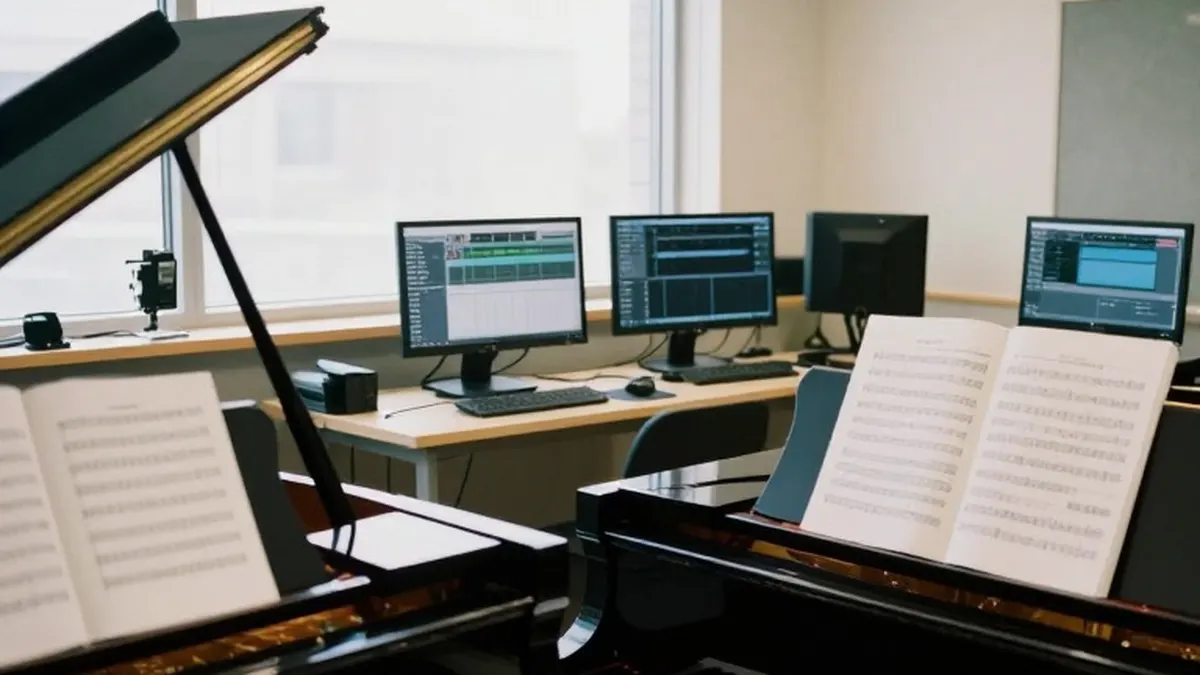
The Juilliard School in New York City has recently expanded its offerings to include several media scoring courses. New classes such as Composing for Visual Media provide fundamental skills for film and television, while Scoring to Picture covers the placement of music in projects. The school has also upgraded its film scoring labs to incorporate interactive music technology, including motion sensors and digital response tools, allowing students to create their own media with the latest devices.
In Los Angeles, the USC Thornton School of Music continues to thrive at the center of the Hollywood music community. Its two-semester master’s degree program in screen scoring recruits approximately twenty students annually. Jeanine Cowen, who has chaired the program since 2022, highlights the school’s collaboration with the cinema school. She describes a recent mock scoring session involving twenty-five musicians and composers that demonstrated the value of live ensembles to filmmakers.
Eastman School of Music in Rochester, New York, pairs intensive conservatory training with a renowned film and media scoring program. Funded in part by composer Jeff Beal, the Beal Institute for Film Music and Contemporary Media will launch a new major in music creation and technology in the fall of 2027. Associate professor Dennis DeSantis says this initiative aims to reach beyond traditional composition methods and keep the curriculum at the forefront of musical innovation.
Berklee College of Music in Boston offers two four-year bachelor of music degrees in film and media scoring and game and interactive media scoring. The school’s Next Gen Composer Lab facilitates a five-day collaboration with the Vienna Synchron Orchestra, allowing composers to conduct and record original music. Berklee has also introduced a one-year, fully online Master of Arts in music supervision, described as the first of its kind, taught by industry professionals.
Other schools on the list include UCLA Herb Alpert School of Music, Colburn Conservatory of Music, and the Royal College of Music in London. Yale School of Music and Curtis Institute of Music both offer free tuition through scholarships, while Oberlin College and Conservatory provides a strong environment for learning sound design and production techniques. Columbia College Chicago and Manhattan School of Music round out the top twenty, each offering specialized programs in composition and media scoring.