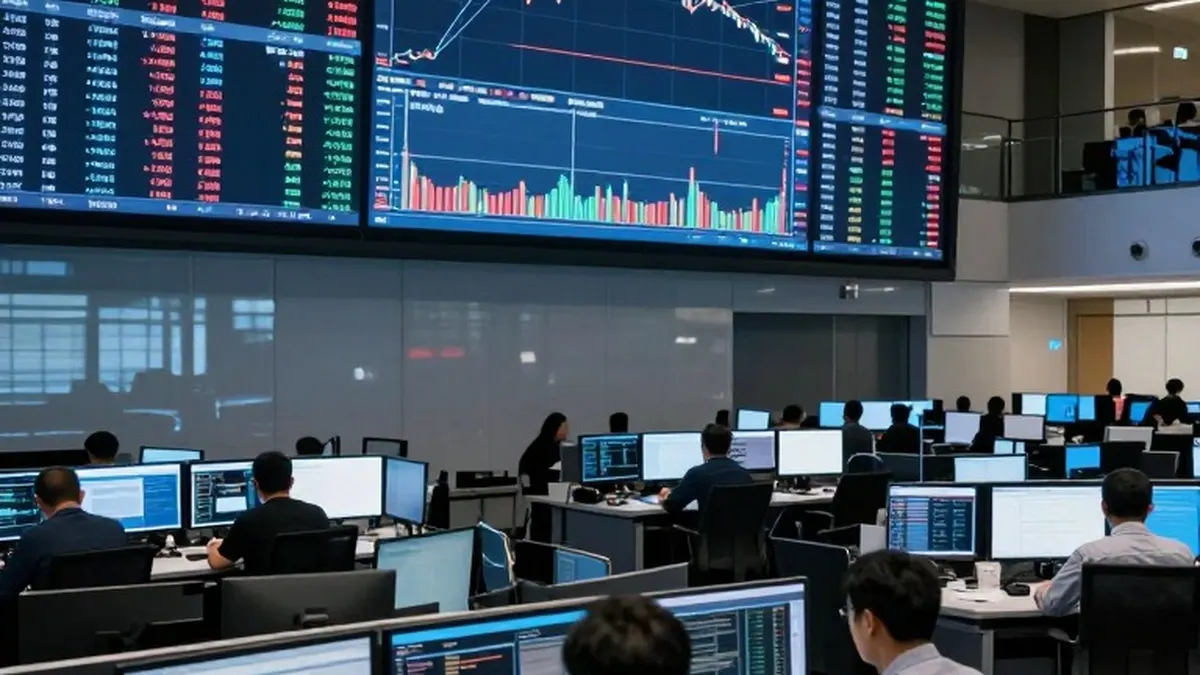
Financial leaders attending the 2026 Global Financial Leaders’ Investment Summit in Hong Kong have issued mixed signals regarding the sustainability of the artificial intelligence boom. While the sector continues to attract massive capital, prominent executives are increasingly vocal about the potential for a downturn. The discourse highlights a growing tension between the rapid expansion of AI infrastructure and the mounting financial obligations required to support it.
Emmanuel Roman, the chief executive of Pacific Investment Management Co, a major bond management firm, told attendees that a downturn in the AI market is inevitable. He described the situation as a period where things are going to break, noting that the precise timing and economic evolution remain uncertain. His comments carry significant weight given his firm's deep involvement in the recent AI financing landscape.
The scale of the current AI buildout has placed substantial pressure on debt markets. Several major technology companies are currently issuing large volumes of bonds to fund their expansion. Meta recently secured orders for $58 billion for a bond offering expected to raise between $15 billion and $20 billion. Oracle indicated on Monday that it would require an additional $20 billion in bonds, adding to its existing financial commitments.
Other tech giants are also tapping into the debt market. Alphabet, the parent company of Google, is selling approximately $6.7 billion in bonds, equivalent to 6 billion euros. Microsoft, which has not sold bonds in a decade, recently issued $25 billion worth. These moves illustrate the sheer volume of capital being deployed to support AI development.
Roman has estimated that the ongoing AI infrastructure buildout could generate $2 trillion in financing needs over the next five years. To put this figure in perspective, the total value of the US bond market is approximately $12 trillion. This comparison underscores the magnitude of the debt being issued specifically for AI purposes relative to the broader market.
PIMCO's position in the AI market is notable because the firm has been a key financier in the sector. It participated in the first chip-based financing for CoreWeave in 2023. Last year, the firm realized $2 billion in paper gains from $29 billion in Meta bonds that were issued to support AI projects. Additionally, PIMCO purchased $4 billion in SpaceX bonds last month. The fact that the company recently sold a portion of its AI debt while its CEO warns of a bubble adds a layer of complexity to its public messaging.
Caution is not limited to PIMCO. Jim Zelter, president of Apollo Global Management, also expressed uncertainty to analysts. While Zelter believes society will utilize significantly more computing power in the future and that AI capabilities are improving rapidly, he stressed that the long-term pricing and economics of the technology remain unknown. Apollo has recently been in discussions with SpaceX regarding a potential $40 billion chip deal.
Market indicators present conflicting signals. The strong demand for Meta's bonds suggests that market enthusiasm has not yet peaked. However, reports from China indicate that its AI bubble may have already burst. On the other hand, Wall Street banks have been eager to finance $63 billion in debt for Anthropic, a company that is not classified as a hyperscaler, demonstrating continued confidence in the sector's growth potential.
Potential triggers for a market shift include US interest rate hikes, geopolitical conflicts such as war, or a crisis in the eurozone. Roman identified these factors as possible catalysts for a downturn. The current market environment is no longer characterized by unchecked growth, and the outcome may depend on upcoming events such as the potential initial public offering of Anthropic. If such an event proves successful, it could inject new energy into the market, but for now, many industry leaders are adopting a more cautious stance.