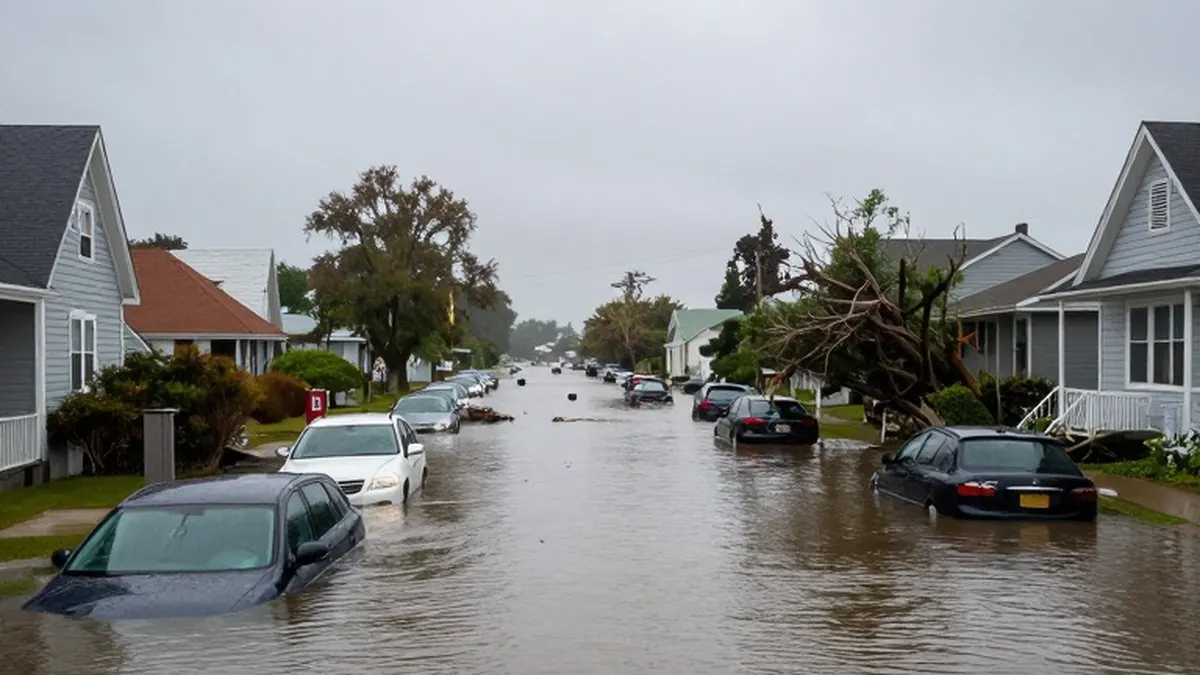
Heavy rainfall over flooded East Coast communities began to ease on Friday, November 27, 2026, allowing utilities to slowly restore service to hundreds of thousands of customers. Despite the improving conditions, many coastal areas remained on guard against high-tide flooding. The severe weather system had previously disrupted travel, downed trees and power lines, and necessitated water rescues across states from New York to Virginia. In several locations, preparations were underway to hold major events on Saturday after unprecedented postponements caused by rain and high winds.
The storm system extended its reach beyond the East Coast. Wet snow fell as far south as the Tennessee Valley, while freezing rain moved across northern New England. Parts of the Midwest, including the Ohio Valley and the lower Great Lakes, reported cold rain. In the Northwest, another system brought rain to coastal Oregon, with more snow forecast for the Cascade Range and mountain passes in Montana and Wyoming.
Travel disruptions were significant across the country. According to flight tracking service FlightAware, 2,893 flights in the U.S. were delayed as of Friday afternoon, with an additional 151 canceled. Power outages, which peaked at over 900,000 customers on Thursday, dropped by approximately 50% by Friday afternoon to under 400,000, according to utility tracker PowerOutage.us. Pennsylvania accounted for about 90,000 of the remaining outages.
The National Weather Service noted that while conditions were expected to improve across the entire eastern U.S. on Friday, the massive system would take time to weaken. Coastal flood warnings were posted from New Jersey to Virginia. Homeowner Chris Rizzo described the scene in his area, noting a lot of standing water, tree branches, and siding ripped off houses and buildings.
Local landmarks and infrastructure suffered notable damage. In Hampton, Virginia, the storm toppled a beloved leafless tree known as the Grieving Tree or Shell Tree, which was regularly decorated by visitors. In Norfolk, Virginia, crews rescued 39 people and two dogs, while roofs collapsed in Ocean City and Rockville. A record 3.04 inches of rain fell at BWI Thurgood Marshall Airport on Thursday, and high tides in Annapolis reached levels among the ten highest on record. In Virginia Beach, a section of a fishing pier collapsed, closing a three-mile stretch of beach.
In Avalon, New Jersey, downtown merchants worked to pump out saltwater after Thanksgiving tides proved among the most significant in the community's history. More than 1,100 people participated in a charity run, and Santa Claus was scheduled to arrive on a fire truck to light the Christmas tree. Borough business administrator Scott Wahl stated that conditions were a million times better than they had been 24 hours earlier.
Residents are reflecting on the increasing frequency of such events. Cheryl McKenna of Ocean City, New Jersey, said water flooded her garage and surrounded her property, keeping her family inside for six hours on the holiday. McKenna, whose family has lived there for 36 years, questioned whether the area remains the right place for them as they are now retired and face recurring flooding.
Another round of rain and strong winds is expected to hit the East Coast by Sunday evening, potentially disrupting the Monday morning commute. CBS News meteorologist Nikki Nolan reported that up to two inches of rain and wind gusts of 65 mph are possible in some areas.
Meanwhile, parts of the South and Midwest saw snow, while California contended with coastal flooding. A winter storm warning was issued for part of Tennessee for up to an inch of snow on Friday. In the Midwest, conditions were calmer than on Thanksgiving, when eastern Missouri received up to 15 inches of snow. Snow is expected to begin falling Saturday from Montana to Colorado, with accumulations of 10 to 18 inches in some areas, before moving into the Midwest and Gulf Coast on Sunday.
On the Pacific Coast, waves driven by high tides caused flooding and affected train service on Friday. Amtrak's Pacific Surfliner canceled or shortened more than a dozen trains between San Diego and Los Angeles, forcing buses into service. Heavy snow was also expected in parts of Montana and Wyoming as a renewed surge of moisture from an atmospheric river moved toward the northern Rockies.