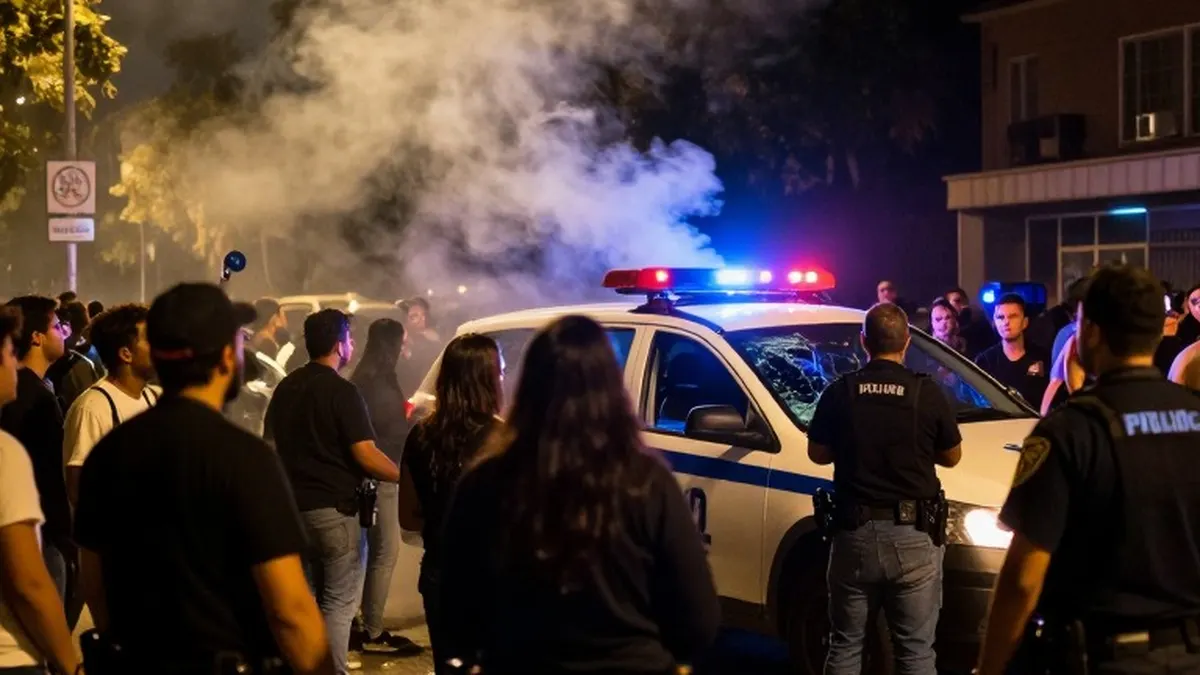
Violent clashes broke out in the Israeli city of Beit Shemesh on the evening of November 20, 2026, following a police attempt to detain an ultra-Orthodox man known for evading military service. According to reports from Channel 12, the arrest was reportedly for reasons unrelated to his draft evasion, yet it sparked significant tension within the local Haredi community. Hundreds of demonstrators gathered at the scene, blocking police vehicles and engaging in confrontations with law enforcement officers.
Footage captured at the scene shows the intensity of the standoff, with one protester seen hurling a garbage can at a police car, which shattered the vehicle's window. In an effort to disperse the growing crowd, police deployed stun grenades. The incident highlights ongoing friction between the state's enforcement of military service laws and segments of the ultra-Orthodox population in Beit Shemesh, a city with a large Haredi demographic.
In Washington, White House National Cyber Director Sean Cairncross announced his departure from the post. A White House official confirmed the news, marking another high-profile exit from the administration following the Republican losses in the recent midterm elections. Cairncross, who heads the Office of the National Cyber Director responsible for coordinating federal cybersecurity strategy, stated that he did not wish to serve another two years. He is leaving now to allow the White House sufficient time to secure Senate confirmation for a successor before Democrats take control of Congress in January.
The timing of Cairncross' exit comes amid a period of disruption in US critical infrastructure. Recent days have seen tech outages affecting air travel, banking, and national security systems. While the administration has faced criticism for its response, top US intelligence officials stated on Wednesday that the series of disruptions was not a coordinated or state-sponsored attack. Officials have repeatedly emphasized that the outages are separate events and unrelated to specific cyberattacks. Cairncross, a former executive at the Republican National Committee, leaves on amicable terms, and his replacement will require confirmation by the Senate, which will be under Democratic control starting in January.
Meanwhile, in Israeli security circles, reports indicate that Shin Bet chief David Zini and his deputy have been using their positions to influence the movement of Arab Israelis into Jewish towns. A senior security source told Haaretz that Zini operates under the premise that all Arabs are supporters of terrorism, viewing such demographic shifts as a threat to the character of the state. Zini had sought to detain four Arab faction leaders for questioning regarding alleged foreign election interference but was blocked by the Attorney General, who cited a lack of legal grounds for the arrests.
During a meeting with Attorney General Gali Baharav-Miara, Zini reportedly referenced Ra’am chairman Mansour Abbas by name, asking to conduct the interrogations in exchange for other concessions. The Attorney General had to explain that in democratic countries, evidence is required before such interrogations are held. Zini’s deputy, whose name is barred from publication, holds similar views, stating in a closed-door meeting that external funding driven by hostile motives is being used to challenge Israel's social fabric, particularly in an election year.
In a separate incident highlighting tensions between Arab MKs and police, Joint List MK Hassan al-Nasasra reported that a police officer called him a "terrorist" during a dispute in southern Israel. Nasasra, a member of the Balad faction, said he stopped near the Beit Kama intersection after spotting a plain-clothed officer beating a handcuffed Arab suspect on the side of the road. The officer demanded Nasasra get back into his car, which the MK refused to do. Nasasra accused the officer of humiliating the detainee, asking why the arrest had to be conducted with such disrespect on the roadside rather than at the police station. The incident is part of a broader pattern of accusations leveled at Arab MKs, whom Prime Minister Benjamin Netanyahu has frequently labeled as terror supporters, a rhetoric that community leaders say exposes them to greater discrimination.