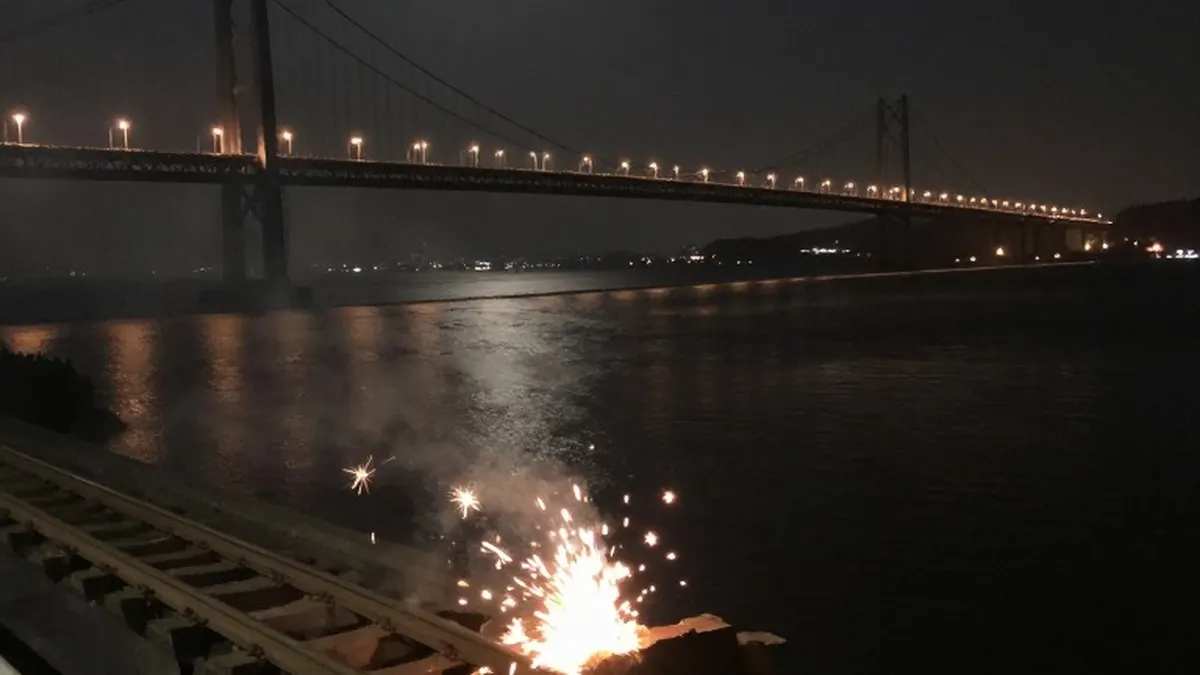
Ukrainian missile forces have successfully struck the Crimean Bridge, specifically targeting the railway tracks during the night of November 18 and 19. The attack was carried out by Neptune coastal missile systems operating under the Naval Forces of the Armed Forces of Ukraine. According to the Ministry of Defence, the strikes recorded impacts near the bridge’s arch and the railway infrastructure.
The General Staff of the Ukrainian Armed Forces confirmed the effectiveness of the operation, stating that the target was hit and traffic across the bridge has been closed. While the full extent of the damage is currently being assessed, train traffic has been temporarily halted. The ministry noted that the scale of the destruction is still being verified by military engineers on the ground.
This bridge serves as a primary land artery for the Russian army, facilitating the transport of fuel, ammunition, and equipment to occupation groupings in southern Ukraine. Russian officials had long promoted the structure as a symbol of the peninsula's occupation, frequently describing it as unattainable and invulnerable. Ukrainian commanders highlighted that the Neptune system has a history of targeting such symbolic structures, recalling its role in sinking the Russian Black Sea Fleet flagship, the cruiser Moskva, in April 2022.
A statement from the General Staff emphasized that the Neptune missiles and other Ukrainian weapons are now placing definitive ends to the bridge's operational history. The forces described the bridge as the lifeline by which occupiers maintain their hold on Crimea. The attack is part of a broader strategy to degrade Russian military logistics, with the military noting that the Kerch crossing is only one link in a larger chain of supply routes feeding the frontline.
In recent days, Ukrainian forces have confirmed damage to other critical infrastructure. On November 15, strikes damaged the road surface of bridges across the Siverskyi Donets River near Pryshyb in Luhansk Oblast and across the Mius River near Taganrog in Russia's Rostov Oblast. Additionally, on November 14, damage was confirmed on a bridge spanning the Mius Estuary near Lakedemonovka, also in Rostov Oblast. These coordinated efforts aim to reduce the enemy's capability to sustain operations at the front.
The current strike follows a series of attacks on the Crimean Bridge earlier in the month. On the morning of November 16, Russian-installed authorities in Crimea reported a strike that led to traffic restrictions. The following morning, reports indicated that one of the bridge's arches and a section of the roadway had fallen into the sea after a second attack, closing the structure to both rail and road traffic.
President Volodymyr Zelenskyy provided details on the weapons used during the night of November 16 and 17. He reported that Palianytsia drones were deployed to strike the road section. Meanwhile, the railway section was targeted using Neptune missiles, Ruta and FP-1 drones, and a Flamingo missile. The Security Service of Ukraine later revealed that these actions were part of a successful multi-stage special operation developed jointly with other branches of the defence forces.
The Security Service stated that the strikes completely destroyed one of the bridge's metal arches and the road span beneath it. Russia, which occupied the Ukrainian peninsula of Crimea in 2014, subsequently built the bridge illegally across the Kerch Strait. The structure features two crossings for cars and rail, connecting Crimea with mainland Russia. Ukraine has repeatedly emphasized the illegality of this crossing, declaring it a legitimate target for its armed forces.
Previous attacks on the bridge have included a series of operations by the Security Service of Ukraine. In October 2022, the service detonated a lorry packed with explosives on the structure. In July 2023, Sea Baby naval drones attacked the bridge's pillars, and in June 2025, the service mined the supports of the structure, resulting in an underwater explosion. These repeated strikes underscore the strategic importance of the bridge in the ongoing conflict.