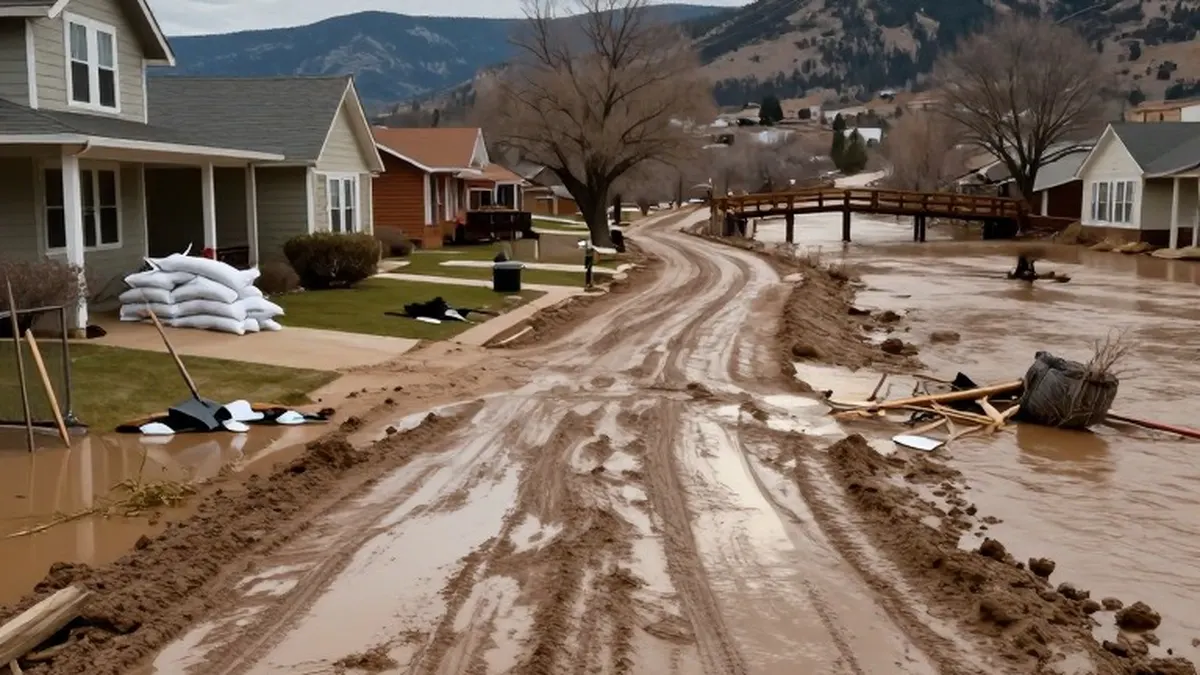
Residents across the U.S. Southwest began digging out on Tuesday after days of severe flooding coated entire neighborhoods in mud and damaged or destroyed homes and businesses, with skies finally clearing even as high water continued to move through the region.
In Pagosa Springs, Colorado, which endured two rounds of heavy flooding in recent weeks, retired school teacher Jack Ellis surveyed the damage along the San Juan River. "This is quite a disaster for everybody, especially in the low-lying areas," he said. "We dig in and dig out, and that's what it's going to take."
More than 20 trillion gallons of rain have fallen on the Four Corners states and Nevada over the past two weeks, according to calculations by Ryan Maue, a former chief scientist at the National Oceanic and Atmospheric Administration. Although conditions were improving on Tuesday, officials warned that flood risks persisted as the water drained across the dry landscape where Colorado, New Mexico, Arizona and Utah meet. Hundreds of evacuees were returning home, but swift-water rescue teams were kept busy. One person died in the floodwaters, and police suspect a second death was also weather-related.
The flooding also disrupted Election Day plans, with some communities in Colorado and Utah making alternative voting arrangements. In Florida, where downpours swamped parts of the state, polling places were changed in at least eight counties after Gov. Ron DeSantis issued an emergency declaration.
In Pagosa Springs, officials said cleanup and repairs could take weeks or longer, with walkways and bridges collapsed or heavily damaged. Outside a resort where the entrance was covered by a tarp and sandbags were stacked, a sign read "Love Pagosa." Ellis said he hoped Washington would step in. "I hope the federal government helps out a little bit. I know we're a blue state. I just hope that they come through because we all pay taxes and we all work for each other in a time like this," he said.
In Durango, roughly 60 miles (96.5 kilometers) to the west, Willow Bradner found her ranch-style home surrounded by about 2 feet (60 centimeters) of mud after an overflowing Junction Creek sent nearly 5 feet (1.5 meters) of water pouring inside at one point. "Our basement became a soup bowl," she said. The basement had been a selling point when she bought the property in 2024, and Bradner, who runs a small custom closet and storage business with her husband, said the couple had asked whether they needed flood insurance and were told they were outside the flood zone.
Bradner said her family, including the couple's teenage daughter, has been offered a place to stay through the end of the year, and countless strangers have shown up with shovels to help. Even so, she said, the loss of the house and the uncertainty ahead are overwhelming. "The majority of our savings is in this house," she said. "We have to dig deep and we have to rebuild."
In New Mexico's San Juan County, where there have been a number of evacuations, officials said the region's major rivers, including the San Juan, Animas and La Plata, have all crested. "None are below flood stage, but will continue to recede," the agency posted online Tuesday. "We believe that the crest has passed on all rivers, but it will take 24-48 hours for floodwaters to recede."