Electric vehicle maker Rivian has acquired Third Dimension, a U.K. startup whose AI technology turns images and video into realistic 3D environments. The deal, reported on 2026-10-22, comes as Rivian works to advance its driver-assistance features and the self-driving system for robotaxis it plans to supply to Uber.
Financial terms were not disclosed. Third Dimension's 15 employees, most of them based in the U.K., will join Rivian's autonomy and AI team, which is led by James Philbin. Philbin said the purchase also gives Rivian a chance to expand its AI hub in London.
Third Dimension was founded in 2024 by CEO Tolga Kart and Piotr Sokólski, who come from the gaming and autonomous vehicle industries. The company raised $7 million in seed funding from investors including Abstract Ventures, MVP, Soma Capital and Solari Capital. Its software was originally built to speed up video game development, though the founders also saw uses in defense and autonomous driving. Rivian is not moving into gaming; the team will now concentrate on automated driving.
Rivian currently sells "Universal Hands-Free" software that lets drivers take their hands off the wheel on highways while continuing to watch the road. By the end of the year, the company plans to release a version able to handle an entire trip, on both surface streets and highways, without the driver touching the wheel. Drivers will still need to supervise and be ready to take over. Rivian is also pursuing full autonomy, which it intends to deploy in robotaxi versions of its R2 SUV available through the Uber app in 2028.
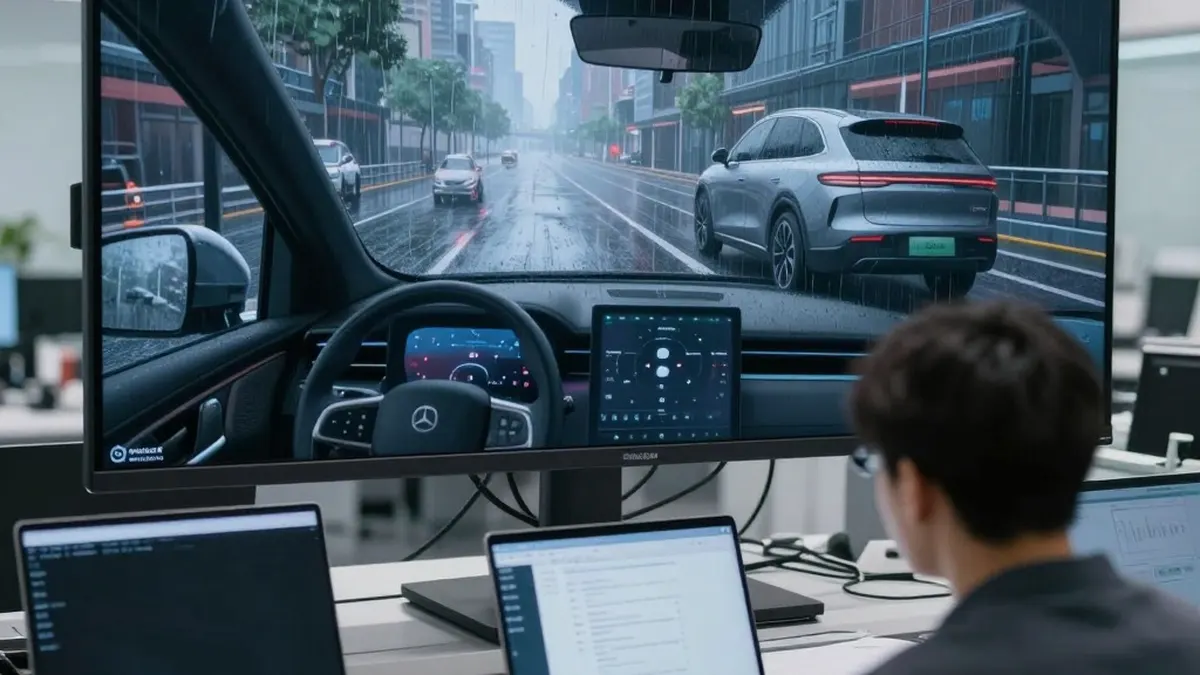
Simulation is a key tool for companies building autonomous vehicles, who use it to train and validate their systems. Kart explained that simulators have traditionally relied on rendering or video game engines and often on synthetic data. Such virtual worlds can look realistic, he said, but a gap with the real world persists, and the usual remedy is to feed simulators ever more data. Third Dimension's approach uses AI to match the physical world instead.
Philbin said the goal is "taking real scenarios, but making them simulatable." Rather than game-style synthetic scenes, the simulations are based on events that actually occurred, but engineers can move the cameras, shift other road users, and change lighting or weather. He described it as a powerful tool and said Rivian had carried out an extensive evaluation of many providers before choosing.
Data is central to the effort. Rivian gathers aggregated, anonymized driving data from tens of thousands of R1T pickups, R1S SUVs, delivery vans and R2 SUVs whose owners have enabled external camera sharing, and uses it to build driving models. According to Philbin, customer fleets upload more than 400,000 sequences to the company each day.
Philbin said the technology will let Rivian simulate complex driving conditions without waiting for rare real-world edge cases to occur. He stressed its value for validation, when the company must decide whether a system is ready to ship. In that stage, he said, a trustworthy measure of the gap between simulation and reality is essential, otherwise engineers risk measuring something that does not represent real-world performance.
Kart said his team welcomes the chance to concentrate on a single problem. As a small company, he told TechCrunch, serving many different customers is difficult, and the team is eager to work on a problem of such scale where its technology can make a real difference.