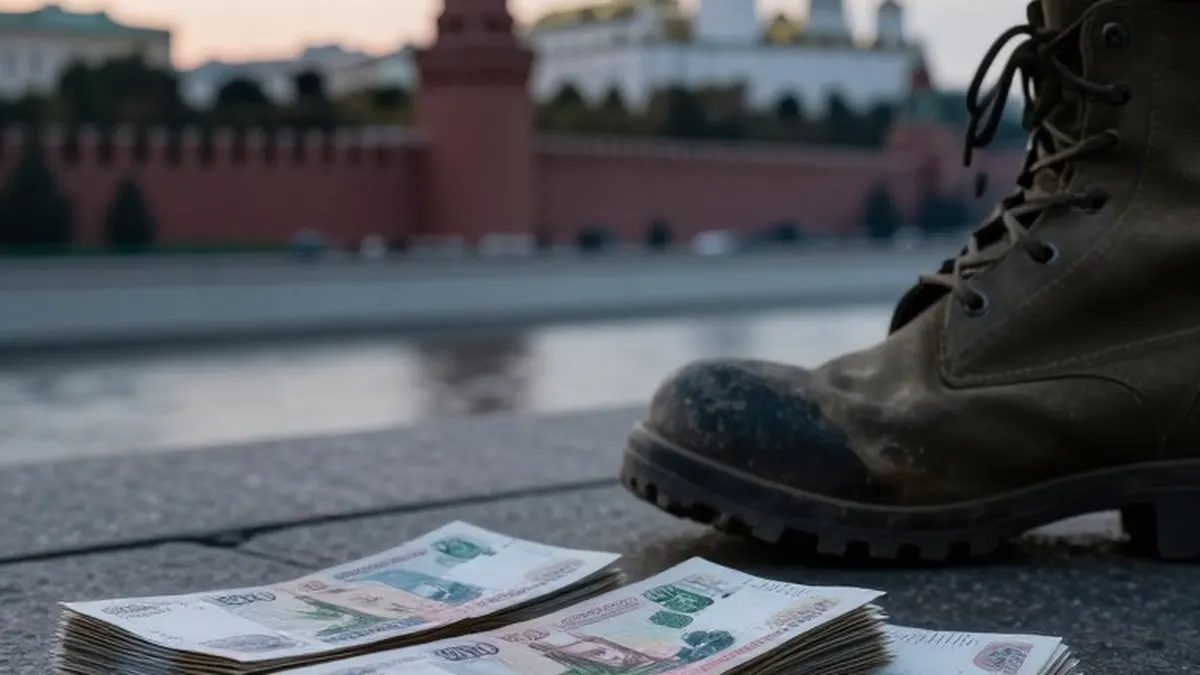
Russian media outlet Novaya Gazeta Europe has reported that the Russian state has spent approximately 43.6 trillion rubles, or 436 billion US dollars, more on military requirements over the past five years than it would have in a peacetime scenario. The analysis sets the 2017 defense spending level as a baseline. Journalists assumed that without war preparations, defense budgets would have increased no faster than the 4 percent inflation rate projected by the Central Bank and the government.
Of the total excess expenditure, roughly 25 trillion rubles, equivalent to 250 billion US dollars, was directed toward payments to individuals. These funds covered military salaries, bonuses, insurance for soldiers and their families, social spending, pensions, and wages for employees at defense companies. The outlet categorizes this portion as consumption rather than a direct loss, although it notes that these payments contribute to inflationary pressures within the economy.
The remaining 18.6 trillion rubles, approximately 186 billion US dollars, is classified by the outlet as unproductive spending effectively lost to the economy. This category includes financing for state defense orders that exceeded pre-war norms. It encompasses weapons that have already been destroyed, as well as those still en route to the front lines or awaiting deployment. This figure represents the net economic loss attributable to military hardware and production that does not yield direct civilian benefit.
Economist Tatyana Mikhailova provided context for this assessment, stating that a tank that has not yet burnt out is already a loss of welfare because it brings no benefit to people. She emphasized that it does not matter whether the tank has burnt out or is still intact. This perspective underscores the idea that military assets represent a diversion of resources from the broader population's welfare.
Estimates from the Bank of Finland Institute for Emerging Economies, known as BOFIT, indicate that the military sector played a dominant role in Russian economic growth. The sector accounted for 25 percent of GDP growth in 2023 and 30 percent in 2024. By 2025, the military's contribution surged to 95 percent of GDP growth. In the first half of 2026, overall GDP growth was virtually within the margin of statistical error, driven exclusively by war-related industries.
The reliance on military spending has significantly altered the trajectory of the Russian economy. Without the contribution of military industries, cumulative Russian GDP growth over the five-year period would have been around 5.2 percent. The actual recorded growth stood at 9.4 percent. However, the outlet suggests that had there been no war or sanctions, the economy would have grown by 9.7 percent. This counterfactual scenario assumes that civilian industries did not lose workers and capital to the military effort.
These findings highlight the substantial economic cost of the conflict for Russia. The distinction between consumption and unproductive spending provides a clearer picture of the financial burden. While payments to personnel enter the broader economy through consumption, the funds spent on military hardware represent a more permanent loss of potential economic output.
The analysis also touches on the broader structural issues facing the Russian economy. A study by a university under the Russian government notes that during Vladimir Putin's rule, the economy has fallen into a trap of technological backwardness. The country has lost a significant portion of its scientific and technological potential. This long-term stagnation is exacerbated by the current war economy, which prioritizes immediate military needs over sustainable industrial development.
The report from Novaya Gazeta Europe offers a detailed breakdown of how war spending impacts national wealth. By separating personnel costs from equipment financing, the analysis allows for a more nuanced understanding of economic losses. The figures suggest that while the war has stimulated growth in specific sectors, it has come at a high cost in terms of unproductive resource allocation.
As the conflict continues, the economic implications for Russia remain significant. The data indicates a growing dependency on military industries for economic activity. This shift may have lasting effects on the structure of the Russian economy and its ability to recover and develop in the post-war period. The findings serve as a critical reference for understanding the financial dimensions of the ongoing conflict.