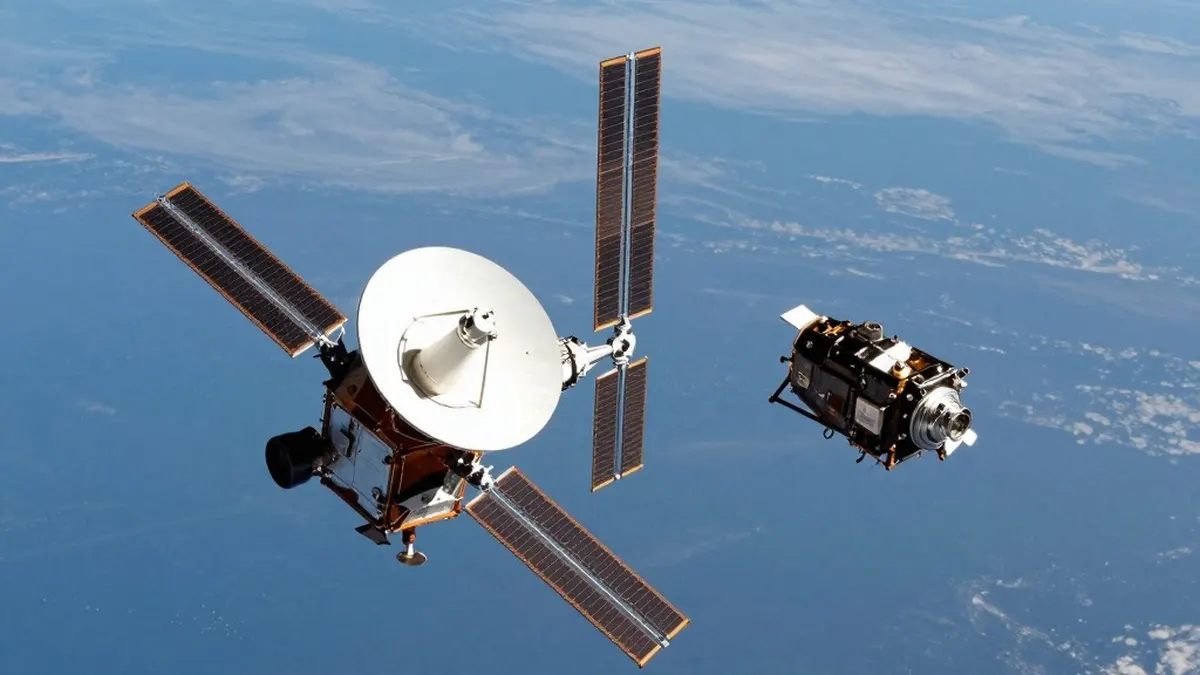
A Russian inspection satellite carried out a very close, unannounced approach to a commercial American spacecraft in low Earth orbit this month, according to satellite trackers. The craft, Kosmos 2612, rendezvoused with ICEYE-X36, a private satellite that observes the planet using synthetic aperture radar (SAR).
The encounter took place between Oct. 15 and Oct. 19 and was reported by Marco Langbroek and other trackers. Langbroek described it as "a worrisome cat-and-mouse game" in orbit. It has drawn considerable attention in space circles because ICEYE-X36 did not consent to the meeting and because of the distance involved: at one point, the two spacecraft may have been only a few meters apart.
Inspections of other countries' satellites are not new. Russia, the United States and China have all moved spacecraft close to foreign hardware in recent years. Most of that activity has occurred in geostationary orbit, about 22,236 miles (35,786 kilometers) up, where a satellite's speed matches Earth's rotation and it stays over one spot. That makes the region popular for spy, communications and weather satellites, and for craft built to shadow them.
Low Earth orbit is different. As far as is known, neither China nor the United States has conducted an uncooperative rendezvous there. Russia has, said Victoria Samson, chief director of space security and stability at the nonprofit Secure World Foundation. "They've done a few," she told Space.com, citing Kosmos 2543 coming within about 19 miles (30 kilometers) of USA 245 in January 2020, and Kosmos 2558 passing within about 43 miles (70 kilometers) of USA 326 in August 2022, followed by repeated approaches to USA 326.
Kosmos 2612 got far closer than those earlier inspectors. The target also differs: USA 245 and USA 326 are classified spy satellites run by the U.S. National Reconnaissance Office, whereas ICEYE-X36 is a privately operated Earth-observing satellite.
Roughly 80 ICEYE satellites are in low Earth orbit. SAR lets them image the ground through clouds, day or night. Some are operated by Finland-based ICEYE and others by its American subsidiary, ICEYE US, which runs ICEYE-X36. At least some of the company's satellites supply imagery to Ukraine, and ICEYE signed a contract in January formalizing that arrangement. The company said at the time that the deal lets Ukraine's Ministry of Defence keep receiving high-resolution imagery, supporting the armed forces with "persistent situational awareness on tactical timelines."
Russian interest in ICEYE satellites appears extensive and longstanding. Kosmos 2612 launched in April with five other spacecraft, and in May four of them, including Kosmos 2612, maneuvered into a co-planar orbit with ICEYE-X36. Such maneuvers burn a lot of fuel and are not undertaken casually. It is unclear whether ICEYE-X36 is dedicated to imaging Ukraine or Russia, though Russia seems to believe it is.
Samson stressed that the purpose of the approach, which appears to be over for now, remains unknown. Russia could have been assessing ICEYE's capabilities or what the satellite is observing, or it may have interfered with its sensors or intercepted or blocked its communications. Samson, however, suspects frustration. "They've been kind of in a stalemate, particularly for the past six months or so," she said, adding that the move may be about "demonstrating military prowess in a manner that the Ukrainians cannot respond to." Ukraine may match or beat Russia on drones, she said, but "when it comes to space stuff, they're not peers."
The episode reflects a space domain that is growing more competitive and contested, with Russia and China challenging long-standing U.S. advantages in reconnaissance and communications. Samson called for more openness from governments, noting that news of the encounter came from private companies and civilians analyzing government tracking data rather than from the U.S. Space Force. "You cannot keep the existence of satellites classified, because people can see them," she said.