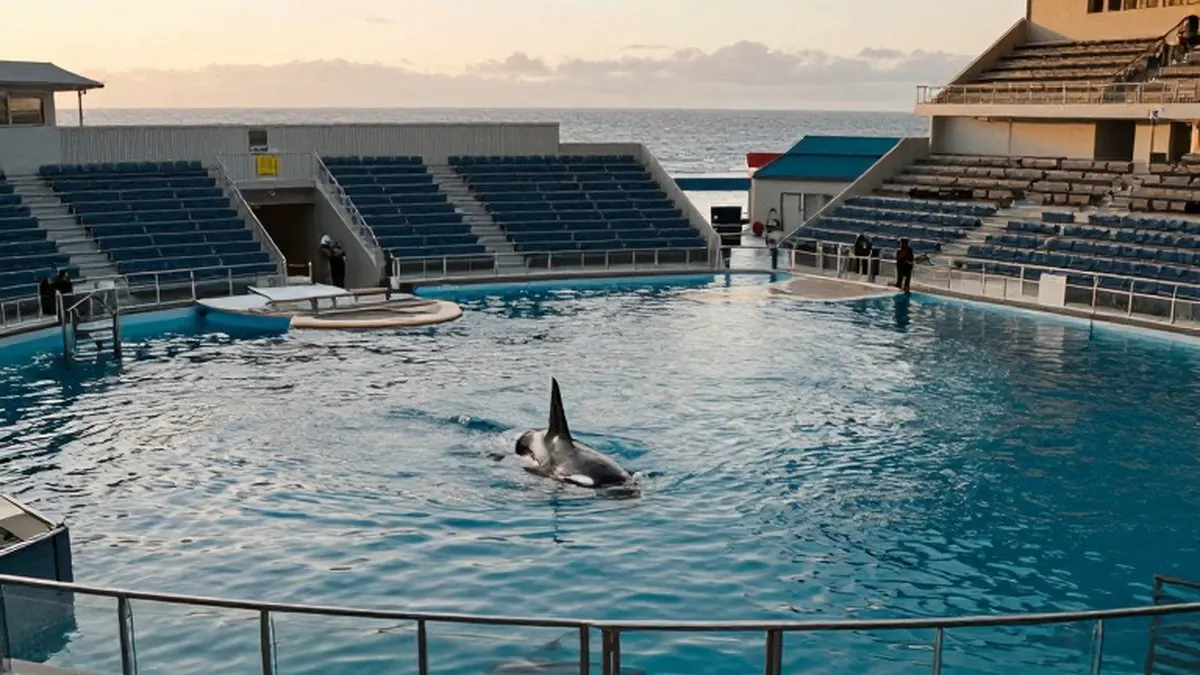
Nakai, a 20-year-old killer whale who had lived at SeaWorld San Diego since his birth, died Thursday night after being treated for an infection, the park announced Friday.
SeaWorld said in a statement that veterinarians and health specialists had been actively treating the infection, but that "aggressive therapeutic and diagnostic efforts were unsuccessful." Nakai died surrounded by animal care and medical team members who had worked closely with him for two decades. The park did not say what kind of infection was responsible.
His death leaves SeaWorld with eight killer whales, aged 9 to 57. The company cannot grow its orca population because of a breeding ban it adopted in March 2016, after years of protests by animal rights groups and a shift in public opinion about keeping orcas in captivity.
Nakai, born in September 2001 at SeaWorld, is the park's second orca to die in the past year. Amaya, a 6-year-old female, died Aug. 20, 2021. Before her, the last death was Kasatka, a 42-year-old female who died of a lung disease in August 2017.
The park described Nakai as a curious and quick learner who often picked up behaviors just by watching other whales in his pod. That ability led scientists to involve him in hearing studies aimed at understanding how noise from ships and other human activity affects orcas. "His contributions to helping improve the health and survival of whales in the wild cannot be underestimated and will never be forgotten," the statement said. An unnamed team member who cared for him since birth called him a "very friendly and an overall playful guy who loved to interact with people."
The animal welfare group People for the Ethical Treatment of Animals offered a different account of the surrounding events. PETA said a SeaWorld visitor sent it a video on Friday morning, just hours after Nakai's death, showing "a violent attack between orcas" that left at least one animal seriously wounded. The group also noted that Nakai was attacked in 2012, losing a chunk of his jaw.
Tracy Reiman, PETA's executive vice president, said that within two days one orca had died and another had been attacked by "frustrated, tightly confined orcas." PETA sent a letter to the U.S. Department of Agriculture on Friday asking for an investigation of SeaWorld.
A SeaWorld spokesperson said in an email that the video is "misleading and misconstrued." Citing two recent scientific papers, the spokesperson argued that it showed common orca behaviors seen in both wild populations and animals in human care as part of natural social interactions.
Scrutiny of SeaWorld's orca program has grown over the past decade following the 2013 documentary "Blackfish." The film focused on Tilikum, the orca that killed trainer Dawn Brancheau at SeaWorld Orlando in 2010, and suggested that orcas become more aggressive in captivity. SeaWorld later announced it was ending killer whale shows, and in 2017 the San Diego park became the first to replace its trick-based Shamu performances with an educational program highlighting natural orca behaviors.