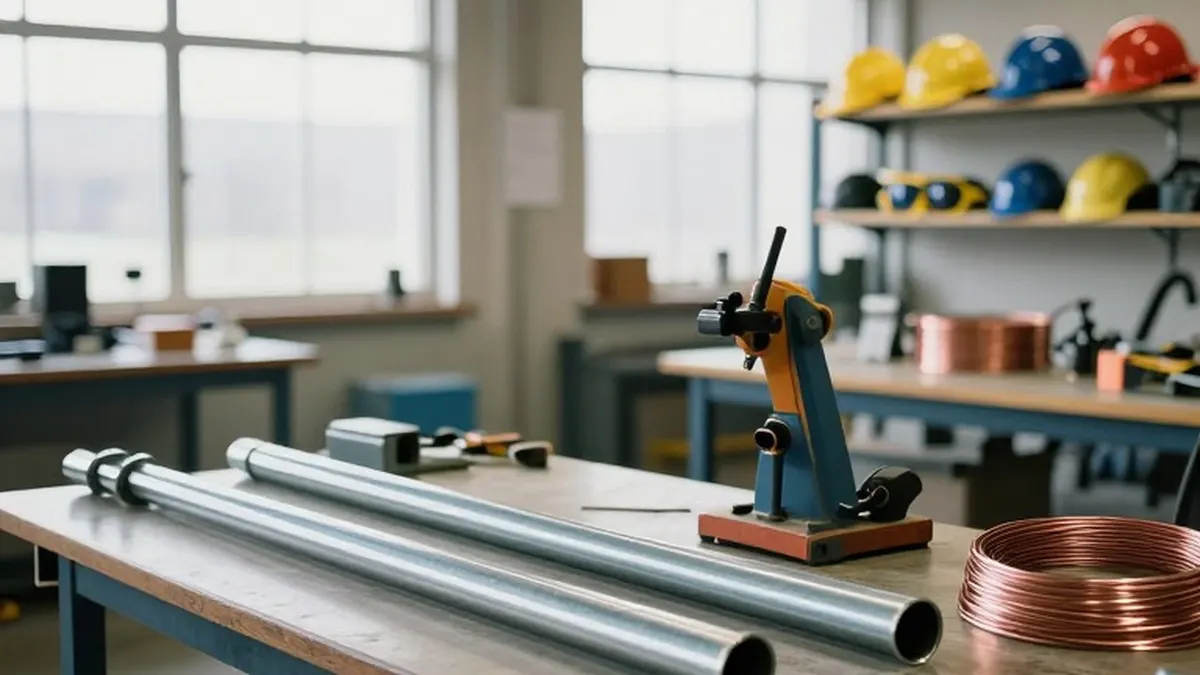
COLUMBUS, Ohio: A few miles south of The Ohio State University, Ashley Baukman is wrestling a piece of steel tubing into a 90 degree bend, using only a manual tool called a foot pedal and her own strength. The conduit bending class at The Electrical Trades Center of Central Ohio is part of an apprenticeship she began in the spring, splitting her time between one day of class every two weeks and construction sites where she works under journeymen electricians.
For the 36-year-old college graduate and licensed social worker, it is a new chapter she hopes will anchor a long-term career. Being the first in her family to finish college had been a point of pride. "I was like, 'Oh, I'm going to do this. I'm going to do it the right way,'" she says. "But it didn't really work out that way, and that's okay. You live and you learn."
The numbers already look different. As an apprentice, Baukman earns just over $25 an hour for time on the job plus a stipend for class days, more than she made as a social worker, and she is on track to nearly double her wage in just over three years. She finds the work satisfying in a way her old jobs were not. "You can see a project to completion, and you can, 'Hey, I did that,'" she says. "It's been pretty fun."
Her timing is good. With artificial intelligence throwing the future of work into question and college costing more than ever, apprenticeships in the skilled trades are having a moment. The earn-as-you-learn model, which pairs coursework with on-the-job training, requires no prerequisites or prior experience, and acceptance is generally based on contractor need. Demand for tradespeople, especially electricians, is up, fueled in part by a construction boom in data centers. The Electrical Trades Center has grown from 500 apprentices in 2022 to more than 800 now, adding daytime classes to what was once a night school.
Baukman may be the only licensed social worker in the program, but she has plenty of company as a college graduate. Trent Parker, the center's director and an electrician himself, says several dozen current apprentices hold four-year degrees and roughly 300 applicants have at least some college on their resumes. He believes the share is rising as attitudes shift. He recalls a recruiting visit to a technical high school 16 years ago, when a vice principal thanked him for coming because the school needed options for students who were "flunking out." "You know, we're looking for high performers," Parker says. "The same people that are going to be successful in college are the same people that are going to be successful here." The curriculum, he notes, is college level: conduit bending is based on trigonometry, and apprentices must manipulate decimals and fractions.
Parker welcomed a 2023 law signed by Ohio's governor requiring licensed school counselors to visit training centers like his to learn about apprenticeships, a step toward undoing the "college or bust" mentality. He even nudged his own two daughters toward the trade. "I asked them several times, 'Are you sure you don't want to be an electrician?'" he says. "Now I get to log into their Sallie Mae loan accounts and, you know, ugh. I agreed to pay what?"
Other college graduates at the center tell similar stories of careers that did not pay enough. After earning her social work degree, Baukman worked for local government agencies with children and seniors but never made enough to support her blended family. Her last job was as a prevention specialist in schools, and becoming a school social worker, the role she really wanted, required a master's degree. With five children at home and an estimated $80,000 in student loans, she could not make the math work. "It just wasn't in the cards," she says. "So I was looking for a change."
Mike Hansen, 39, arrived after college, ten years in the Army and some graduate school. He had been on track for a doctorate in sport and performance psychology until he watched others in academia struggle. "They were doing 40 hours of teaching and zero hours of research for $40,000 a year," he says, so he left after his master's. He wishes he could tell his 17-year-old self to consider the trades, but in his generation vocational education carried a stigma. "You were considered a burnout," he says. Michael Hughes, who majored in English with "a pipe dream" of writing for television and movies, worked jobs including a stint with the Geek Squad before apprenticing. Now he pulls wire, adds pipe and replaces panels and fuses at sites including a police station, a paper mill, a sheet metal plant and an auto plant.
Between new construction, commercial renovations and the data center buildout, Ohio electricians are flush with work. Parker has heard of projects paying $5 or $10 over the union-negotiated hourly wage, others paying double time for all overtime, and even a rumor of triple time. "There's some crazy money to be made out there," he says. Apprentices are guaranteed a minimum starting at $23 an hour with built-in raises up to $46 an hour, and with overtime many journeyworker electricians earn well over $100,000 a year. Harry Cekovich, a 34-year-old Ohio State graduate assigned to a solar field, collects overtime plus a $100 per diem running cables through rows of panels. He once earned six figures combined as a massage therapist and bartender, but only by working 60 or 70 hour weeks with no benefits. Now the union contract gives him retirement benefits and health insurance with no premiums. "It's nice to be able to go to doctors and get checked up now," he says.
Data centers now account for about half the work in the school's jurisdiction, and the apprentices have mixed feelings about them. Cekovich jokes he would work at data centers exclusively if double or triple pay is real, while Hansen cites their heavy energy and water use and noise and says he probably will not pick data center calls once he becomes a journeyman. Ohio Gov.-elect Amy Acton has called for a "conditional moratorium" on new data center construction to ensure developers cover their own utility costs, meet environmental standards and use union labor. Whatever happens, Hansen expects steady work at hospitals, schools, commercial buildings and factories. "I would like to see Chat GPT wire a three-way switch," he says. "We're still going to need electricians."