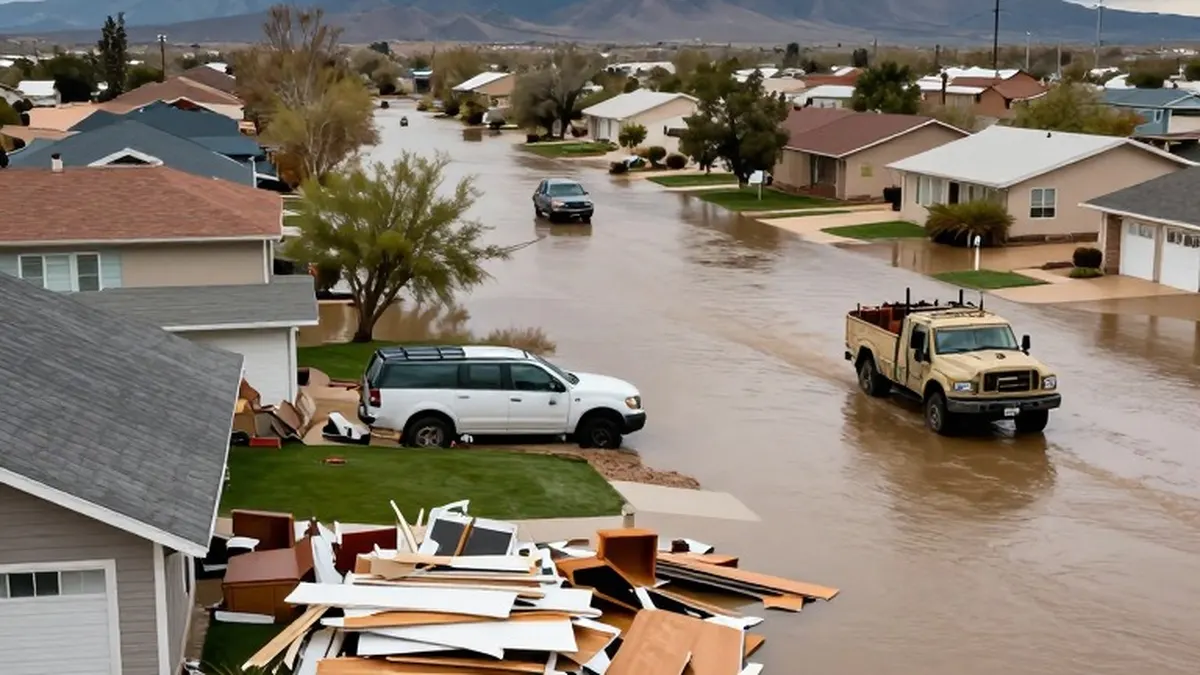
Thousands of people across the Four Corners states are displaced or facing major cleanups after intense rainstorms linked to a very active, El Niño-driven Pacific hurricane season. Colorado, New Mexico, Utah and Arizona all saw substantial flooding last week, and damage assessments are only beginning to arrive from cities, towns and remote areas.
Farmington, New Mexico, was hit especially hard. Torrential rain over Colorado's San Juan mountains sent floodwater down the San Juan River, which runs through the city on its way to Lake Powell on the Utah-Arizona border. Small towns along the river, including Pagosa Springs in Colorado, Bloomfield in New Mexico and Bluff in Utah, also reported historic flooding.
About 46,000 people live in Farmington, a longtime center for coal, oil and natural gas production and an important hub for the northeast side of the Navajo reservation. Evacuation notices began reaching residents' phones as early as Wednesday night. Connie Gooch, who has lived in the city for more than 65 years, said her sister was told on Thursday to leave. Her sister usually fills sandbags as the river rises, Gooch said, but this year the water came too fast.
National Weather Service data from a Farmington river gauge show the San Juan grew 13 times larger in just 36 hours. The river stood at roughly 3.5 feet early Thursday and reached 14 feet by Friday, possibly a record for the city. The Navajo Reservoir upstream mostly contained the water from the mountains, but surges from two normally dry tributaries, Gobernador Canyon and Cañon Largo, poured into the city. "This is a catastrophic flood of historic proportions," said Devon Neeley, San Juan County's public information officer.
Reports from elsewhere were similar. In South Fork, Colorado, fire and rescue captain Tyler Schmidt said several neighborhoods sat under two to three feet of water. Responders there are focused on lifting final evacuation orders as water recedes, assessing damaged bridges and testing well water along the Rio Grande in the San Luis valley. Sewage spilled from flooded treatment plants in Sedona, Arizona, and other places, and KNAU reported extensive damage on the Hopi reservation. The surrounding Navajo reservation also saw rescues, washed-out roads and historic flooding.
Neeley said firefighters, police, National Guard troops and out-of-state swift water teams rescued between 200 and 300 San Juan County residents. People were pulled from vehicles stuck in running washes and, by helicopter, from rooftops. The National Guard used high-clearance and amphibious vehicles because the water was so high.
By Sunday the rain had eased and rivers were falling, and some residents began returning to inspect their homes. Gooch brought tarps and supplies to her sister's house, where the river had reached four feet inside. She described a neighborhood of people hauling furniture out and piling demolition debris in their yards.
Officials are asking thousands of evacuated residents to stay away for now. San Juan County Fire Chief David Vega said that with the swift water danger past, a new set of hazards has emerged, including raw sewage, damaged gas lines, live power lines and the floodwater itself. "Stay out of the water," he said, citing gas, diesel, pesticides and fertilizer.
New Mexico Governor Michelle Lujan Grisham visited San Juan County on Monday. Responding to a county recovery estimate from manager Mike Stark, she said she hoped costs would be only $30 million to $40 million, but believes infrastructure, road and environmental damage could reach $200 million to $300 million. Monday night, her office announced the federal government had "partially granted" the state's request for an emergency declaration, and she has signed executive orders making another $8.25 million in state funding available for flood response.