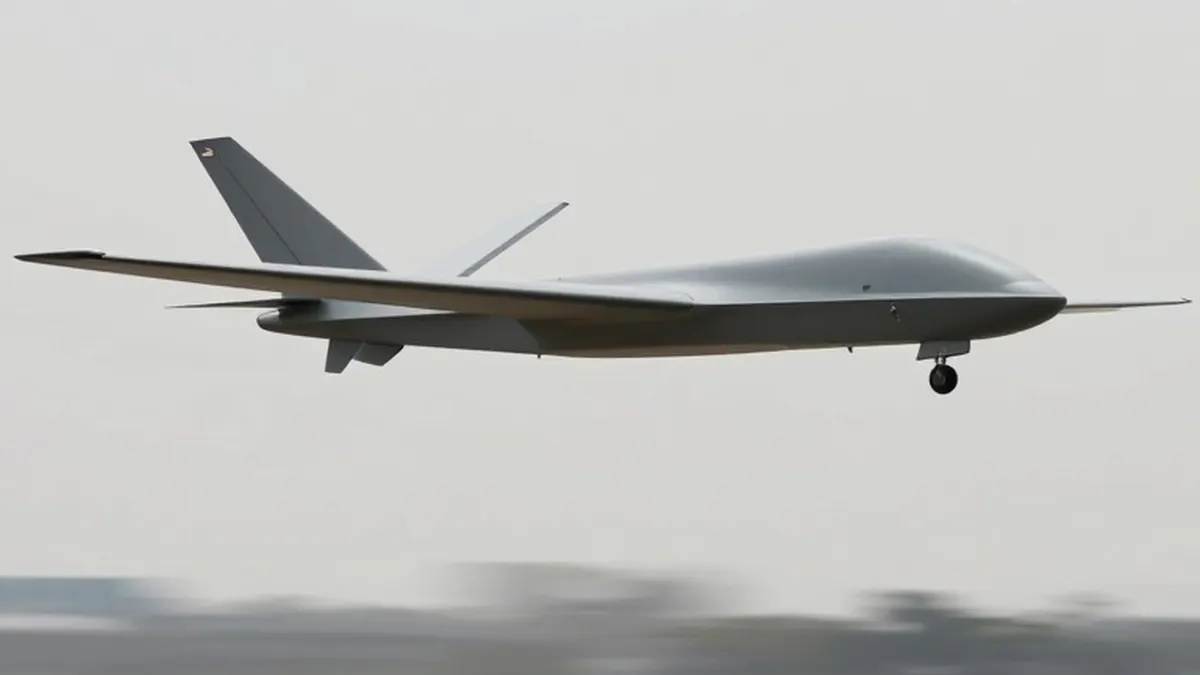
The SPYS anti-aircraft drone, developed by the German-Ukrainian company Quantum WIY Industries, has established a new speed record for unmanned aerial vehicles carrying a combat payload. The high-speed interceptor achieved this milestone following a series of rigorous tests designed to evaluate its performance under conditions that closely mimic actual combat scenarios.
During the trials, the new version of the SPYS was tested with a dummy warhead weighing 500 grams. The drone completed two distinct test flights at an altitude of 200 meters. In the first flight, the aircraft benefited from a tailwind, allowing it to reach a peak speed of 558 km/h. The second flight was conducted against a headwind of 15 meters per second, during which the drone maintained a peak speed of 483 km/h.
The average speed recorded across these two flights was 520 km/h. This figure has been officially certified as a new record for anti-aircraft drones by representatives of Ukraine's National Register of Records. The achievement highlights the increasing speed capabilities of modern interceptor technology used in air defense systems.
In addition to the speed trials, company representatives conducted a simulated sortie at the request of Ukrainska Pravda. In this scenario, the interceptor was tasked with engaging a jet-powered drone. The SPYS maintained a speed of over 500 km/h for several minutes, demonstrating its sustained performance capabilities in a hypothetical engagement.
The significant improvement in speed was the result of major upgrades to the drone's onboard electronics and its physical structure. Engineers redesigned the fuselage to reduce aerodynamic drag. This included the installation of narrower wings and a redesigned nose section. The placement and design of the antenna, as well as the air intakes, were also modified to enhance efficiency.
To support these aerodynamic changes, the Ukrainian company ISM Components developed a new flight controller and electronic speed controllers for the upgraded SPYS. The drone was also fitted with new motors engineered to withstand higher loads while providing improved cooling, ensuring reliability during high-speed maneuvers.
A representative of Quantum WIY Industries noted that the interceptor is now equipped with automatic take-off systems and target-area navigation that utilize radar and Sky Map data. The system also features terminal guidance, which allows the drone to home in on its target with precision. These technological advancements aim to make the interception process more autonomous and effective.
The upgraded model incorporates a Ukrainian thermal imaging camera to aid in target identification. Furthermore, the company reports that 70 to 80 percent of the drone's components are now produced locally, reducing dependence on external supply chains and supporting domestic manufacturing capabilities.
This development comes as Germany prepares to fund the procurement of tens of thousands of interceptor drones for Ukraine's defense forces. The country will purchase drones developed by the Quantum WIY Industries team, which is a joint project between Ukraine's WIY Drones and Germany's Quantum Systems. The new speed record underscores the potential of this partnership to bolster air defense infrastructure.