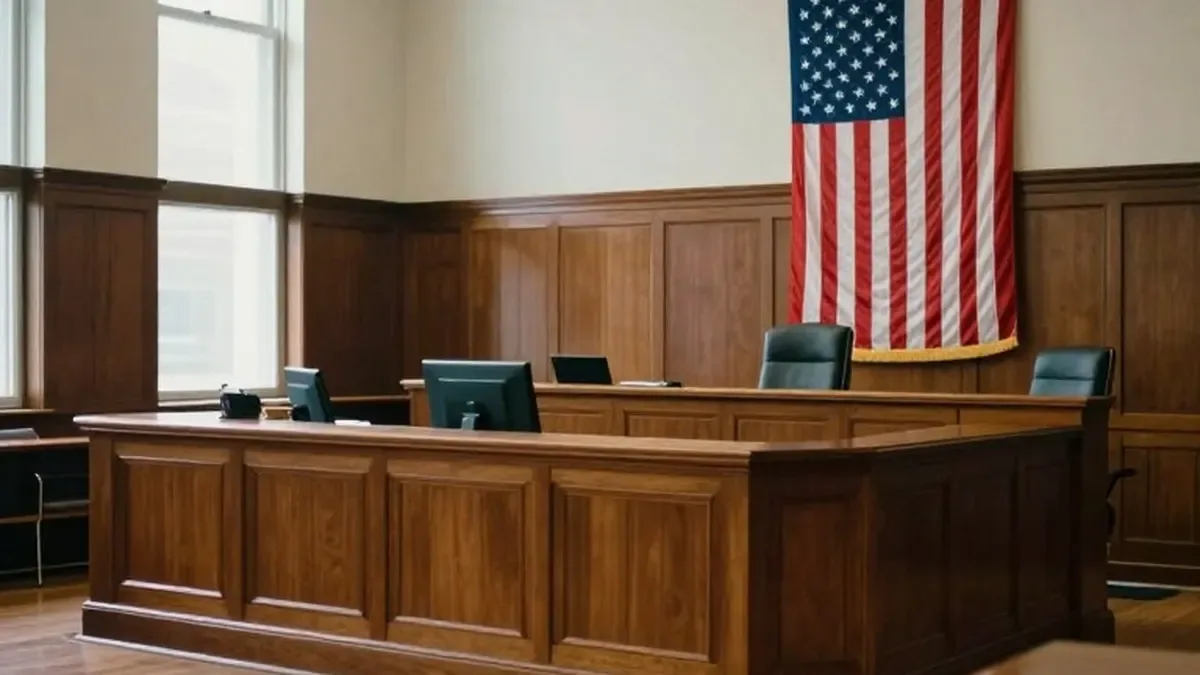
The Supreme Court appeared sharply divided on Tuesday as it heard arguments in a case that could reshape the enforcement powers of numerous federal regulatory agencies. The central issue is whether administrative bodies can impose fines for violations of federal law without a jury trial, a practice that has been standard for decades across various government programs.
The dispute centers on Sun Valley Orchards, a New Jersey based company that participates in a federal immigration program allowing farm owners to hire temporary migrant workers. Under the rules, employers must provide wages and basic necessities like housing, meals, and water. The Department of Labor oversees this system to prevent foreign workers from undercutting domestic labor markets.
In this instance, the Department of Labor fined Sun Valley Orchards approximately half a million dollars. The penalty was issued for unsanitary conditions, including unsafe drinking water, overcrowded housing with twenty bunk beds, broken sinks, and the failure to pay promised wages. The orchard disputes the charges, arguing that the Department's imposition of monetary fines through administrative proceedings is unconstitutional. They further contend that this process denies them their right to a jury trial when appealing to federal courts.
Chief Justice John Roberts strongly suggested that the executive branch, under the current administration and many predecessors, may have exceeded its constitutional authority. He addressed Deputy Solicitor General Sarah Harris, who represented the Labor Department, stating that the government seemed to be leveraging broad executive authority beyond what is justified. This view implies that the agencies are encroaching on the territory of the judicial branch.
Justice Sonia Sotomayor inquired about the potential disruption if federal courts were required to enforce such laws instead of designated agencies. Harris responded that requiring civil penalties to be heard in Article III courts would be a nuclear option. She warned that such a ruling would disrupt diverse programs including Medicare, Medicaid, and the federal student loan program.
Justice Elena Kagan questioned why the government did not simply go to court always. Harris called this approach catastrophic, explaining that limited resources would lead to massive under-enforcement of the law. In contrast, lawyer Robert Johnson, representing Sun Valley Orchards, argued that while the statute contemplates penalties, it does not specify where they should be adjudicated. He maintained that federal courts, rather than administrative agencies, should impose these penalties.
Justice Ketanji Brown Jackson pushed back on Johnson's position, suggesting he was fighting the reality of congressional intent. She noted that Congress aimed to ensure farm workers did not undercut domestic workers. Justice Brett Kavanaugh expressed skepticism, stating that the proposal from the orchard was at war with clarity and was not great systematically going forward.
The exchange became lighthearted when Justice Samuel Alito described the proposed outcome as a hodgepodge opinion. Justice Kagan quickly interjected with a chuckle, noting that the court does not ever write that sort of thing. In her rebuttal, Deputy Solicitor General Harris was candid about the stakes. She stated that while losing would be a big deal for the government, having a legal mess would be even worse.
Harris added that many other statutory regimes would be affected if the court ruled against the administration. She warned that if the current system is dismantled, the administration would have to return to Congress to fix the legislation. Her voice rising, she asked the justices to indicate now if the government needs to engage legislative affairs immediately because the issue will snowball.