The Tallinn Black Nights Film Festival, known as PÖFF, opens its 30th edition on Friday with 230 feature films and 259 shorts from 87 countries. The scale is a world away from its modest 1997 debut, when the program consisted of just 24 titles from the Nordic countries, Germany and France.
Back then, Estonia had only declared its independence in 1991 amid the collapse of the Soviet Union, cinemas were scarce, and roughly 6,000 admissions were counted as a success. Last year, admissions approached 95,000. The growth has made Tallinn a fixture on the festival circuit and the largest film festival in Northern Europe. In 2014, it earned FIAPF A-list accreditation, placing it alongside Cannes, Venice, Berlin, Sundance, Toronto, Karlovy Vary and Locarno.
The driving force behind that rise has been founder and CEO Tiina Lokk. Earlier this year, she stepped back from the festival director role to focus on overall strategy and development, while her daughter Triin Tramberg was promoted to artistic director. Yet Lokk admits she was far from certain at the start. "I had deep doubts," she told The Hollywood Reporter, even though, as a film critic, theorist and historian, building a festival where she could pick her favorite films was a dream.
The doubts had grounds. Estonia had no festival tradition: the Soviet Union had only the Moscow Film Festival, which did not even run annually, plus the traveling All-Union Film Festival that rotated among the 15 republics. Tallinn hosted it just once, in 1982, the last republic to do so. The country remains small, with 1.3 million people today, and the post-Soviet years brought reforms and hardship that left little room for cinema. "There was even one year when there were zero feature films made," Lokk recalled.
The mid-1990s offered minimal infrastructure for film lovers. Estonia had three or four cinemas in total, screening only Hollywood blockbusters and Chinese B-grade kung-fu films. Politicians were unmoved by her pitch. "We don't need that in Estonia," was a typical response, she said. "If you want to go to cinemas, go to Helsinki or go to Paris." It was also a rougher era on the streets. "There were bombs blowing up cars in the street. The mafia was around. It was a different time."
Lokk, who then ran her own distribution company, FilmaMAX, drew encouragement from the international network she had built, with embassies in Estonia urging her on. After repeated rejections while searching for a hotel venue, her final option agreed to host and sponsor the event. Money was scarce: some support came from the diplomatic corps, a "very, very small" amount from the state, and contributions from friends and classmates.
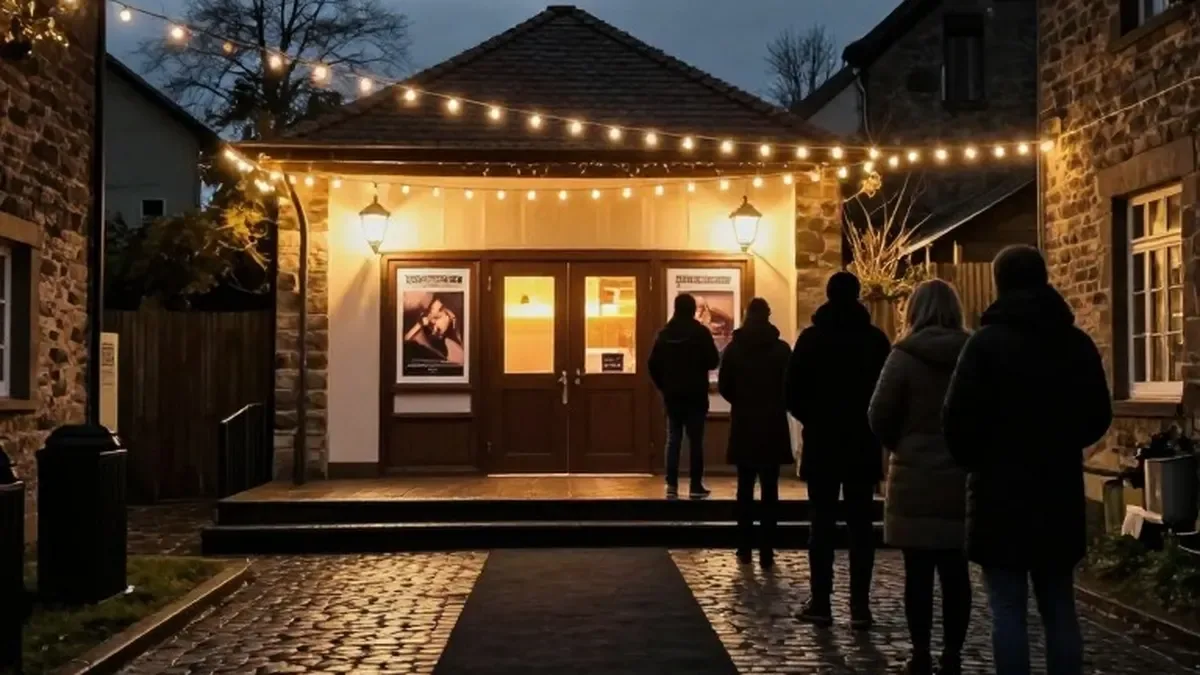
The festival first took place in early December, an empty slot on the festival calendar, before moving to November. The reason was commercial, not meteorological. November is dark, Lokk explained, and her distribution experience showed it was the best-selling time for cinemas. The darkness became central to the brand: PÖFF stands for Pimedate Ööde filmifestival, Estonian for Black Nights Film Festival, and since 2016 the event has swapped the traditional red carpet for a signature black one, a nod organizers deliver with self-irony about lacking the resources for full red-carpet glamour.
The festival's mascot carries similar local logic. With Berlin's bear and Venice's lion already claimed, PÖFF chose the wolf, a legendary creature in Estonian fairy tales and epics. Lokk said the choice was sealed by a documentary, Mother Wolf, whose closing shots show a lone mother wolf howling under a full moon. The idea extends to the festival's "Wolf Pack," a community of film enthusiasts, cultural supporters, companies, guests, volunteers and interns who contribute time, money or both each year.
The anniversary edition is looking back as well as forward. The 1997 opening film, Drifting Clouds by Finnish auteur Aki Kaurismäki, who received the festival's Lifetime Achievement Award in 2006, will screen again, while guests this year include Tim Blake Nelson and Goldshifteh Farahani. Three exhibitions in Tallinn mark the milestone, including a display of all 30 festival posters and a tribute of 20 guest portraits. PÖFF has also steadily broadened its industry role, launching the Baltic Film Competition in 2008, a Baltic documentary competition last year, Industry Days for its youth-focused Just Film program in 2023, and expanding its Industry@Tallinn and Baltic Event strand and educational initiatives.
For Lokk, the anniversary is a natural moment to hand over more responsibility. "The festival has become big, I am getting older, and there is a new generation," she said. Tramberg, for her part, says she has ideas about what the festival can become, but that the priority is keeping it relevant so people still gather in cinemas. "This is a moment to explore emotions together," she said. Lokk is already looking further out: "We have our 30th edition this year. Now there are the next 10 years where we have to think about what direction we are taking."