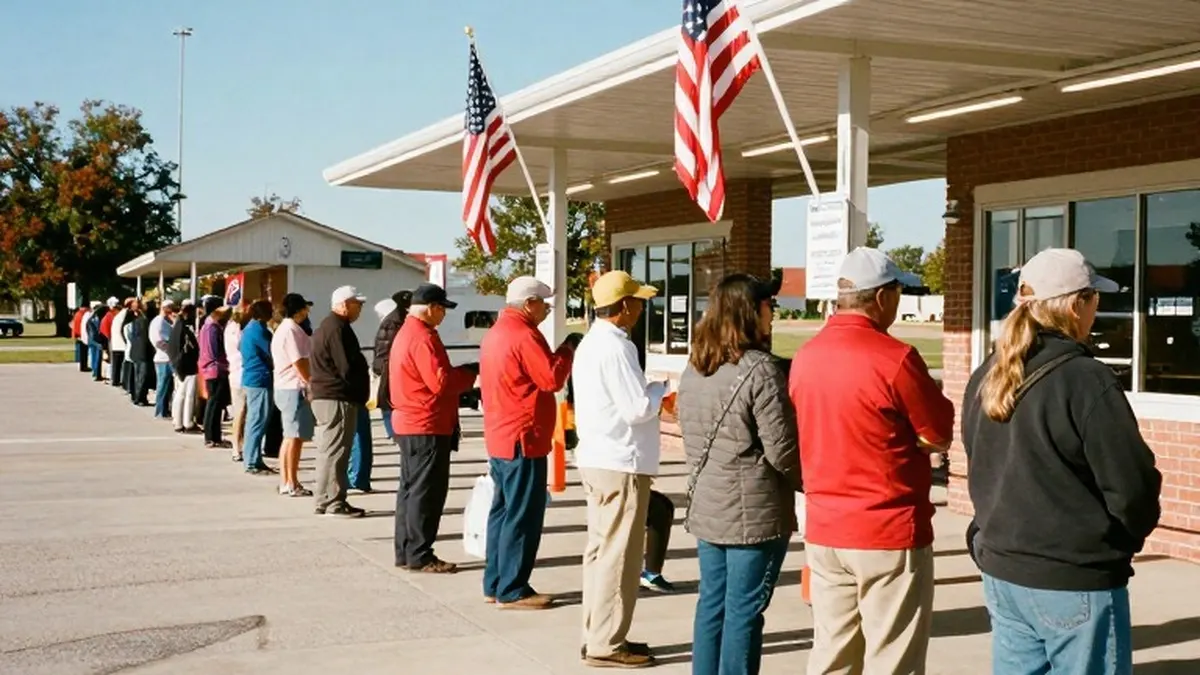
Texas voters began casting their ballots on Tuesday, November 3, in a United States Senate race that has set a new record for spending. The contest between Republican candidate Ken Paxton and Democratic candidate James Talarico has attracted at least $573.2 million in support for both sides. This figure makes it the most expensive Senate race in American history.
A substantial portion of the funding came from billionaire Elon Musk, who donated at least $212 million to support Paxton. Musk’s aerospace company SpaceX is based in southern Texas, and his financial involvement has drawn significant attention. The massive influx of money has left some voters uneasy, particularly in a race heavily focused on the cost of living and affordability.
Rico Sanchez, a 40-year-old union sheet metal worker, expressed his frustration with the high costs associated with the election. Voting for the Democratic ticket due to rising living expenses, Sanchez stated that such large sums of money were being spent on the wrong things. He described the situation as being about control, a sentiment shared by other voters who felt the scale of spending was intimidating.
Kasey Blanco, a 21-year-old voter who split his ballot by supporting Republican Governor Greg Abbott and Democrat Talarico, described the spending as scary. He noted that the extent to which politicians were entering the race distorted the political landscape. Blanco emphasized that political power should remain in the hands of the people, a view that resonated with many who felt disconnected from the high-stakes financial battles.
The record-breaking spending includes both funds raised directly by the campaigns and outside expenditures. Talarico raised $155 million, significantly outpacing Paxton, who raised $40 million. Federal laws limit how much individual donors can give to campaigns, but political action committees known as super PACs can spend unlimited amounts as long as they do not coordinate directly with the candidates.
Paxton has been the primary beneficiary of super PAC spending. According to a New York Times analysis, Musk spent at least $212 million on Paxton, with $168 million going to the Senate Leadership Fund. This fund has almost exclusively supported the Republican candidate. The newspaper noted that this figure is likely an undercount due to dark money spending. Additionally, Trump’s MAGA Inc PAC has spent at least $10 million to support Paxton, while the Lone Star Rising PAC has spent at least $21 million on Talarico.
In their final pitches before the vote, both candidates addressed the issues head-on. Talarico focused on Paxton’s past corruption allegations during his time as Texas attorney general. He used Musk’s spending as evidence that big money interests were prioritizing themselves over everyday voters. His campaign frequently referenced the television series Friday Night Lights, framing the race as an underdog story. A victory for Talarico would mark the first time a Democrat has won statewide office in Texas since 1994.
Talarico told supporters in San Antonio that the campaign was aiming to do something historic. He said they would shock the billionaires and the world by taking back Texas. In contrast, Paxton portrayed Talarico as an outsider to Texas ideals. The Republican candidate emphasized the state’s three-decade dominance by Republicans and its low-tax, conservative model. Paxton referenced the 1836 Texas Revolution, warning that if Texas falls, there is no other place to move to.
Voters expressed mixed feelings about the candidates and the spending. Monique Orellana, 46, said she was uncomfortable with Musk’s presence in the race. She wanted elected officials to represent the people and keep their promises. Orellana cited broken pledges regarding wars and grocery prices as reasons for her dissatisfaction. She said she would vote Republican if they followed through on their commitments, but currently, she is not feeling that assurance.
Luis Plazas, 58, was less concerned about the amount of spending but focused on the economy and immigration policies. He voted for Republicans down the ballot, citing his Christian faith and belief in family values. Plazas acknowledged he was not fully happy with the contenders but stated that conservative values were his main concern in this election.