Twenty-five years ago, on October 23, 2001, Apple chief executive Steve Jobs introduced the first iPod. He opened the presentation by teasing "a breakthrough digital device that's not a Mac." The product that followed became a pocket-sized music phenomenon and a favorite carry-everywhere gadget until smartphones matured enough to make it redundant. Its headline promise was simple: a whole music library in your pocket for $399.
The launch came as Apple's fortunes were recovering. Jobs had steered the company beyond its beige-box era into Mac OS X, and iBooks and iMacs were selling well, even though the dot-com bubble had burst not long before. Jobs predicted that the "Mac could become the center of your digital lifestyle," acting as a hub for digital cameras, camcorders, DVD players and portable music players.
Music was the chosen target, Jobs reasoned, because everyone loves it and the market had no clear leader. He acknowledged that smaller firms such as Creative and Sonic Blue, along with the much larger Sony, already sold portable players, but said "none of them has really found the recipe yet, for digital music." Four mainstream categories existed at the time: CD players, MP3 CD players, flash players and hard-disk jukebox players. Jobs considered the last the best way into the market.
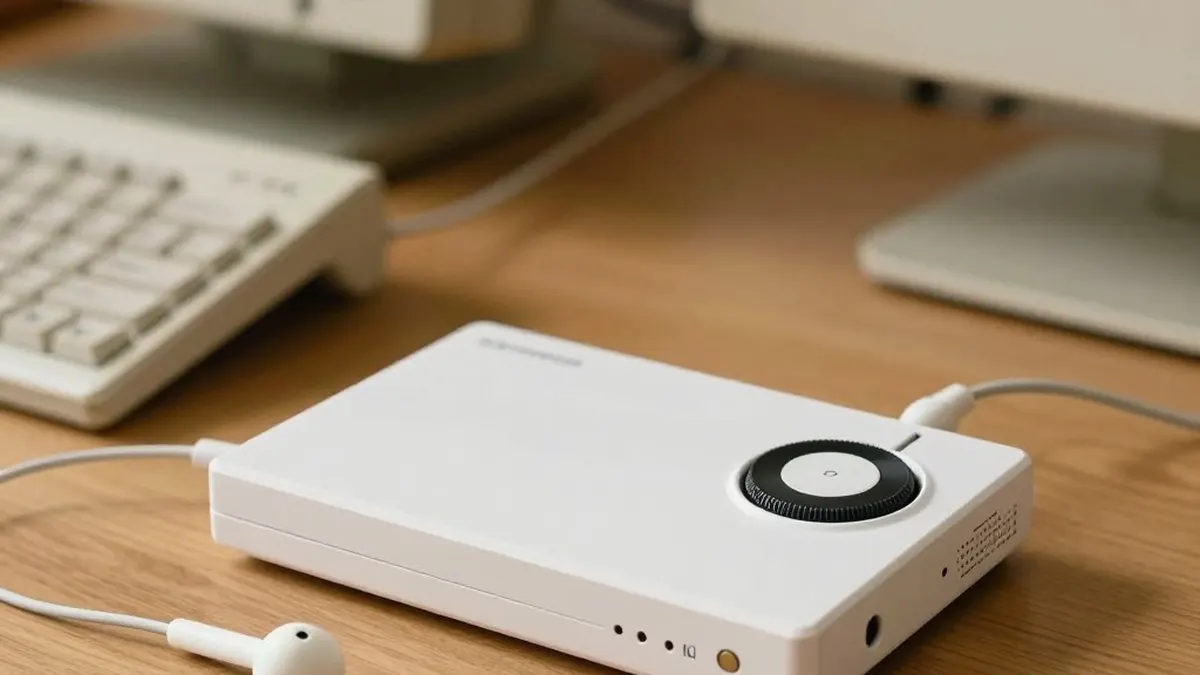
The iPod was presented as an MP3 player with CD-quality sound that handled the popular formats of the day, including MP3, WAV and AIFF. Its 5GB of storage could hold about 1,000 typical pop songs encoded as MP3s at 160Kbps. "For most people it's their entire music library," Jobs said.
He then laid out three claims meant to set the device apart. The first was portability. Built around Toshiba's new 1.8-inch, 0.2-inch-thick hard drive, the iPod measured 2.4 x 4 x 0.78 inches and weighed 6.5 ounces, "lighter than most cell phones." It offered 20-minute skip protection and charged and transferred files over a single FireWire 400 cable. Jobs said FireWire could move a whole CD onto the player in five to 10 seconds, against roughly five minutes over the USB connections of the era, and fill the device with 1,000 songs in about 10 minutes rather than five hours. A rechargeable lithium-polymer battery gave 10 hours of continuous playback, and Apple said an empty one could reach 80% in an hour.
The second claim was design. Jobs pointed to the minimal, durable back and sides and promised "Apple's legendary ease of use." Controls were meant to work with one hand, with an accelerated scroll wheel that used a piezoelectric clicker for tactile feedback, letting users find music by playlist, artist or song. The first track demonstrated on stage was Sarah McLachlan's "Building a Mystery."
The third was Auto-Sync with iTunes. iTunes 2 launched the same day, adding features such as MP3 CD burning and support for syncing the new player. Libraries built and curated on a Mac would automatically match the iPod whenever it was connected to transfer music or charge. The device could also serve as a FireWire hard drive.
The first iPhone arrived more than five years later, in early 2007, and the two products shared Apple's lineup for over a decade. The iPod's popularity nonetheless faded. The last model was the seventh-generation iPod Touch, released in May 2019, and the line sat unmaintained until Apple officially discontinued it in May 2022.