A lawsuit filed Wednesday against the U.S. Department of Education accuses the Trump administration of illegally refusing to follow all of the rules of the federal closed school discharge program, which cancels student loans for borrowers whose colleges shut down abruptly. The department told NPR it stands by how it has implemented the program.
The case was brought in federal court by Student Defense, a nonprofit borrower advocacy group. It was filed on behalf of Kendrick Gaussoin and potentially thousands of other borrowers.
For more than three decades, federal law has required the education secretary to cancel the debts of qualified borrowers whose schools close suddenly. The nonpartisan Government Accountability Office found that more than 1,100 colleges closed between 2010 and 2020, leaving 246,000 borrowers eligible for a discharge. Under the traditional rules, a borrower must have been enrolled when the school closed or have left no more than six months earlier.
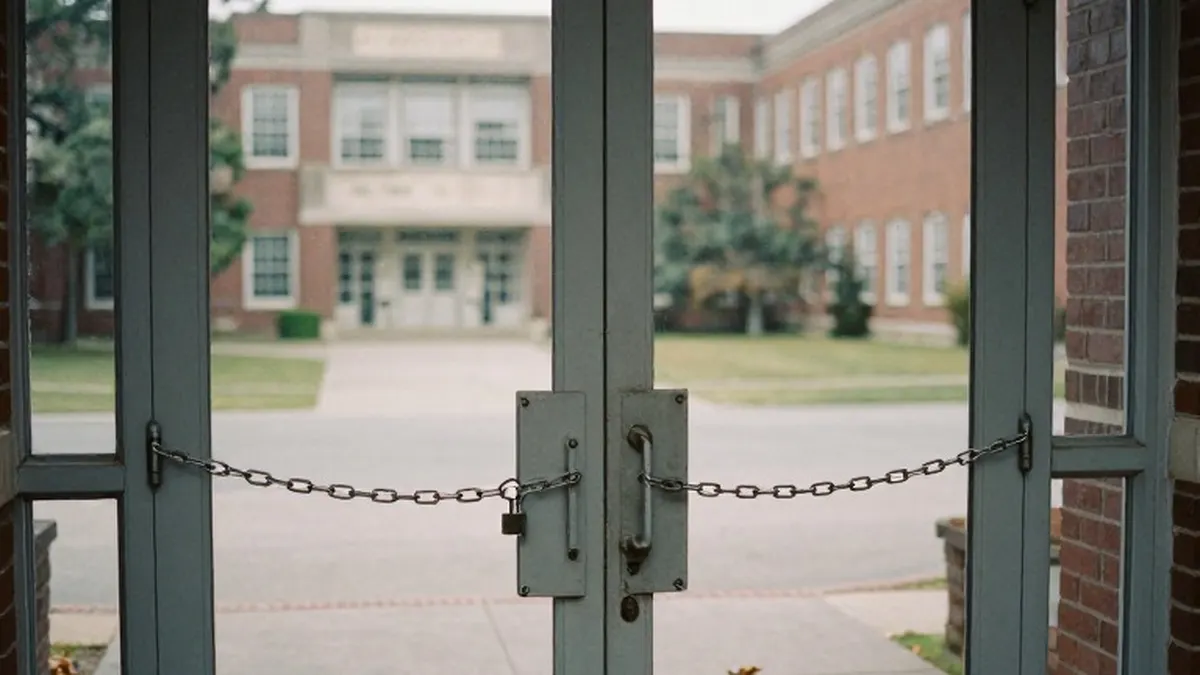
Gaussoin was studying photography at the Brooks Institute, a for-profit college in Ventura, California. He arrived one August morning in 2016 to find the doors chained and classmates in tears. "Everyone felt like they'd lost everything," he recalled. He had taken an eight-month leave beginning in December 2015 to work as a photographer, which put him outside the standard six-month window.
That changed in the final days of the Biden administration. In an order dated Jan. 6, 2025, then-Undersecretary James Kvaal widened the window for borrowers from several closed schools, including Brooks, citing "exceptional circumstances." Anyone enrolled as of May 6, 2015, would qualify for a discharge and a refund of past payments. Gaussoin applied on Aug. 23, 2026, and was denied in a letter dated Aug. 31 that cited the traditional requirements.
Education Department spokesperson Ellen Keast said the Biden administration had pursued "unlawful policies" and that its undersecretary had "inappropriately" expanded the discharge period days before leaving office. Yet during the first Trump administration, Education Secretary Betsy DeVos used the same authority in November 2019 to widen the window for students of the Art Institute of Colorado and the Illinois Institute of Art.
Bonnie Latreille, a former senior official at Federal Student Aid under President Biden, said the secretary legally has the authority to expand the window. She said a top department official told her during the transition not to process discharges under the expanded window without approval from the incoming Trump team. Two other former officials corroborated her account but asked not to be named. Higher education attorneys not involved in the case told NPR that reversing the change would require a reasoned legal explanation shared publicly. The department did not respond to a request for its legal justification.
Brooks, founded in 1945, was once well regarded, but enrollment fell after its 1999 sale amid accusations of high-pressure sales tactics and misleading claims about graduation rates, job placement and cost. Gaussoin's mother, Christine Gaussoin, took out Parent PLUS loans and says the school led her to believe they would cover his costs. When the school asked for more money, Kendrick took out federal loans himself.
Kendrick, now married with two young children and working for an online retailer, owes nearly $22,000 including interest and has no degree. Christine owes about $28,000 and says she worries she may never repay it. Her own application for a discharge was denied this month. "The school promised us that this was gonna be his ticket," she said.