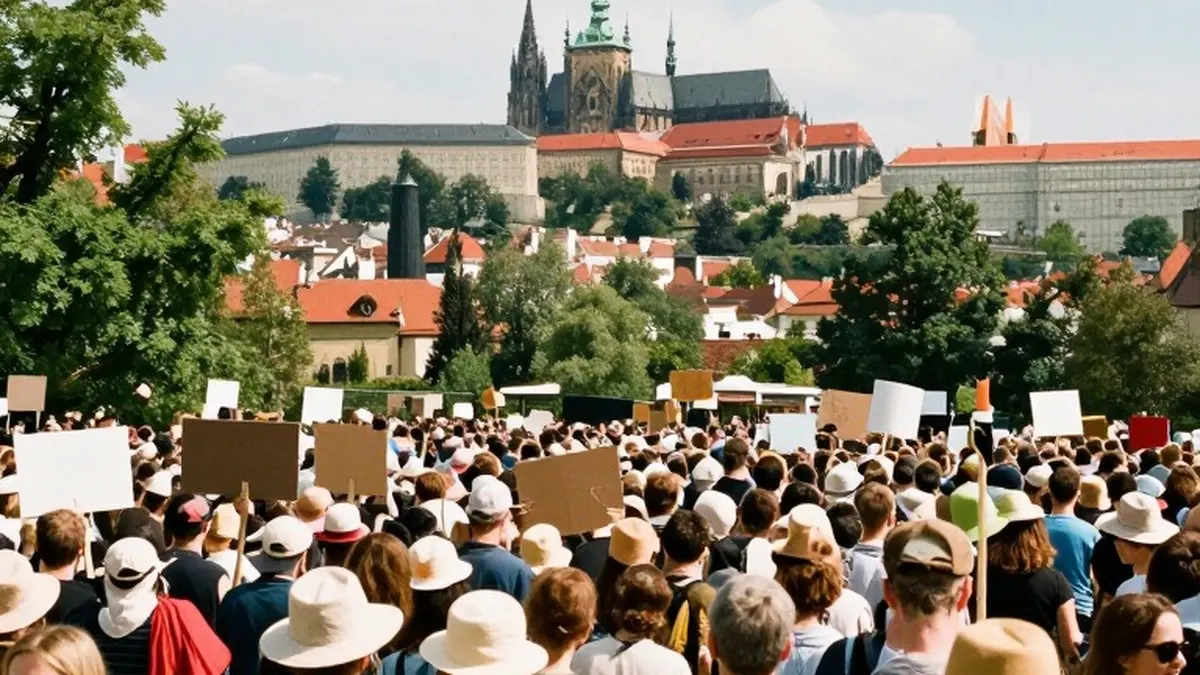
A massive crowd of demonstrators filled the streets of Prague on Sunday afternoon, gathering to express opposition to proposed reforms in the funding of Czech public service media. Many protesters assembled in Letna Park, where the atmosphere was charged with a sense of urgency and collective action against the legislative changes.
The visual identity of the protest included creative tributes to national broadcasting heritage. Some participants wore pointed hats fashioned from folded newspapers, a nod to an animated character who has introduced Czech Television’s nightly children’s bedtime stories for several decades. This symbolic gesture highlighted the deep cultural connection many citizens feel toward the state broadcaster.
Local authorities had anticipated a significant turnout in the days leading up to the rally. The protest took place shortly before the November 17 holiday, which commemorates the 1989 Velvet Revolution that ended Communist rule and brought dissident playwright Vaclav Havel to power. This timing underscored the historical weight of the current democratic struggle.
The central issue of the dispute involves a bill introduced last month by the government of Prime Minister Andrej Babis. The proposal seeks to replace the current monthly fee of 205 crowns, equivalent to approximately $9.45, which is charged to each household, with direct funding from the state budget. This shift in financial structure is the primary driver of the public outcry.
Critics of the reform argue that moving the funding source to the state budget will make public media outlets more dependent on the government. They fear this increased dependency could stifle media freedom and compromise editorial decisions. In contrast, the government maintains that the plan will not affect the independence of the editorial staff or the content of the programs.
The legislative process is ongoing, with the bill having passed a preliminary vote in parliament. It now awaits further debate and potential amendments. The dispute has led to sustained industrial action, with broadcast workers striking against the proposal since June. Earlier this month, public media employees staged a one-day strike, which was joined by boycotts from artists and students.
The demonstration was organized by the group Million Moments for Democracy. The organizers expressed strong dissatisfaction with the current leadership, stating that Prime Minister Babis and his government appear to believe they can ignore experts and silence critics. They described the treatment of democratic institutions as if they were personal property, a view that resonated with the large crowd.
Organizers of the event estimated that between 400,000 and 600,000 people participated in the rally. They described the gathering as potentially the largest public assembly in Czech history. This scale of participation signals a significant level of public engagement with the media funding debate.
Public opinion surveys provide context for the protest. While general trust in media remains low, with figures ranging from 30 percent to 33 percent according to the latest Reuters Institute Digital News Report, public service journalism remains a trusted source. Czech Television continues to be the most-watched broadcaster across several age groups in the country.
The proposed media reform has also drawn scrutiny from the international community. Several major organizations, including the European Broadcasting Union, the European Federation of Journalists, Reporters Without Borders, and the International Press Institute, have all voiced criticism of the changes. Their involvement adds an external layer of pressure on the Czech government to address the concerns raised by domestic stakeholders.