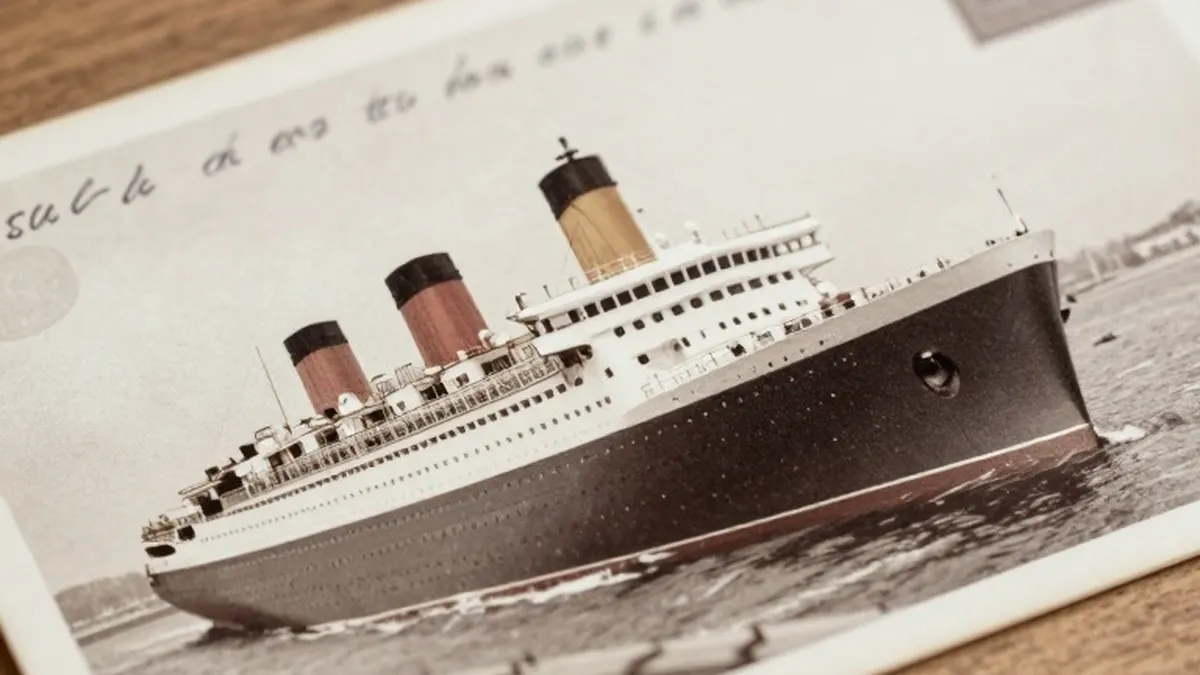
A rare piece of maritime history has been sold at auction, marking the end of an era for collectors interested in the legacy of the RMS Titanic. The item in question is a postcard sent by Jack Phillips, the vessel's chief radio officer, just days before the ship departed on its final transatlantic journey. According to U.K. auction house Henry Aldridge and Son Ltd., the postcard fetched a hammer price of 32,000 British pounds, which translates to approximately $41,800.
The document provides a poignant glimpse into the life of the crew member who would become central to the disaster narrative. Phillips, who turned 25 years old while aboard the liner, sent the card to his sister, Elsie Phillips. The postmark on the item is dated April 6, 1912, which was four days prior to the Titanic setting sail from Southampton, England, for New York City.
The front of the postcard displays an image of the Titanic while it was docked in Southampton. The auction house described the physical state of the item as being in very good to fine condition, noting only some light soiling and toning. The personal message on the back offers a casual and cheerful tone, contrasting sharply with the tragedy that would unfold later that month.
In his brief note, Phillips thanked his sister for a previous letter and mentioned that the weather had been glorious. He stated that he had visited Cowes the day before the postmark date and promised to write again before the ship set sail. The message concluded with the simple, affectionate sign-off, "Love all, Jack."
The final cost for the winning bidder was higher than the hammer price due to additional taxes and fees. The total amount paid was 40,000 British pounds, equivalent to roughly $52,300. This sale underscores the enduring public fascination with artifacts connected to the 1912 disaster.
The Titanic struck an iceberg on the night of April 14, 1912, during its maiden voyage. The collision led to the ship sinking, resulting in the deaths of more than 1,500 people. As the vessel filled with water, Phillips remained at his radio station, working tirelessly to send distress calls and coordinate rescue efforts from nearby ships.
The ocean liner carried approximately 2,200 passengers and crew members. Phillips and his junior wireless officer, Harold Bride, were responsible for handling various communications, including messages from passengers. They received multiple warnings about ice fields from other vessels during the crossing and relayed most of these alerts to the ship's bridge.
However, one specific warning regarding an ice field did not reach the bridge on the fateful night. According to the auction house, Phillips only left his station when the water level reached his equipment. He eventually perished from exposure to the severe cold while resting on an overturned collapsible lifeboat.
Harold Bride, who survived the sinking, later recognized Phillips for his dedicated efforts during the crisis. Bride famously referred to Phillips as "the man who saved us all," a testament to the crucial role the radio officers played in saving lives during the maritime disaster.