President Donald Trump arrived in the Philippines on Tuesday to begin a three-day tour of Asia. The visit serves as a break from recent domestic challenges, including a significant disruption in the U.S. aviation industry and a scandal that has unsettled the global artificial intelligence sector. The itinerary includes meetings with regional partners, trade discussions, and historic three-way nuclear talks with Chinese President Xi Jinping and Russian President Vladimir Putin in China. Trump has also suggested the possibility of a meeting with North Korean leader Kim Jong Un.
This is the president's first trip abroad since his party suffered substantial losses in the midterm elections. The political landscape in Washington has been further shaken by the recent departure of Jensen Huang from Nvidia. Huang admitted to an affair with an alleged Chinese government agent, a move that rattled both the White House and the stock market. Beijing has stated that it was not involved in the matter.
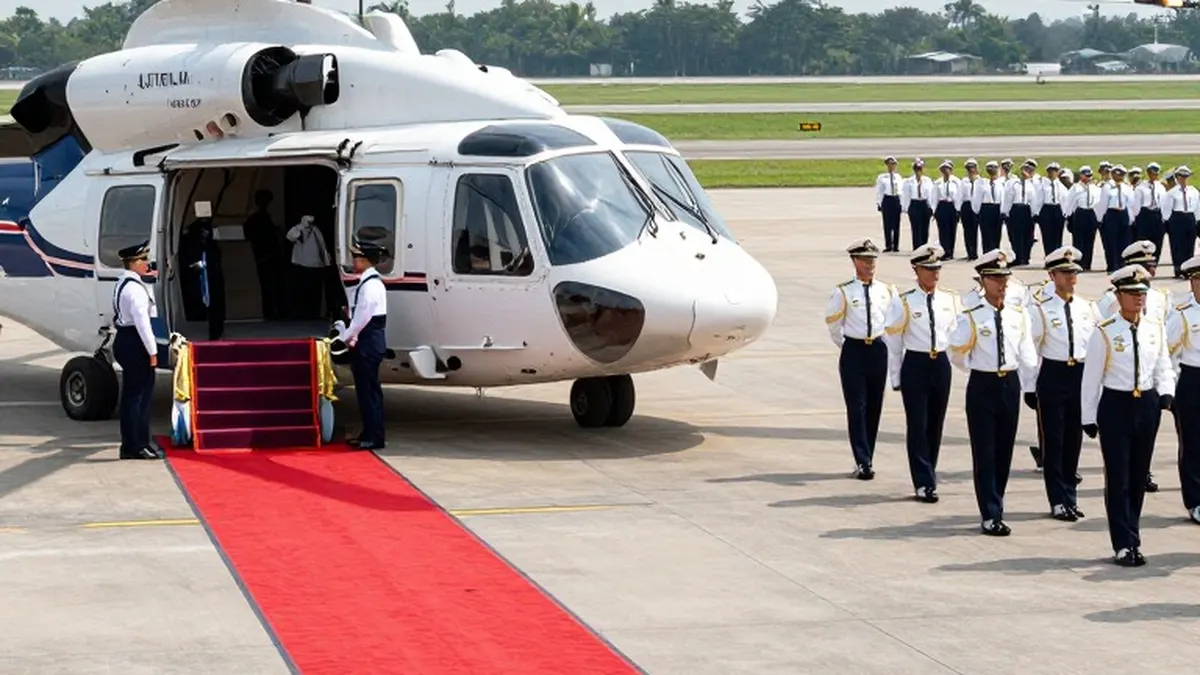
Upon descending the stairs from Air Force One, Trump greeted the crowd with a fist pump and a smile. A child handed him small American and Philippine flags, which he waved in large circular motions. A marching band played the song YMCA as he walked toward a waiting helicopter. The welcoming ceremony included reassuring displays of support from Washington's oldest treaty ally in the region.
Trump's initial schedule in Manila is packed with diplomatic engagements designed to showcase strong alliances. He is scheduled to attend a cocktail reception and dinner with other world leaders, serving as the guest of honor at the annual Association of Southeast Asian Nations summit. Before the gala, he will participate in a special summit with ASEAN leaders. The group is expected to discuss deepening trade and security ties, as well as longstanding regional conflicts, including the violence in Myanmar and disputes in the South China Sea.
The South China Sea remains a critical global trade route where confrontations have escalated in recent years. These tensions are particularly acute between Chinese and Philippine coast guard and naval forces in disputed shoals. ASEAN leaders have been working toward a non-aggression pact with China to manage these contested waters. Washington rejects Beijing's expansive claims and has repeatedly affirmed its obligation to defend the Philippines if Filipino forces face an armed attack.
The president's first formal agenda item on Tuesday is a meeting with the leaders of the Quad nations, which include the U.S., Australia, India, and Japan. This group aims to counter China's influence in the Asia Pacific region. This gathering marks their first meeting since Trump returned to the White House last year. Following this, he is scheduled to sign a trade deal with Thailand, a type of agreement he has actively pursued since launching a trade war last year.
The trade framework with Thailand was announced last October. It involves Thailand removing tariffs on most American goods and lowering barriers for U.S. autos, food products, and pharmaceuticals. The administration also noted that Thailand would spend more than $18 billion on U.S. aircraft and purchase American farm goods and liquefied natural gas. Although the Supreme Court overturned a 19 percent tariff on Thai goods in February, the administration imposed a new 12.5 percent tax in July citing forced labor issues.
While the president engaged in diplomatic festivities, about 1,500 left-wing protesters gathered in a downtown Manila square. They held a noisy rally to call on Philippine leaders to adopt an independent foreign policy rather than following U.S. cues. Protesters waved red flags and displayed a streamer reading Resist U.S. war and plunder. They planned to burn an effigy of Trump, while riot police stood nearby with shields and wooden truncheons.
Protest leader Teddy Casiño told The Associated Press that the Philippine government should stop being a puppet of Donald Trump. He urged the Marcos administration to uphold an independent foreign policy. On Wednesday, Trump is set to receive a red-carpet welcome and full military honors from President Ferdinand Marcos Jr. The two leaders are expected to affirm their commitment to the longstanding treaty alliance during a state banquet at the Malacanang presidential palace.
Officials are also arranging a possible brief reunion between Trump and Imelda Marcos, the former first lady and mother of the incumbent president. Now 97 and using a wheelchair, Imelda Marcos has a long-standing friendship with Trump. Philippine Ambassador to Washington Jose Manuel Romualdez noted that personal connections are very important to the U.S. president. Trump is also expected to announce commercial deals in aviation, defense, energy, and technology before heading to Shenzhen for the Asia-Pacific Economic Cooperation summit.