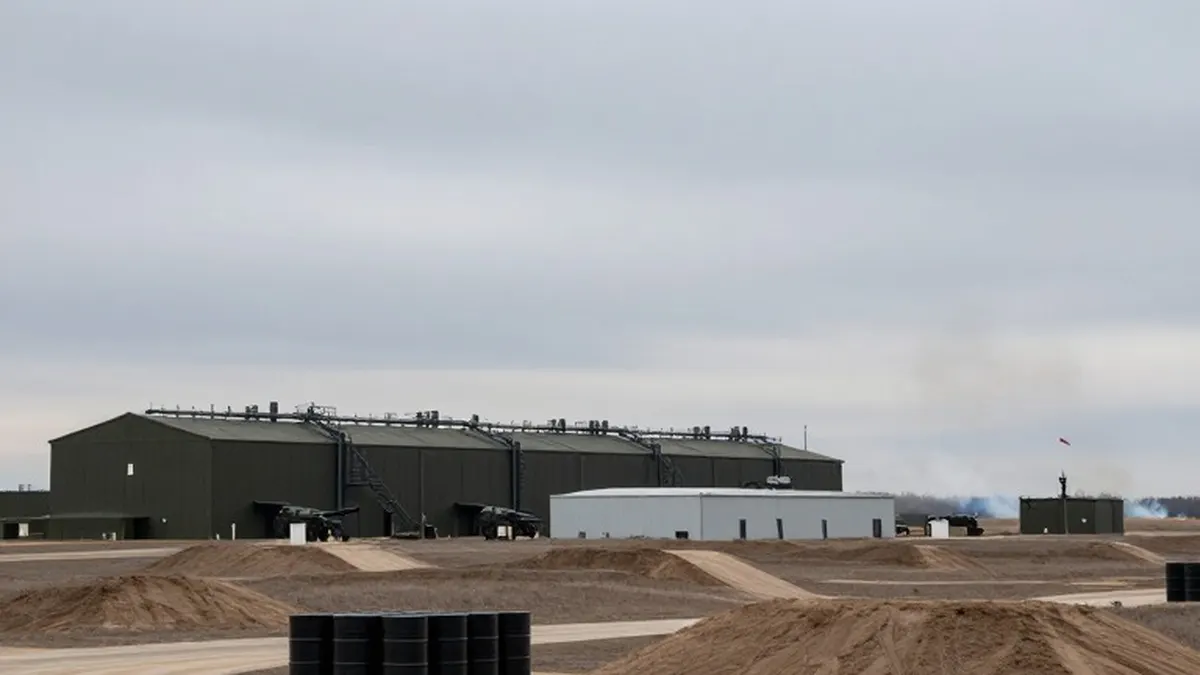
President Donald Trump announced on Monday afternoon via social media that he has directed the United States military to stop its preparations for a planned detonation in Iowa. The order targets 68 deteriorating barrels of lead azide stored at an Army ammunition plant in Middletown. Trump stated that the decision regarding the unstable and highly explosive material has now been transferred to a federal court and Rob Sand, the governor-elect of Iowa. Sand is not scheduled to be sworn into office until January.
The Army initially intended to carry out the detonation on November 20. However, the blast was delayed on Thursday following significant public outcry and a legal challenge filed by environmental organizations. According to projections, the explosion would release a plume of toxic gases and neurotoxic lead. This cloud of contaminants could travel as far as 100 miles from the Iowa Army Ammunition Plant, affecting a wide region of the state.
Local residents and officials in Iowa reported that they were informed of the detonation plans only days before the original date. Environmental groups, with Earthjustice leading the effort, submitted an emergency court filing. In that document, they argued that the Army had failed to fully evaluate safer alternatives for disposing of the lead azide before proceeding with the controlled explosion.
Late on Thursday, a federal appeals court granted Earthjustice’s request to suspend the Army’s permit issued by the Environmental Protection Agency. This permit had authorized the controlled detonation. Around the same time, Acting Secretary of the Army Adam Telle announced that the detonation would be postponed until Monday. He explained that the delay would allow the military to communicate more effectively with residents of Iowa regarding the situation and the military’s plans.
Documents released by the Army last week revealed that the military first discovered in March that the lead azide had begun to degrade and crystallize. This chemical is commonly used in detonators for munitions. However, when it takes on a crystallized form, it becomes highly unstable and extremely sensitive to physical movement or friction. The facility reportedly contains approximately 9,700 pounds, or 4.4 tons, of this material stored in barrels within earth-covered containers.
The decision to halt the process marks a significant shift in how the federal government is managing the disposal of hazardous military materials. By pointing to the federal court and the incoming governor, Trump has highlighted the complex interplay between executive action, judicial review, and state leadership in this ongoing environmental and safety dispute.