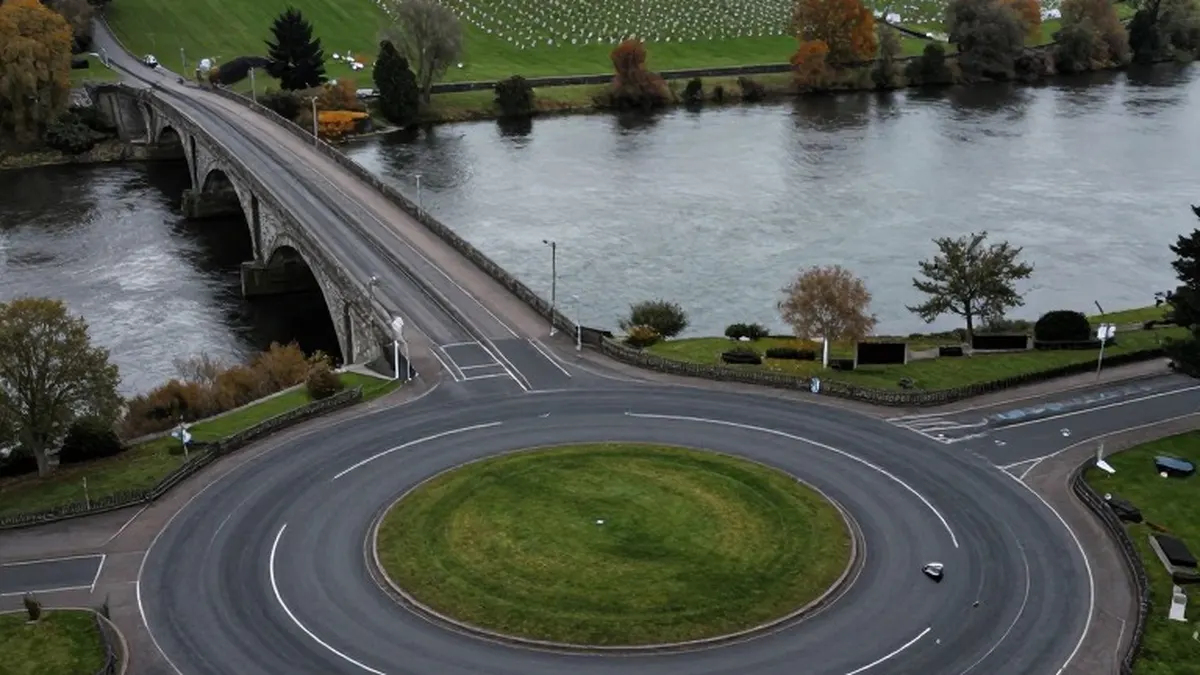
A 250-foot triumphal arch championed by President Trump could win final federal approval on Thursday, when the National Capital Planning Commission convenes to vote on the project. Whether construction ever begins, however, may depend on a federal judge weighing requests to halt it.
The arch is the only item on the commission's agenda. The meeting will be held online only and is expected to run five hours because of unusually heavy public participation, with nearly 120 people signed up to speak. Democratic lawmakers, veterans, historic preservationists and more than 100,000 people have already registered opposition through written comments, local protests and earlier commission meetings.
Critics say the structure, planned for Memorial Circle on the bridge connecting the National Mall to Arlington National Cemetery, would obstruct an important view, insult service members buried on nearby hallowed ground and add risk to Washington's notoriously complicated airspace. The White House has repeatedly said the arch will "enhance the visitor experience at Arlington National Cemetery" and become "one of the most iconic landmarks not only in Washington, D.C., but throughout the world."
The commission is widely expected to approve the project. It endorsed preliminary site and building plans over the summer, and its new Trump-appointed chair, Mark Paoletta, voiced enthusiastic support for the arch in an op-ed last month. The administration says that after a successful vote, only sign-off from its own Department of the Interior is needed, and it notified a federal judge that, pending those approvals, "construction could commence as early as" Thursday.
That notice was filed in an ongoing lawsuit brought by Vietnam War veterans and an architectural historian, who argue the arch is unlawful without approval from Congress. The administration has not sought that approval, citing instead a century-old congressional authorization for a pair of columns on the same traffic circle that were never built. The plaintiffs asked District Judge Tanya Chutkan for a preliminary injunction blocking "any steps to construct, or to direct or facilitate construction, of any structure in Memorial Circle, absent congressional authorization" while the case proceeds. Over the weekend, D.C. and Virginia jointly filed their own suit calling the arch "flagrantly illegal," and Chutkan consolidated the two cases.
On Monday, Chutkan ordered the government to notify the court within one hour of any arch decision by the planning commission, the National Park Service or the Interior Department, and within 30 minutes of any activity related to construction. The administration asked for 24 hours' notice instead, saying decisions take time to move through chains of command, but the judge kept her timeline. Plaintiffs pointed to East Potomac Park, where the government gave less than a full day's notice before cutting down 430 trees during a holiday weekend. On Wednesday night, the government told the court that Grunley Construction Company, a Maryland-based firm, may be arranging off-site preparations for construction mobilization ahead of permit approval.
The arch would stand more than twice the height of the Lincoln Memorial, and renderings show a white concrete structure topped with three golden statues, including a winged woman holding a torch with an eternal flame. The Federal Aviation Administration said in September the arch would not pose a hazard to airspace if continuously lit a certain way, though aviation safety experts told NPR those unconventional lighting recommendations add risks such as glare and fire hazards.
Days after the FAA report, Trump announced on social media that the arch would actually serve as a military complex housing snipers and ammunition, a shift legal experts viewed as an attempt to frame the project as a national security matter. Defense Secretary Pete Hegseth called the arch a "generational national defense opportunity" in a court declaration. At a hearing Friday, Chutkan questioned how military equipment would square with accommodating what the government has said could be up to 22,000 civilian visitors per day.
The administration says construction would take two to three years, with crews working 20 hours a day year-round, and argues there is no need for judicial intervention now because the first six months involve underground excavation. Lawyers for D.C. and Virginia counter that the harms, from traffic disruption to environmental damage, "cannot be remedied if construction of the Arch proceeds." Critics accuse Trump of rushing approval before this week's midterm elections, and several Democratic lawmakers have vowed not to let the arch proceed if their party retakes control of Congress.