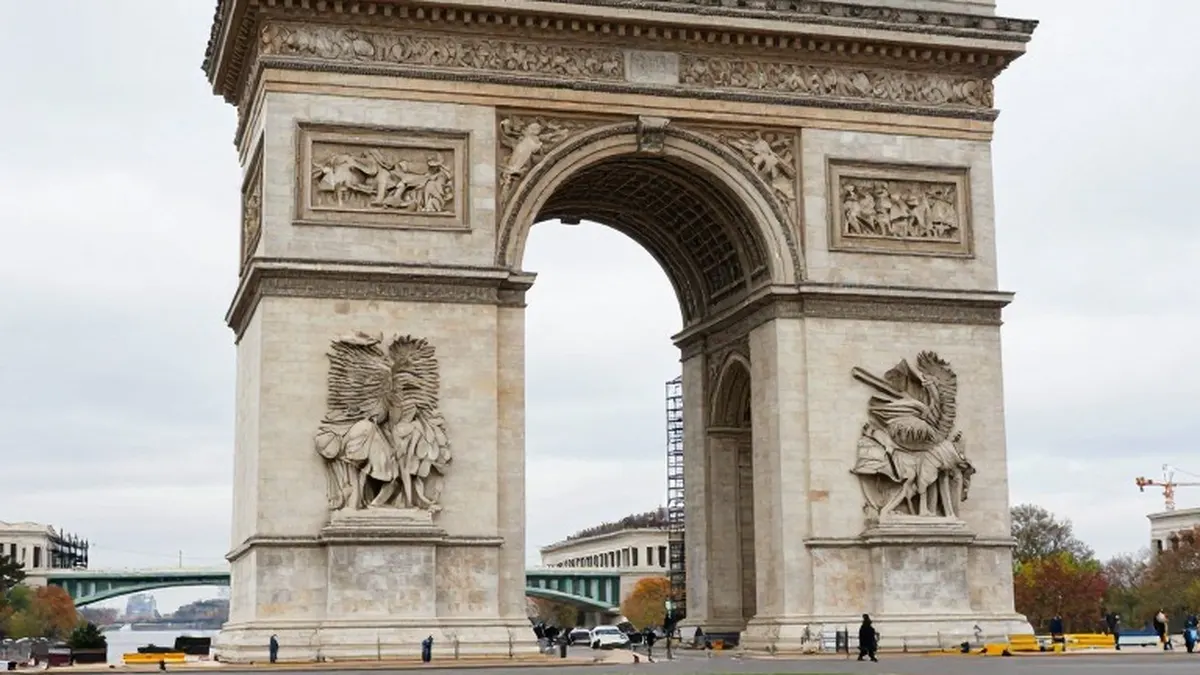
The National Capital Planning Commission is expected to vote Thursday to approve President Donald Trump's planned "Triumphal Arch" for Washington, D.C., a massive and controversial project that could see construction begin almost immediately after the vote.
The commission, which is led by Trump appointees, is widely considered likely to give the project a green light. Its decision follows a hearing at which numerous area residents lined up to voice opposition to the monument, which would rise in Memorial Circle between the Lincoln Memorial and Arlington National Cemetery.
Mark Paoletta, the Office of Management and Budget general counsel who was appointed chairman of the commission in August, said in remarks at the meeting that it was a "national disgrace" that such a memorial had not already been built, and he praised Trump's "monumental vision." He said the structure would be "the grandest arch ever built by mankind."
Opponents of the project, including the governments of Virginia and the District of Columbia, are seeking an emergency court order to block construction, arguing the project is illegal. They have already asked a judge to immediately halt any building work, saying they want to head off possible legal gamesmanship by the administration. They pointed to its earlier destruction of the East Wing of the White House to build a ballroom that includes national security measures.
"It is entirely foreseeable that, once construction begins, Defendants will argue, as they have done in other cases, that an order halting construction would irreparably harm the federal government, pose security risks, and impermissibly alter the status quo they have unilaterally created," they said. "The Court should not allow this cynical gambit to succeed."
U.S. District Judge Tanya Chutkan has asked to be notified after the commission's vote.
Trump has said the arch would celebrate the nation's 250th anniversary and would include a military complex with drones and snipers that he described as important for national security. The final plans submitted to the commission, however, make no mention of drones, ammunition storage or sniper positions.
Preservationists and military veterans first filed suit to block the project earlier this year, arguing that it needed to be authorized by Congress and that the chosen site was improper. "Its location on Memorial Circle would situate the monument on an axis between the Lincoln Memorial and Arlington National Cemetery, obstructing a line of sight that was designed to represent the unification of the Nation following the Civil War and that has existed for nearly a century," they said.
Virginia and the District of Columbia filed their own action to stop the project last week, contending that it "defies at least five federal statutes," including one that "generally limits buildings in the District to a maximum height of 130 feet." The 250-foot arch "would exceed that limit almost twice over," they said, arguing it would harm residents of both jurisdictions. Their suit said the arch "is slated to be built on a busy traffic circle that abuts the border between the jurisdictions, at the center of a historic viewshed, in a river whose environment the District has a statutory responsibility to protect," adding that both construction and the finished monument would disrupt operations and require substantial resources to mitigate the impacts.
In court filings, the administration countered that the city and state lack standing to sue and that Congress approved the project roughly a century ago, when it "authorized erecting and redesigning 166-foot-tall columns surmounted by statues, exceeding any applicable height limits, and those columns have not yet been built." Attorneys for the city and state called those arguments "implausible," noting that the columns were initially planned alongside Memorial Bridge before the idea was dropped. "As Defendants do not dispute, the Memorial Bridge Act nowhere mentions an arch," they said.