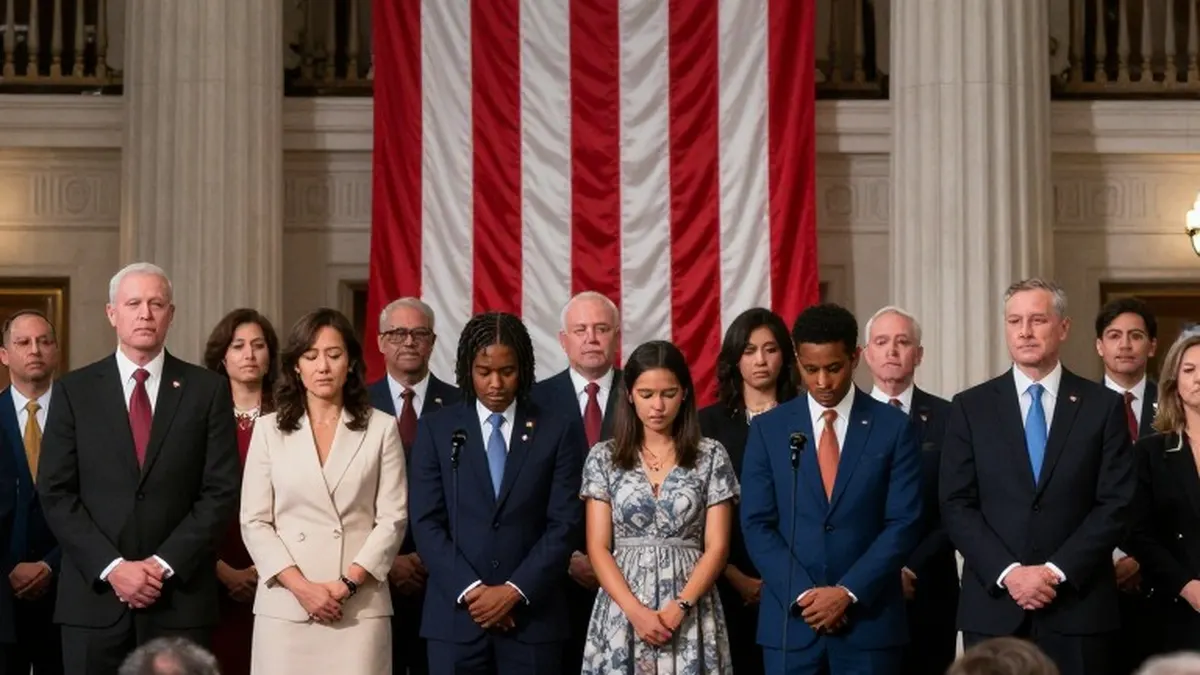
President Donald Trump addressed the nation on Monday from the headquarters of the Justice Department in Washington, where he sharply criticized California Governor Gavin Newsom. The president denounced Newsom's proposal to commute the death sentences of more than 500 convicted murderers. This appearance was notable for its rarity, as the last time a president spoke from this location was in March 2025, when Trump called for the incarceration of his political opponents.
During his remarks, Trump labeled Newsom, a potential candidate for the 2028 presidential election, a terrible governor. He argued that the American people stand with the victims of crime, not with those who kill them. Without specifying exactly how his administration would intervene in state cases, Trump vowed that the federal government would not allow the commutations to proceed. All the sentences currently under discussion originate from state court convictions.
The event also featured the announcement of several new executive actions. Trump issued a presidential directive ordering the Justice Department to seek the death penalty for individuals convicted of killing children, as well as for rapists and human traffickers who murder their victims. The order also instructed the attorney general to speed up the execution process for inmates currently on federal death row.
To illustrate the human cost of these legal battles, Trump invited relatives of several victims to the stage. Some speakers became emotional while recounting the deaths of their loved ones. Among them was Marc Klaas, whose 12-year-old daughter Polly was abducted and killed in 1993 in Petaluma. Klaas described Newsom's actions as outrageous. The conviction of Richard Allen Davis, who killed Polly, had previously contributed to the passage of California's three strikes law. At the time of the abduction, actress Winona Ryder had offered a reward of $200,000 for information.
Another family member, Sandy Friend, spoke about her 8-year-old son Michael Lyons, who was killed by Robert Boyd Rhodes. Friend challenged Newsom to face the families directly. She described the horrific details of her son's murder, noting that he was tortured for ten hours. Friend criticized the governor for erasing the death sentence without notifying the victims' families. She expressed how difficult it was to relive the trauma during her speech.
Governor Newsom responded to the event through a video message posted on social media. He accused Trump of selling pardons to benefit his associates. Newsom assured the families that their grief was real, emphasizing that under his plan, every person on California's former death row would die in prison. He contrasted this with his view of Trump's associates, whom he implied would be released. The governor described the current Justice Department as a protection racket rather than a law enforcement agency, reiterating his belief that state-sanctioned killing does not align with California's values.
The atmosphere at the Justice Department shifted dramatically at the end of the event. After shaking hands with the emotional family members, Trump left the stage as his campaign anthem, a upbeat version of YMCA, played in the background. This moment provided a stark contrast to the somber tone of the preceding speeches.
The political exchange between Trump and Newsom occurs against a backdrop of recent difficulties in carrying out executions across the United States. Last week, prison staff in Texas spent more than an hour attempting to find a vein in inmate Reinaldo Dennes, who cried out in pain during the process. In September, Christa Pike, the only woman on Tennessee's death row, became the first person to survive a lethal injection. She was placed on a ventilator and regained consciousness several days later.
Public opinion on the death penalty remains complex and is trending downward from its peak in 1994, when 80% of Americans supported it. A Gallup poll conducted this month showed that 49% of U.S. adults favor the death penalty for murder convictions, while 45% are opposed. A separate Pew Research Center survey from August found that 66% of Americans support the penalty for murder, yet 59% do not believe it deters crime. There is also a significant partisan divide, with Democrats increasingly opposing capital punishment.