U.S. President Donald Trump, Chinese President Xi Jinping, and Russian President Vladimir Putin commenced an unprecedented three-way meeting on Thursday. The summit, held on the sidelines of an Asia-Pacific gathering in Shenzhen, placed the ongoing conflict in Ukraine and nuclear arms control at the center of their agenda.
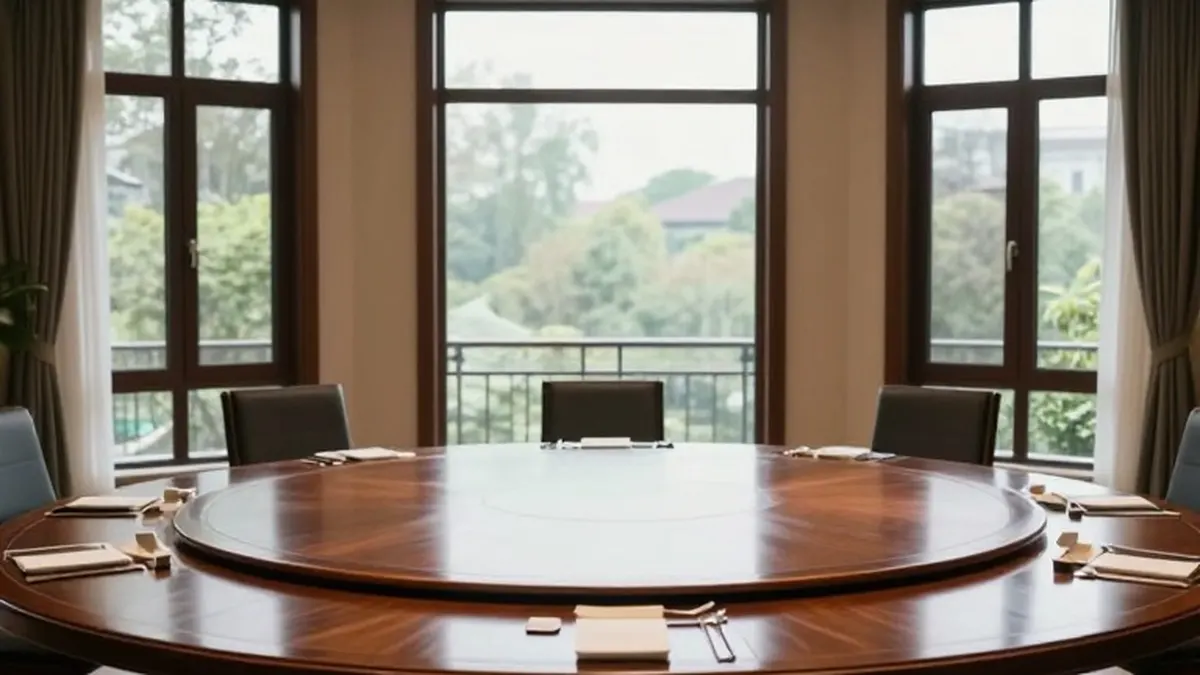
The leaders sat at a large round table in a villa, taking turns to deliver opening remarks. Trump described the occasion as a historic moment, stating that the three nations had much to discuss. He emphasized the importance of engagement by noting that peace has rarely been achieved by declining opportunities for dialogue.
Putin highlighted the shared interests of the three countries in resolving regional conflicts, specifically mentioning Ukraine. In contrast, Xi, who presided over the meeting according to Chinese state media, did not explicitly reference the war. Instead, he offered a broader philosophical remark, suggesting that global peace depends on the harmony of major powers, while turmoil results from their clashes.
Prior to the trilateral session, Trump held separate meetings with both Xi and Putin, referring to both leaders as friends. During these discussions, Trump noted that he and Xi shared strong views on the importance of oil flowing freely through the Strait of Hormuz, a route currently disrupted by the Iran war. Xi had remained silent on the topics of Ukraine and Iran during the first day of the summit.
Analysts suggest that while the meeting is symbolically significant, it is unlikely to yield major agreements due to deep-seated differences regarding Ukraine, Iran, trade, and nuclear arsenals. Patricia Kim, a foreign policy fellow at the Brookings Institution, noted that China may be reluctant to appear as a broker for a Ukraine deal, particularly given the absence of Kyiv and European leaders. Kim added that Beijing has characterized the war as fundamentally a European problem, reducing its inclination to take on resolution responsibilities.
The summit was marked by significant ceremony. Trump contrasted the elaborate welcome he received with the more muted greetings given to other leaders, including Japanese Prime Minister Sanae Takaichi. Takaichi, who arrived without a welcoming ceremony, has been an isolated figure during the event. Japan-China relations have strained since 2025, following Takaichi's comments regarding potential military deployment in response to moves on Taiwan. Takaichi maintained that Tokyo's position on Taiwan has remained unchanged since 1972.
Xi personally greeted Trump at the airport, a gesture he has not made for a visiting leader since assuming the presidency. The two leaders also shared a brief hug. Trump praised the fanfare and respect shown during the arrival, calling it a win for both nations. This welcome followed speeches by Xi and Putin in which they criticized Western trade protectionism and sanctions.
During the APEC proceedings, Xi advocated for free and open trade, countering Western critiques that China's growth model creates global imbalances. Putin, who recently faced a setback in Ukraine following the damage to a key bridge linking Crimea to Russia, underscored Russia's role in ensuring food and energy security for the Asia-Pacific region. Meanwhile, Trump, navigating a mid-term election loss and a spy scandal involving Nvidia, reminded the audience of the United States' long-standing status as a Pacific power.
Nuclear arms control remains a central but difficult topic. Trump has pushed for its inclusion despite China's historical objections to joining talks with the U.S. and Russia, which possess larger arsenals. Trump acknowledged the difficulty of giving up weapons during the initial talks. Craig Singleton of the Foundation for Defense of Democracies observed that while the leaders have reasons to pose together, agreeing on substance is far more challenging due to divergent interests.
The diplomatic engagement occurs amid ongoing tensions over technology. Although the U.S. and China recently extended a trade truce, reports suggest Nvidia chips are being diverted to China through Southeast Asia. This raises questions about the effectiveness of U.S. export controls and the future of Chinese access to advanced technology, a concern that analysts describe as a significant issue for Beijing.