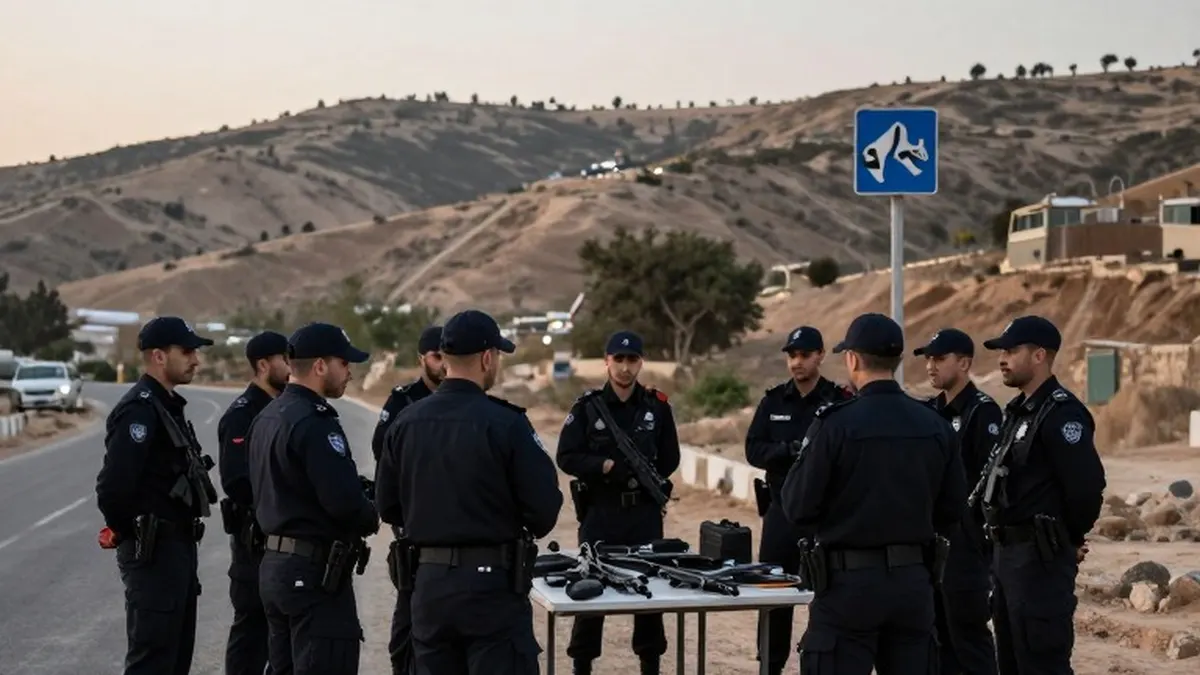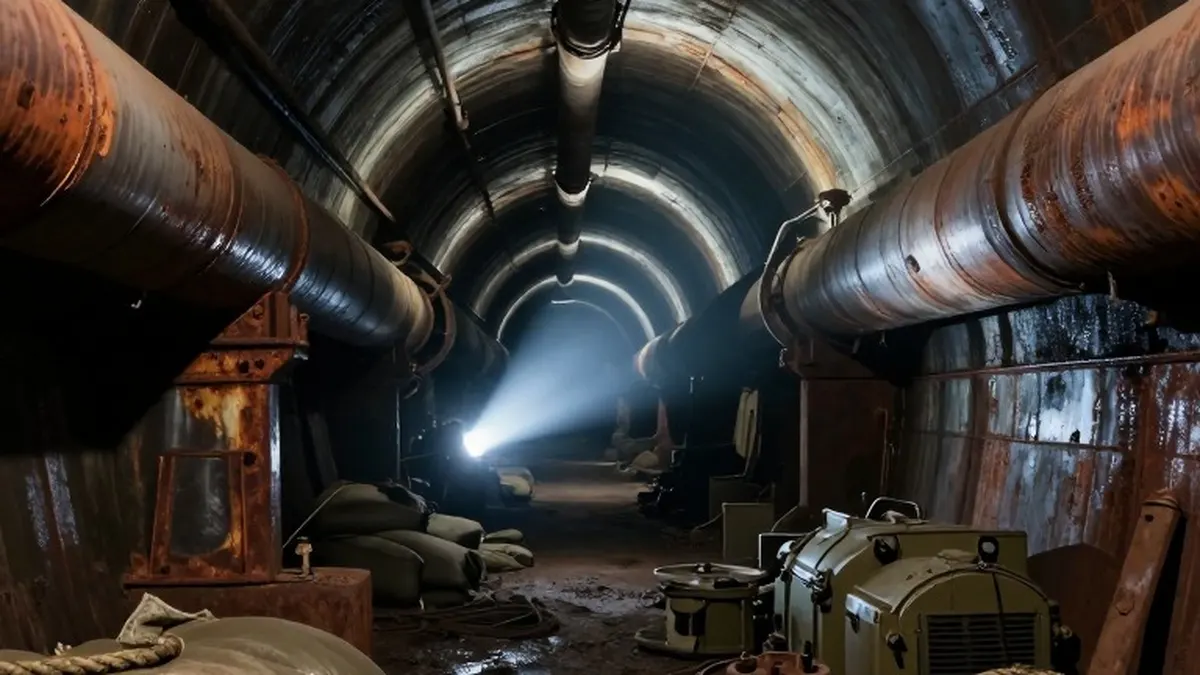
After years of fighting across the fields, forests and skies of Ukraine, the war with Russia has opened a new front beneath the earth. Ukrainian forces have taken the battle to Russian troops inside the network of disused gas pipelines and tunnels around the eastern town of Kupiansk, the New York Times reported at the end of October, adopting underground tactics that Moscow's forces have employed for more than two years.
Kyiv launched Operation Veles in October, sending specially trained and equipped soldiers 15 kilometres along a gas pipeline just 1.2 metres in diameter to secure the tunnel's entrance where it passes beneath the Oskil River into a frontline city Russia has been fighting to capture. President Volodymyr Zelensky last week described the operation as a "great success", saying his troops had managed to "eliminate" around a hundred Russian soldiers and take more than 30 prisoners during the fierce fighting that raged unseen underground. For almost two weeks, the Ukrainian army has been showing Western media the grim reality of its efforts to seize control of the pipeline.
Huseyn Aliyev, a specialist on the war in Ukraine at the University of Glasgow, said the operation marked Ukraine's embrace of methods long practiced by Moscow. "This is the first time I know when Ukrainians have started using the same methods," he said, noting that the tactic "is becoming very widespread". Zelensky, for his part, said Kyiv had made the approach its own: "Ukrainian warriors have successfully transformed this tactic, modernised it, and made it much more sophisticated and technologically advanced."
Will Kingston-Cox, a specialist in Russia and the Ukraine war at the International Team for the Study of Security (ITSS) Verona, said Moscow had previously used such tunnels to slip past Ukrainian defences. He pointed to Avdiivka in January 2024, where Russian troops reached the rear of a Ukrainian fortified position through what appeared to have been a drainage conduit. Russian forces later used the same approach to retake the Kursk region from Ukrainian control, and then in the Kupiansk region, where the two sides fought for each foot of pipeline burrowing through the earth.
Ryhor Nizhnikau, a senior research fellow at the Finnish Institute of International Affairs, said these tactics were only possible because of the Soviet-era pipelines that once carried Russian natural gas across Ukraine into Europe. "This is a new battlefield, but it's much smaller in scale," he said. "You can only operate in the network of pipelines that exists. But the fact is that we do see this network being used much more intensively over the past year." Similar networks are found in the Kharkiv, Luhansk and Donetsk regions and parts of Zaporizhzhia, he said, while Gustav Gressel, a military analyst at Austria's National Defence Academy, said sewage and drainage pipes could serve the same purpose in cities: "In urban conglomerations, the wastewater system becomes another battlefield." The layouts are no secret to either side, Nizhnikau added: "Everyone knows how these pipelines were built in Soviet times. So you have the map, and the Russians have the map."
Ukrainian forces initially preferred to wait for Russian soldiers to surface from the tunnels in a grim game of whack-a-mole rather than fight underground, Aliyev said, and for a long time openly mocked the Russian pipeline assaults as dangerous and ineffective. But the Russian victories in Avdiivka and Kursk forced Kyiv to reconsider, and in September 2025 the Russian independent investigative outlet iStories revealed that Moscow was stockpiling ammunition and supplies to use the Kupiansk pipeline for a larger-scale offensive.
Kingston-Cox said the new underground front gives both sides ways to launch attacks and counter-attacks at a time when the mass proliferation of drones makes above-ground assaults fraught. "On open ground, a group can obviously be spotted well before it reaches its objective," he said. Nizhnikau said that with drones a constant threat for tens of kilometres on either side of the front, even narrow, potentially gas-choked tunnels can seem the better option: "It's more predictable for people. I understand it's really horrible, but then, it's better than being killed by a drone."
Gressel stressed that the tunnels, while perilous, offer soldiers rare protection from the drones responsible for the bulk of casualties in the four-year war. "Radio-controlled drones lose their signal at the entrance, and for fiber-optic drones the cable often snags in corners," he said, adding that nets, small wire or fishing lines can be spun around entrances to detonate drones prematurely.
Nizhnikau cautioned that such tactics should be understood as "a support measure" to the broader fight, and Aliyev agreed tunnel warfare cannot be replicated along the whole front, since much of it lacks the necessary infrastructure. Kingston-Cox said a narrow pipe can deliver infantry past an obstacle but has very limited capacity to support a larger force: "If the defender is watching the opening and people are coming out a few at a time, this could become extremely vulnerable." Even so, he said, these high-risk tactics can help "break local deadlocks", and with operations such as Veles, Ukraine is showing it is ready to take the fight to Moscow on any battlefield.