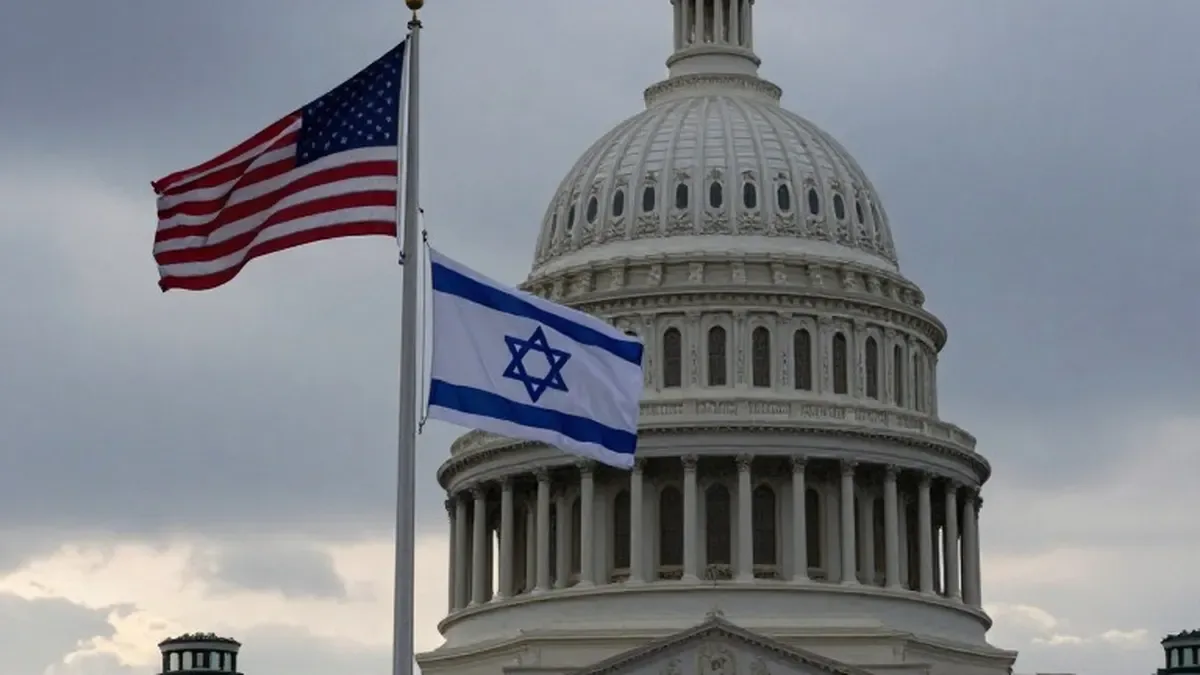
A former senior Biden administration official has warned that the Democrats' sweeping victory in the US midterm elections could carry far-reaching consequences for Israel, including a fundamental shift in Washington's approach to military assistance.
Phil Gordon, who served as national security adviser to then-US Vice President Kamala Harris from 2022 to January 2025, told The Jerusalem Post that American public support for providing financial assistance to Israel has declined to the point where it may no longer be politically sustainable within the Democratic Party. "I honestly don't think any of the candidates [in the next Democratic presidential primary] will support the notion of financial assistance to Israel," Gordon said. "That's not an arms cutoff or an arms embargo, but just the idea of American taxpayers financing Israeli purchases of weapons. I think that's probably a thing of the past."
Gordon cautioned against interpreting the midterm results as primarily a referendum on Israel, describing the vote instead as a broad rejection of President Donald Trump's domestic and foreign policies. He cited inflation, affordability, the war in Iran, corruption allegations, and the administration's approach to artificial intelligence and data centers as factors behind the Democratic gains. "Affordability was the core issue here," he said, noting that Trump won the presidency in part by promising to bring down prices but failed to deliver.
Still, Gordon said the election reflected a wider deterioration in American attitudes toward Israel that extends beyond one party. "Americans in general, this is not just a party thing, because Republicans too, are not as supportive of Israel as they have historically been, and certainly not of the current government," he said. The shift, underway for years, was significantly accelerated by the war in Gaza and then the war in Iran, particularly among Americans who viewed Israel as having pushed Washington toward military confrontation with Tehran.
Positions that were once controversial or even extreme, such as conditioning aid to Israel or imposing sanctions on settlements, are now mainstream, Gordon said. He pointed to the growth in Democratic senators willing to back legislation associated with Sen. Bernie Sanders conditioning military assistance: "That went from a handful to 20 to like 47."
Gordon, who was part of the Obama administration team that negotiated the current memorandum of understanding providing $4 billion in assistance per year between 2019 and 2028, said the bipartisan consensus that once made such agreements straightforward has eroded. Asked whether a Democratic administration would make negotiations over a new MOU harder for Israel, he answered: "Yes." He went further, saying he was "not even sure about the Republican side," pointing to Trump's recent comments suggesting the framework of long-term assistance may be ending. He noted that an MOU remains subject to congressional authorization and appropriations, adding: "I don't know that you could count on a future president or Congress to appropriate that funding." Israel's own economic development has also changed the debate, he argued, with American taxpayers increasingly questioning why they should finance weapons purchases for what is now a wealthy country.
Gordon distinguished between direct financial assistance and the separate debate over arms sales. A full embargo or halt to weapons sales remains a position associated mainly with the progressive wing and younger voters, he said, but conditioning military sales on Israeli government policy has moved much closer to the Democratic mainstream. Asked whether he personally supports that approach, he replied: "Yeah, I think arms sales should be conditional." As a starting point, he said, Israel should be required to comply with existing US law restricting weapons transfers to countries that obstruct humanitarian assistance. He recalled the Biden administration's decision to withhold certain 2,000-pound bombs during the Gaza war and President Joe Biden's televised warning that the United States would not provide certain weapons if Israel conducted its Rafah operation in a particular manner.
Within the Democratic Party, Gordon identified three major sources of opposition: the conduct of the war in Gaza, Israel's perceived role in pushing for the war in Iran, and the government's policies in the West Bank, including settlement expansion, settler violence, the establishment of outposts, and what he described as de facto annexation. He said candidates in the next Democratic presidential primary will be pressed on military assistance, settlements, sanctions, and the MOU, and that it would be difficult to emerge from the process unwilling to consider withholding weapons or voting against Israel at the United Nations. "The old politics of Israel policy just don't fly anymore," he said.
Asked whether there is a realistic path to restoring normal relations while Benjamin Netanyahu remains prime minister, Gordon answered bluntly: "No. I think bridges have been significantly burned." He said the inclusion of National Security Minister Itamar Ben-Gvir and Finance Minister Bezalel Smotrich in Netanyahu's coalition, politicians widely viewed in Democratic circles as "beyond the pale and racist," makes a normal relationship with leading Democrats hard to imagine. Gordon declined to speculate on whether Harris might seek the nomination again in 2028, saying that decision rests with the former vice president, who has said she is considering her political future. His message to Jerusalem, he said, was clear: bipartisan support, long-term military financing, and diplomatic backing can no longer be treated as automatic. "Things you could assume before or count on before, like consistent support in the United Nations or no arms conditionality or no sanctions, the politics have changed," Gordon said. "Israelis need to realize that and handle it."