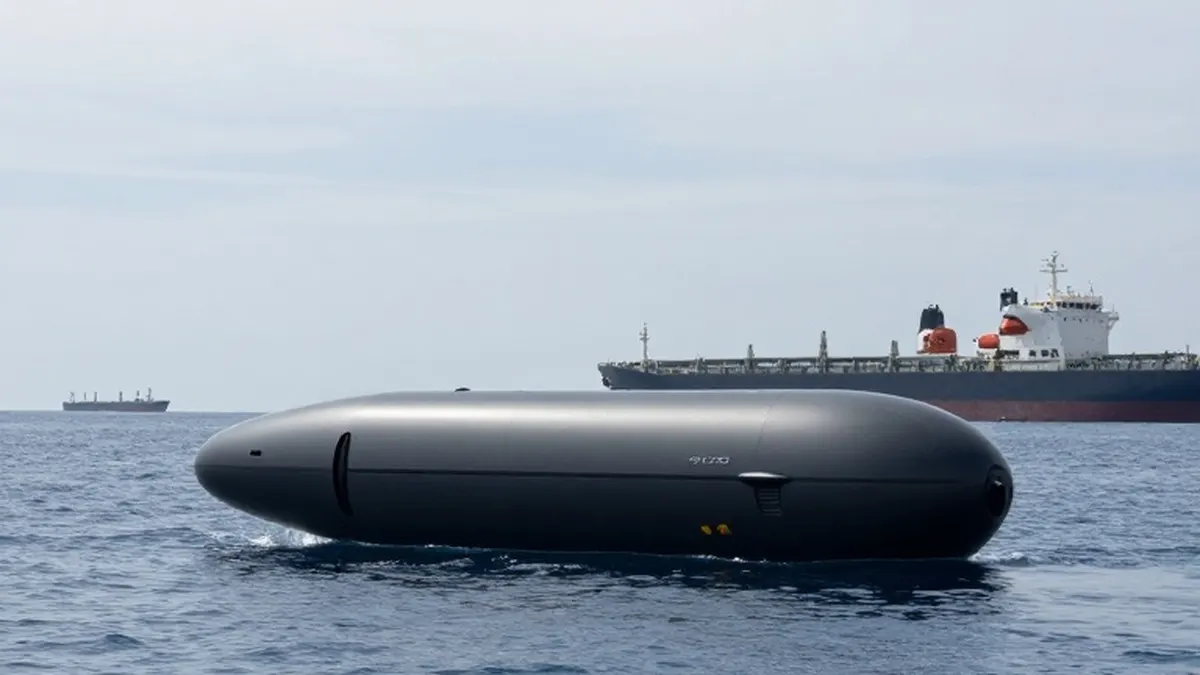
The United States Navy has placed a new order for 82 Lionfish unmanned undersea vehicles as the Islamic Revolutionary Guard Corps continues to target commercial shipping in the Strait of Hormuz. This acquisition aims to strengthen the Navy's capacity for mine countermeasures, intelligence gathering, and undersea surveillance in a region where underwater explosives pose a significant and often hidden threat to maritime operations.
The Lionfish system is manufactured by HII, a subsidiary of Huntington Ingalls Industries. The Navy currently operates 50 of these vehicles. With this new procurement, HII is tasked with building, testing, and delivering a total of 175 Lionfish systems. The contract carries a potential value of over $347 million, with provisions allowing the production scale to expand to 200 units if required.
Duane Fotheringham, president of HII’s Unmanned Systems group, stated that the updated award demonstrates the Navy’s ongoing commitment to the platform. He noted that the company is focused on delivering autonomous systems that offer critical undersea warfare capabilities to sailors and marines, aligning with evolving mission requirements.
The Lionfish platform is derived from the REMUS 300 unmanned underwater vehicle, a design used in both commercial and defense sectors. It features a modular, open-architecture design that allows for the integration of various payloads. This flexibility enables the system to be upgraded as operational needs change, providing multi-mission adaptability for diverse tactical scenarios.
According to the Defense Innovation Unit, the primary goal of the Lionfish program is to ensure free access to global maritime routes. The system is designed to protect these routes from the dual threats of underwater explosive devices and adversary infrastructure. The DIU emphasized that the platform represents a stepwise improvement in underwater robotics and artificial intelligence.
HII describes the Lionfish as the first and only cyber-compliant unmanned underwater vehicle currently in production for the US Navy. Developed in collaboration with the DIU and the Naval Information Warfare Center-Pacific, the system is intended to replace the older MK 18 Mod 1 Swordfish UUV. The predecessor platform was based on the REMUS 100 design.
Captain Jonathan Haase, the program manager for Expeditionary Missions at the DIU, highlighted the technical advancements of the new system. He noted that the Navy has secured the first cyber-secure UUV that incorporates next-generation modularity and sensors. This development provides a significant capability boost in the domain of underwater robotics and AI.
HII also produces the MK 18 Mod 2 Kingfish, which is based on the larger REMUS 600 platform. The Navy currently operates close to 90 Kingfish vehicles. The company has a long history of delivering REMUS vehicles, with more than 750 units shipped to over 30 countries, including 14 NATO members. HII reports that more than 90% of the systems delivered over the past 25 years remain in active service.
The decision to expand the Lionfish fleet coincides with a broader trend among the US military and its allies to utilize unmanned platforms. These systems are increasingly viewed as essential for expanding maritime surveillance, reducing risks to crewed vessels, and enhancing operational effectiveness in contested waters. Although HII has not specified where the new drones will be deployed, the intensifying threat to shipping in the Gulf underscores the need for autonomous underwater reconnaissance and mine detection capabilities.
The strategic importance of these assets was highlighted earlier this year when Iranian media reported in September that it had captured two unmanned underwater vehicles in the Strait of Hormuz. The captured systems included a Remus 600 and a Dive-LD UUV manufactured by Anduril, further illustrating the high stakes involved in undersea operations in the region.