Family members of California murder victims spoke out in anger on Thursday against Gov. Gavin Newsom, one week after he acted to commute the death sentences of more than 500 inmates awaiting execution.
The executive action, viewed as one of the most significant moves against capital punishment in recent history, has infuriated crime victims who say they have already suffered the devastating loss of loved ones.
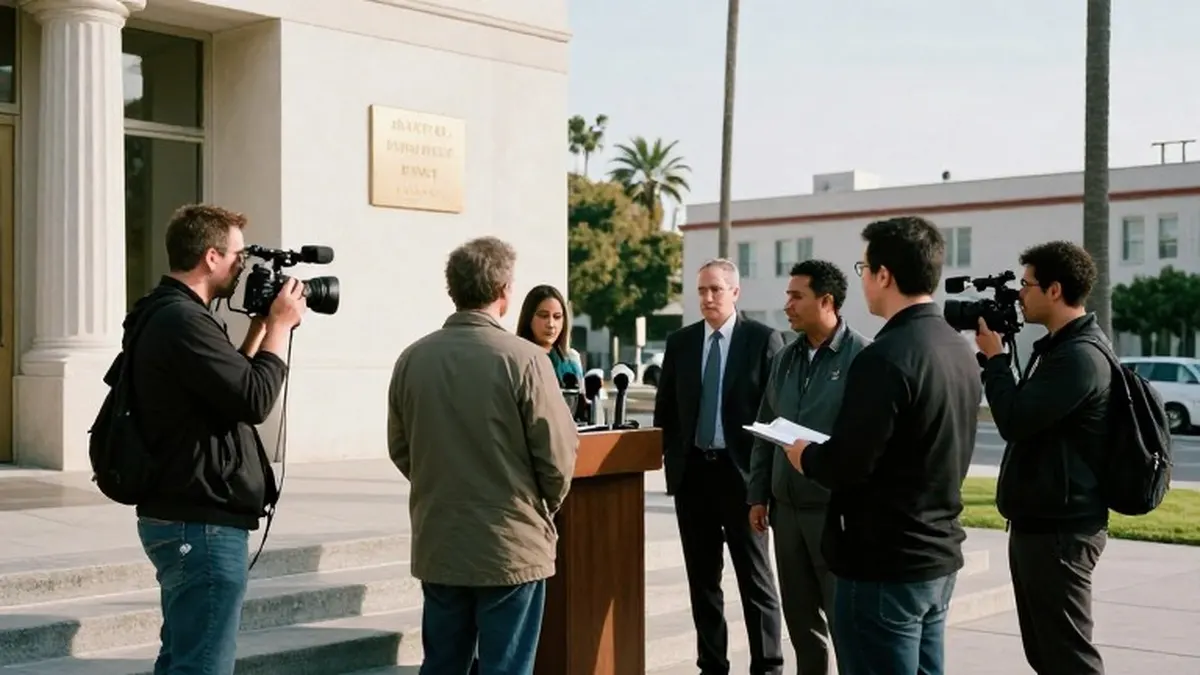
Faye Jenkins, whose daughter and son-in-law were tortured and killed inside their Riverside County home in 2008, argued that California voters support the death penalty and that Newsom had no business overriding them. "We voted for this," Jenkins told reporters outside the Orange County District Attorney's Office in Santa Ana.
"Who gives you that right to make the decision for all of us? You didn't ask me, you didn't ask my husband, you didn't ask other families. Don't inflict your personal beliefs on all of us," she said. California voters last weighed in on capital punishment in 2016, when they rejected an abolition measure by a relatively narrow margin.
Jenkins described the four Marines who killed her daughter in brutal terms. "People used to say they're animals. No, I love animals. These were monsters," she said. "They tortured my daughter and made my (son-in-law) watch while they sexually assaulted her. They stomped him and beat him so badly he even had shoe prints on his back, the impression where they stomped him so hard. Who does that? And these are people that (Newsom) thinks deserve a second chance?"
Steve Herr, father of Samuel Eliezer "Sam" Herr, recounted sitting through 203 court dates before neighbor Daniel Wozniak was convicted and sentenced to death for the 2010 killing of his son and the victim's friend Juri "Julie" Kibuishi in Orange County. "He was sent to San Quentin's death row to await his execution and I thought that was the end of that horrible nightmare," Herr said. "That was not to be."
Representatives for Newsom did not immediately respond to a request for comment on Thursday. To complete the commutations, Newsom would need the consent of the California Supreme Court for 382 of the 548 condemned inmates, converting their sentences to life without the possibility of parole, known as LWOP.
Orange County District Attorney Todd Spitzer contended that procedural shortcuts around LWOP could eventually allow dangerous killers to go free. "Life without the possibility of parole is absolute nonsense," Spitzer said, adding that he faced heavy social media criticism over the weekend from people accusing him of fear mongering and lying about the law. "We practice law every day and we have people who've been sentenced to life without the possibility of parole who are getting out of prison," he said.
Loyola Marymount University law professor Stan Goldman acknowledged that mechanisms exist to gain parole after an LWOP sentence, but said he could not think of an example of such a release off the top of his head. "As a practical matter, it's not a real problem," Goldman said Thursday. "If the past is prelude to future, it is very unlikely someone, or masses of people, will be released despite the fact they've been given LWOP after they were released from death row."