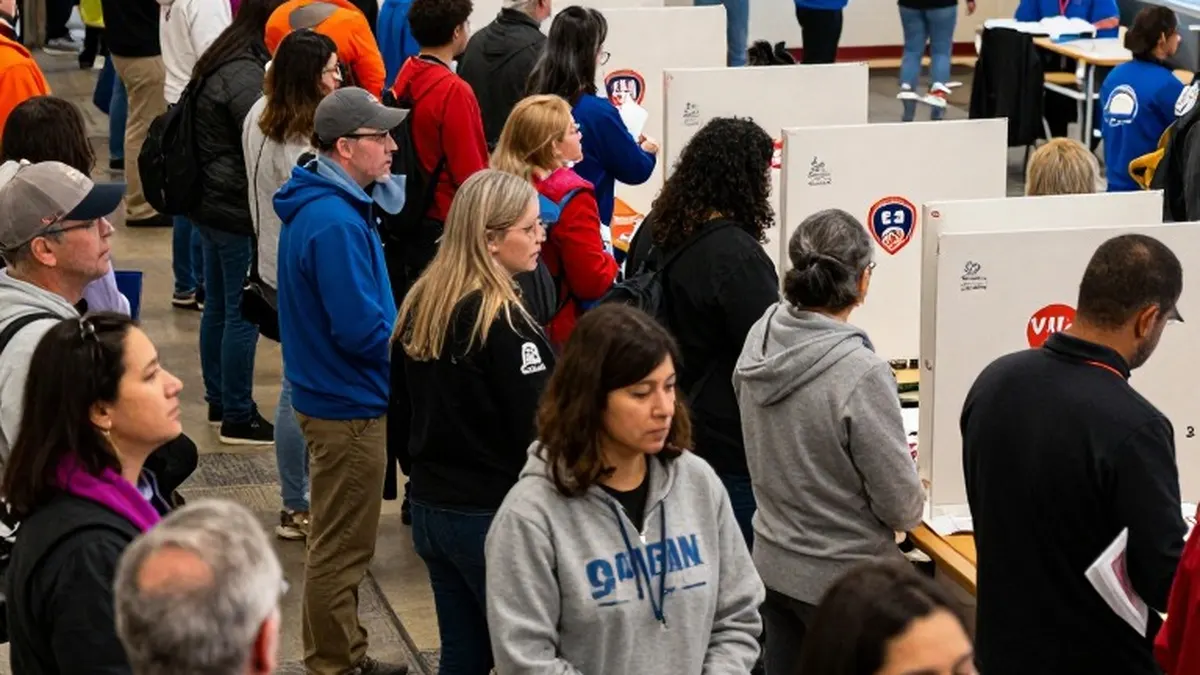
Alaska voters are set to decide one of the most closely watched U.S. Senate races in the nation, a contest that has been dominated by litigation and allegations of strategic maneuvering in the final days before Election Day. The race between incumbent Republican Senator Dan Sullivan and Democrat Mary Peltola, a former U.S. representative, has become a focal point for determining which party will control the Senate.
The campaign took a tumultuous turn less than two weeks before the vote, triggered by suspicions that Peltola’s team helped recruit a third candidate with a confusingly similar name. This move revived long-held claims by the incumbent that the additional candidate was a sham intended to cause voter confusion. President Donald Trump placed significant emphasis on this issue, labeling the third candidate, retired teacher Dan J. Sullivan, as fake. He directed the Justice Department to file a lawsuit to block the certification of results pending an investigation.
Peltola described the federal lawsuit as flagrant corruption. A federal judge dismissed the suit last Sunday, leading the Justice Department to file an appeal. The candidacy of Dan J. Sullivan, who received 2.5% of the vote in the August primary and has conducted minimal campaigning, has consumed much of the public attention in this late stage of the election. Recent reports indicated that Peltola’s campaign appeared involved in efforts to recruit him, a claim she has firmly denied.
Peltola told supporters that she is not interested in tricking voters. Dan J. Sullivan, who resides in the small fishing village of Petersburg, has also denied contact with Peltola’s campaign but has not responded to recent messages. The Justice Department confirmed the existence of a criminal investigation, though U.S. Attorney Michael Heyman declined to specify the targets or potential crimes under review. Donors to Dan J. Sullivan’s campaign reported that FBI agents have inquired whether they felt deceived by the lesser-known candidate.
The official ballot distinguishes the two candidates by listing Dan S. Sullivan as the Republican incumbent and Daniel J. Sullivan Jr. as an independent. Voters are navigating these complexities while sifting through a flood of outside funding and advertisements. Both campaigns have accused one another of spreading falsehoods, creating a tense atmosphere as the state prepares to cast its ballots.
Local voters expressed mixed reactions to the developments. Dylan Wood, an attendee at a Peltola rally in Juneau, stated he would vote for the most progressive-leaning candidate. While he does not know the full truth behind the claims regarding Dan J. Sullivan, he expressed concern over government interference in the election process. He noted that the ballot clearly marks the incumbent, making the choice straightforward for those wishing to support him.
John Delgado, an independent who leans Republican, praised Sullivan’s performance and described him as a classy act. However, he suggested that Peltola should withdraw from the race. Delgado argued that if she claimed ignorance about the situation, it would diminish his opinion of her, as he believed she would be lying.
In the primary election, Peltola finished first with 49.5% of the vote, while Sullivan received 41.4%. The remaining vote was distributed among fourteen other candidates. Sullivan’s opponents have portrayed him as a rubber stamp for Trump. The president was seen alongside Sullivan in late September, when he announced that South Korea planned to invest about $54 billion in a liquefied natural gas project in Alaska, although South Korean officials later stated they needed to assess the project's commercial viability.
Sullivan, a retired Marine, highlighted his support for Trump’s tax breaks, social service cuts, and immigration enforcement measures. He also pointed to his record supporting the military. Vice President JD Vance traveled to the state to rally support for Sullivan. The senator argued that Peltola was ineffective during her time in the House and warned that Trump’s efforts to expand oil and gas development were at risk if Democrats regained control of the Senate.
Peltola, who is Yup’ik, has emphasized her roots in the state and her ability to work across party lines. She blamed the war in Iran, which has contributed to high fuel prices in remote Alaskan communities, for economic strain. She stated that she is willing to work with Trump on additional drilling and described her collaboration with Sullivan as a positive experience. Under Alaska’s ranked-choice voting system, a winner may not be known immediately, as ballots postmarked by Election Day can be received for up to 15 days. Final tabulations will occur after the November 18 deadline, with rankings determining the outcome if no candidate secures more than 50% of first-choice votes.