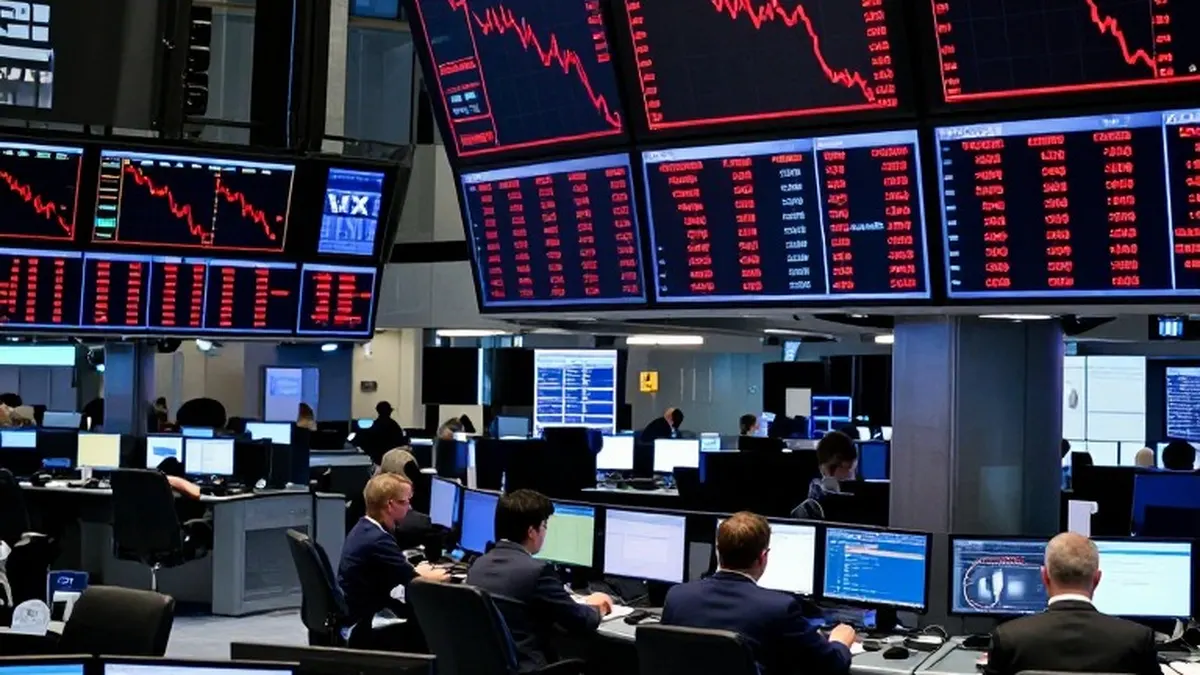
A significant wave of caution has swept through Wall Street, with traders aggressively purchasing protective put options on the S&P 500 Index. This surge in hedging activity, observed on Tuesday, suggests that investor anxiety is broadening to include risks beyond the recent concerns surrounding artificial intelligence. The market is reacting to a series of headlines, including nationwide tech outages, upcoming earnings from Nvidia, and the initial public offering from Anthropic.
The Cboe Volatility Index, commonly known as the VIX, experienced a sharp increase of nearly five points during Tuesday's selling, peaking at 27.7. According to Barchart data, the ratio of put to call volumes on the SPDR S&P 500 ETF reached 1.5, marking the highest level since the first week of April. As of the latest reports, the VIX remained above the 26 mark. This continued rise represents the fourth consecutive day of gains for the volatility gauge.
The VIX has not traded below 16 since October 16, indicating a sustained upward trend in market uncertainty. This volatility increase coincides with the S&P 500 slipping below this month's previous lows. The benchmark equity index traded under 7,300, its lowest price since June. Additionally, Cboe's three-month volatility gauge, VIX3M, briefly reached its highest level since April, further highlighting the persistent tension in the market.
While Nvidia's earnings report contributes to the uncertainty, the broader market reaction suggests a more widespread fear. Nvidia's stock options currently imply a move of more than 7% following its report, the largest expected swing in almost two years. However, volatility in the S&P 500 jumped more than in the Nasdaq 100 on Tuesday. This divergence points to a general unease among investors regarding large-cap stocks, not just those in the tech sector.
Eric Metz, CIO at SpiderRock Advisors for BlackRock, noted via email that S&P 500 volatility is expanding faster than Nasdaq 100 volatility because it is coming from a lower base. He stated that the market is pricing in acute near-term stress across large caps broadly, even though tech-specific fear remains notable. This perspective aligns with the observation that the rally in fear is not limited to a single industry group.
Within the technology sector, software stocks faced the steepest declines ahead of Anthropic's IPO. Options volume on the iShares Expanded Tech-Software Sector ETF surged to almost four times its 30-day average, according to Cboe LiveVol data. Salesforce was particularly hard hit, with put contracts outpacing calls on twice the average options volume. This specific pressure on software firms underscores the targeted nature of the recent selling.
Noel Smith, co-CIO of Kai Asset Management, described the situation as a market-wide phenomenon. He emphasized that there are many reasons for investors to be risk-off, noting that the current anxiety is not solely focused on AI stocks. This sentiment reflects a broader reassessment of risk across various market segments.
Despite the spike in volatility, bulls have not been entirely absent from the session. The Nasdaq 100 Index managed to hold its November low, and the VIX remained below its high of 28.4 recorded on November 5. These factors suggest that while fear is elevated, it has not yet reached panic levels seen in previous market corrections.
Matthew Nadel from VolSignals observed that while volatility is at a relatively elevated level, there has not been excessive fear in the options market. He cited fixed-strike volatility in S&P 500 options, which measures changes across specific option strikes. Nadel noted that while there has been a decent move higher in S&P 500 fixed strike volatility, the overall increase has been mostly orderly, indicating a structured rather than chaotic market reaction.