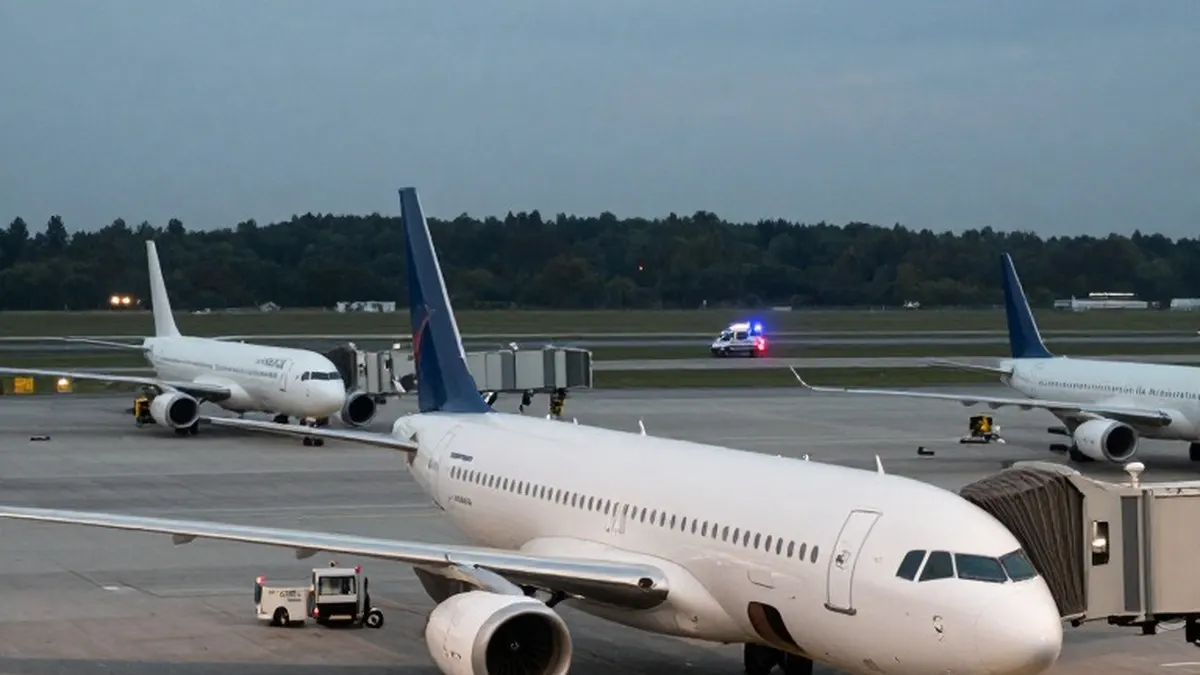
A fresh wave of bomb threats targeted passenger flights across Europe on Friday, marking the third such wave this week. Spain's foreign minister said the continent appeared to be facing "hybrid aggression and a form of psychological warfare."
The threats, all of which proved to be hoaxes, followed a day of major disruption on Thursday, when dozens of flights were affected. Some planes made unplanned landings while others were escorted or intercepted by fighter jets, a sharp escalation after an initial wave of threats on Tuesday. No explosive devices have been found, and every plane has landed safely.
Danish police said Friday they were investigating threats directed at air traffic at Copenhagen airport, adding that their immediate assessment was that passengers had not been in danger. The airport said it was operating normally.
Czech police reported bomb threats against flights departing from and arriving in Prague. An airport spokesperson said nine flights were affected, four inbound and five outbound, but no devices were found and no flights were canceled or diverted. Soon after, an Italian airport authority source said a Wizz Air flight from Prague to Rome was diverted to Venice, where it landed safely.
The office of the French prime minister said four new bomb threats had been made against aircraft flying over French territory, and that all of the planes had landed safely. Separately, CNN Portugal reported that a bomb alert on a Ryanair flight from Rome to Lisbon triggered a security operation after landing.
Security experts said Thursday that the threats carried the hallmarks of a coordinated hybrid attack, though they cautioned that individuals could also be issuing copycat threats or acting on personal grievances. No country has formally attributed blame.
The threats follow a series of sabotage attacks and attempts on targets across Europe, ranging from German electricity substations to defense-related facilities in the Baltic region, supermarket refrigerators in France and elsewhere, and Leipzig airport in Germany. Many officials have tied the campaign to Europe's support for Ukraine in its war against Russia, accusing Moscow of hybrid disruptions that are cheap to carry out, easy to deny, and unlikely to provoke an armed response.
Spanish Foreign Minister José Manuel Albares told national broadcaster TVE that while determining exactly what happened would take time, "it cannot be mere coincidence that so many incidents with exactly the same modus operandi are happening across Europe." He added: "The most reasonable assumption is that we are facing an attempt at hybrid aggression and a form of psychological warfare," and said Europe must prepare for more such challenges.
On Thursday, an airport source in Italy said bomb threats sent to several airlines and airport operators in Rome and Milan claimed to come from "fighters of the Male State." Reuters could not independently confirm who sent the email, and there was no immediate indication of who was behind the other threats. Vladislav Pozdnyakov, a Russian blogger who founded the anti-feminist Male State movement in 2016, which was later banned in Russia, said the group no longer existed and had no involvement.