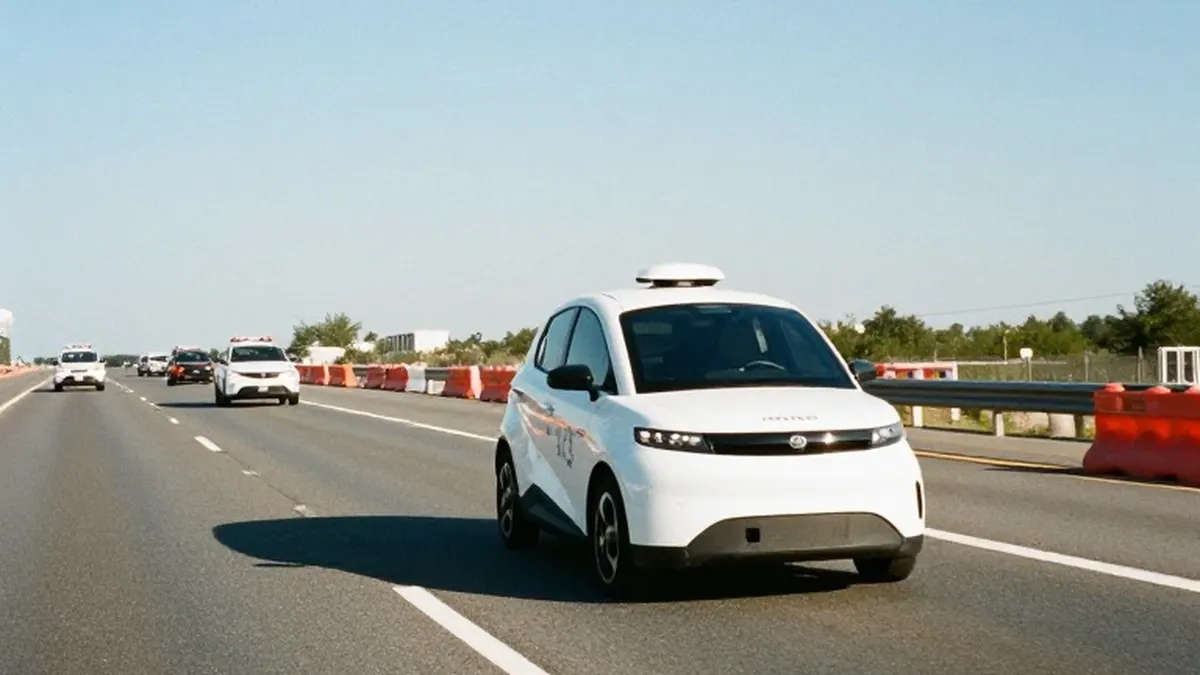
Waymo has once again suspended its commercial driverless rides on freeways across all United States markets. This decision follows a series of recent incidents that led the California Department of Motor Vehicles to issue a temporary ban on the company's vehicles from state interstates last week. The pause represents the second time this year that the autonomous driving leader has halted highway operations due to safety concerns.
The latest trigger for the ban was a video captured on November 6 on Interstate 280. The footage shows a Waymo robotaxi attempting to overtake two California Highway Patrol cruisers during a traffic break. For a human driver, such a maneuver would constitute a moving violation that could result in a license suspension. This incident added to a growing list of freeway errors that prompted regulatory action.
Construction zones have also presented significant challenges for the technology. According to a recent recall filed by the company, Waymo vehicles failed to recognize closed freeway lanes due to construction on 11 separate occasions between October and November 2026. In each case, the vehicles drove into the restricted areas instead of switching lanes.
This setback marks a reversal in the industry's expectations. For years, experts believed that freeways would be the simplest environment for autonomous vehicles due to the lack of pedestrians and complex intersections. However, Waymo has accumulated millions of miles in dense urban areas while struggling with the higher speeds and specific rules of interstate travel.
This is not the first time the company has faced such issues. Earlier in the year, Waymo paused freeway rides after its vehicles entered active construction zones in Arizona and California. The company issued a recall in June and resumed operations in late July after software updates. Yet, the recent violations suggest that the previous fixes were insufficient.
Phil Koopman, an emeritus professor at Carnegie Mellon University who specializes in autonomous vehicle safety, criticized the company's approach. He noted that Waymo is using recalls as temporary fixes rather than addressing the root causes of the problems. Koopman argued that the company continues to scale up despite these recurring issues.
Koopman suggested that Waymo is relying on dynamic geofencing to avoid known hazards, such as flood zones or school buses, rather than improving its core perception and reasoning capabilities. He pointed to previous recalls regarding intersection crashes and flooded roadways as evidence of this pattern.
In response to the DMV order, Waymo stated that it is working closely with regulators to find a solution. The company emphasized that its vehicles have not crashed or injured anyone while in restricted freeway areas. Chris Pappas, a Waymo spokesperson, confirmed that the service continues to operate safely on surface streets, serving over half a million trips per week.
The company had previously avoided highways, opting for longer routes on local roads. However, in late 2025, Waymo declared it was ready to expand onto freeways. Co-CEO Dmitri Dolgov acknowledged at the time that mastering freeway driving at scale required a strong focus on system safety and reliability.
Experts warn that the stakes are higher on the freeway than on city streets. At speeds of 60 to 70 miles per hour, stopping distances are longer, and mistakes can be fatal. Koopman believes that the transition to end-to-end machine learning has made the system struggle with subtle contextual clues, such as construction gaps or police gestures. He argues that regulators need to demand more transparency than just software patches to ensure future safety.