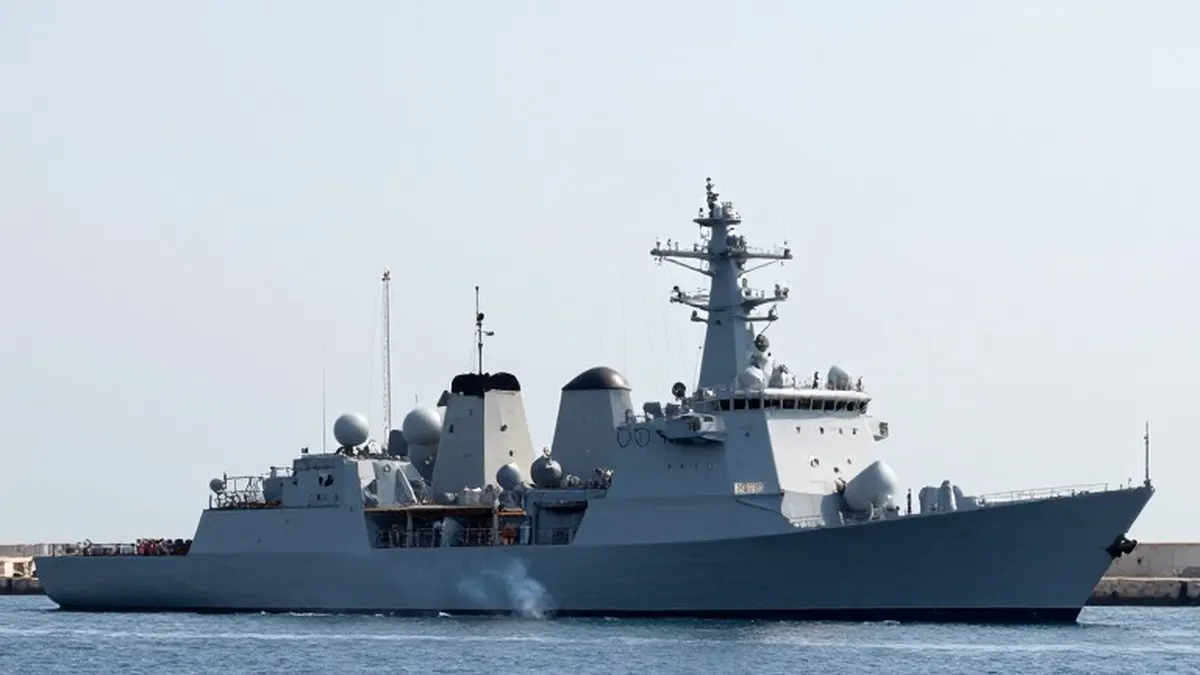
Ukrainian forces conducted a significant naval strike off the coast of eastern Libya on Sunday, targeting the Russian corvette Merkury and the freighter MV Angara. According to Ukrainian intelligence, the Merkury was one of Moscow's newest warships, equipped with advanced three-dimensional radar and various missile systems. It had been commissioned only three years prior. The ship was escorting the Angara, a Western-sanctioned vessel transporting military equipment to the port of Benghazi as part of Russia's Libyan Express supply route.
Kyiv announced that seven Ukrainian-made naval drones, launched from a mothership, hit both vessels. Ukraine claimed the corvette was sunk, although Libyan military officials told the Associated Press that the ship was severely damaged. President Volodymyr Zelenskyy described the operation, which took place 2,400 kilometers from the front lines in Ukraine, as exemplary. This strike marks a notable expansion of Ukraine's operational reach, aiming to undermine Russia's capacity to project military power internationally.
Analysts suggest the attack serves as a political demonstration of Ukrainian capability. Igar Tyshkevich, a Kyiv-based analyst, noted that if such attacks continue, Russia will find it harder to present itself as a strong global player. The strike could particularly affect Moscow's image among African governments and military authorities that have recently strengthened ties with Russia. Since the full-scale invasion began in February 2022, Ukrainian forces have damaged or destroyed numerous Russian naval vessels, but this operation extends that trend to new geographic theaters.
The strategic importance of eastern Libya to Russia is highlighted by the presence of radar and advanced air-defense systems in the region. The area serves as a gateway to the Mediterranean and a logistics hub for Russia's military presence in North Africa and the Sahel. Ports like Benghazi and Tobruk facilitate the movement of heavy equipment by sea, connecting maritime routes with inland airbases and transport corridors leading toward the Sahara.
Andrey Pronin, a pioneer in drone warfare, stated that the operation provides a formula to interrupt Russia's Sahel operations. He remarked, "This is the way. We'll keep sinking [Russian ships] one by one. Easy does it." While the full extent of the damage is still being assessed, Russia has promised revenge. Ruslan Suleymanov, an associate fellow at the New Eurasian Strategies Centre, observed that even in Moscow, the scale of the damage is not fully understood yet.
Suleymanov explained that Benghazi has become a key logistical hub for the Russian military in the Middle East and North Africa, especially since the fall of Syrian President Bashar al-Assad in 2024. The attack represents a heavy blow to Moscow's international image, showing that the war extends beyond Ukraine and that Russian forces are vulnerable in Libyan areas. Ukraine stated that the Angara was carrying Russian military equipment that supports Moscow's wider presence in Africa, including the Sahel region.
Nikolay Mitrokhin, a researcher at Germany's Bremen University, said Ukraine partially destroyed the sea component of the supply chain for the Africa Corps, a Kremlin-backed military force operating in the region. Kyiv has been guiding its strategy by the principle that the enemy of my enemy is my friend, aiding anti-Moscow forces regardless of their affiliations. Reports indicate that Ukrainian special forces and drone operators have supported Syrian rebels and other groups in the region, further complicating Russia's strategic position.
Mitrokhin noted that Russia faces the rising influence of Ukraine as a global player in unexpected regions. He suggested that the Pentagon may be involved in these strikes, allowing the United States to limit Russia's growing clout without direct conflict. The operation may also complicate efforts by the Malian military and Russia's Africa Corps to consolidate positions in northern Mali, where Ukrainian drone pilots are reportedly assisting local forces.
Ukraine's approach contrasts with what some see as NATO's indecisiveness. Lieutenant General Ihor Romanenko, former deputy head of Ukraine's General Staff, stated that while alliance nations act slowly, Ukraine finds ways to fight the enemy in complicated situations. This strategy highlights Ukraine's ability to leverage minimal resources to challenge Russia's expanding footprint across the African continent.