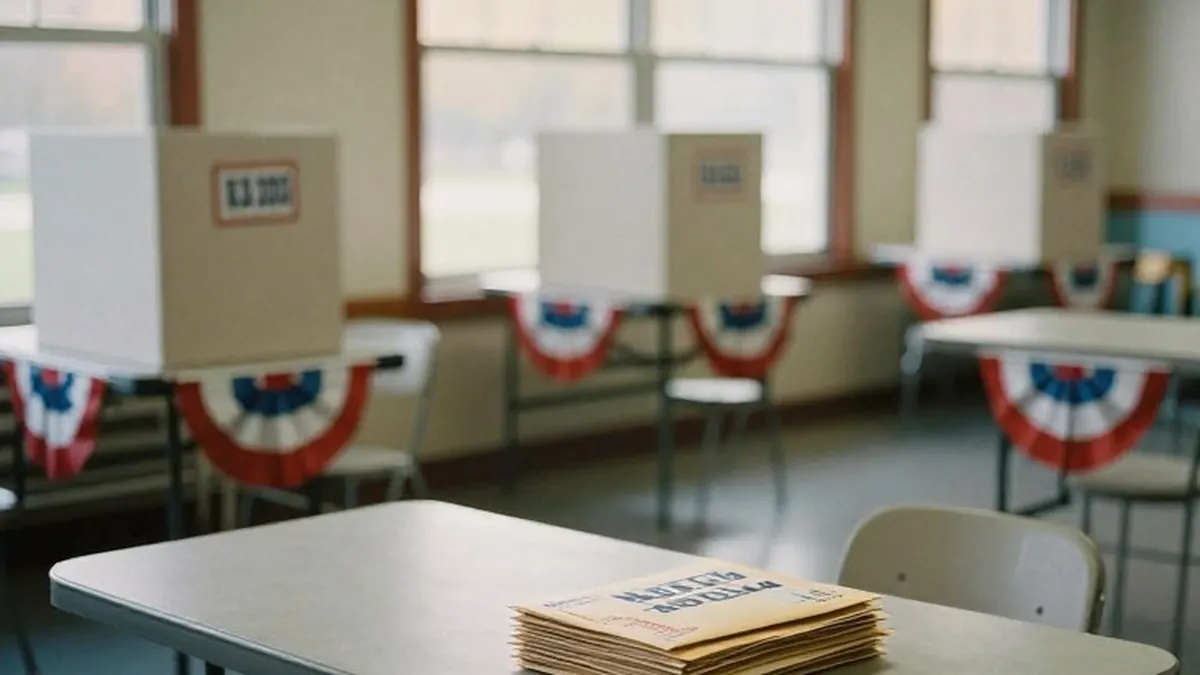
With early voting in Florida nearly two weeks underway, accounts of federal immigration enforcement agents showing up at polling locations have spread anxiety across the state. Yet elections officials and fact-checkers say there is no evidence of any organized effort to intimidate voters at the polls.
Last week, U.S. Customs and Border Protection vehicles were seen parked outside an early voting site in Tallahassee. In a separate case in Key Largo, masked agents were reported to have carried out an operation near a polling site, an incident the Monroe County Supervisor of Elections has just finished investigating.
Leon County Supervisor of Elections Mark Earley, speaking Friday on WLRN's South Florida Roundup, said he reached out to the FBI after the Tallahassee sighting. The inquiry produced a far simpler explanation: the agents had come to cast their own ballots. "They were just there trying to vote before they got sent out of Florida," Earley said. "They wouldn't be here for Election Day."
Earley said the scare could have been avoided if federal officials had clearly stated from the start that there would be no immigration presence at polling places. Instead, he said, the administration's "maybe" answers have fueled voter fears and left local elections officials working to calm the public. "What we've been hearing behind the scenes is just the opposite," he said. "That there would be absolutely no presence in any coordinated manner."
Amy Sherman, a senior correspondent for PolitiFact who has followed the issue, called the prospect of agents being deployed to polling places "Highly, highly unlikely" during Friday's program with host Tim Padgett. "The numbers don't make sense," Sherman said. "There's about 100,000 voting sites. There are not anywhere close to that number of ICE agents."
Sherman also noted legal barriers. Federal law prohibits troops at the polls absent something on the order of a foreign invasion, which she said she does not see happening, and federal and state voter intimidation laws apply to everyone, including police officers, ICE agents and campaign workers. She added that voting options are too widespread to police: absentee ballots went out in Florida in late September, and Broward County offers two weeks of early voting. "It would not be realistic for ICE to shut down all their activity and pivot to entirely going to voting sites," she said.
Even so, the concerns are not abstract, especially for Latino communities that have felt the weight of the Trump administration's immigration enforcement over the past two years.
Jared Nordlund, Florida state director for the Latino civil rights nonprofit UnidosUS, said on the program that the fear is real but may be producing the opposite effect. "Latino voters and families across the country are probably more awake than ever to go vote," he said, adding that many feel there was "a big bait and switch" between what they voted for in 2024 and what followed.
Nordlund pointed to economic strain, including rising gas and food prices, alongside enforcement actions as factors pushing Latino voters toward the polls and away from the Republican Party. He described visiting small business owners in Doral, home to the largest Venezuelan migrant enclave in the country, who are near closing because customers are afraid to leave home. "People are showing up to go vote, and they want to go do it early," he said.