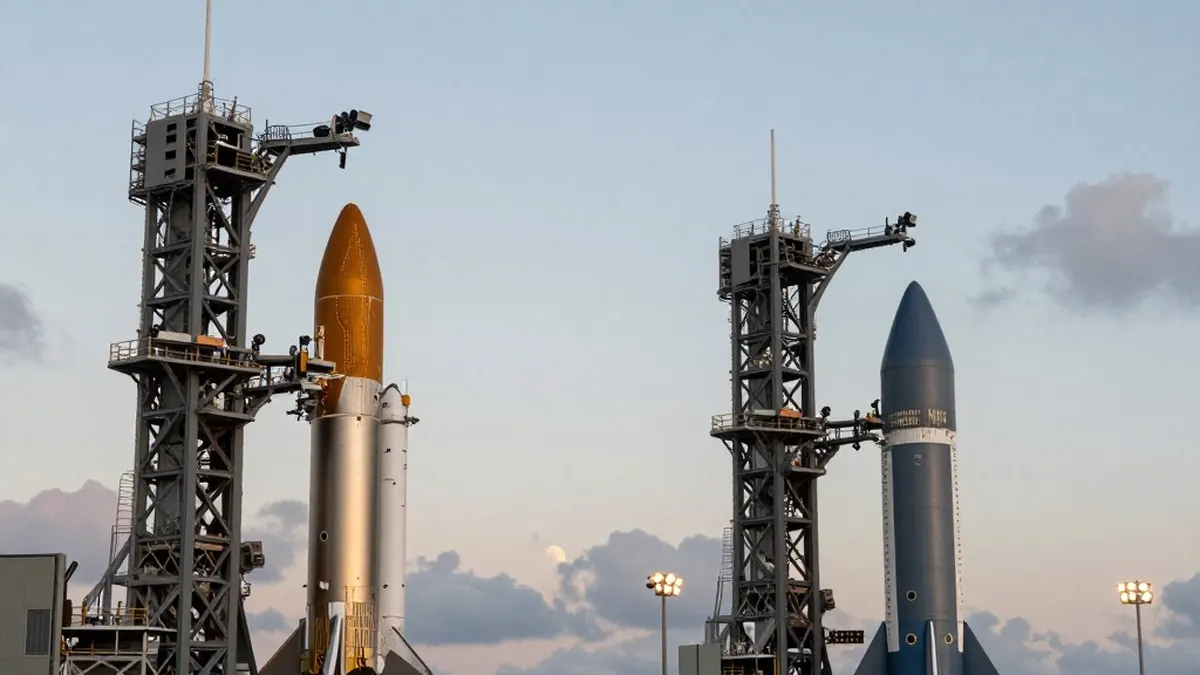
NASA has published new detail on how SpaceX and Blue Origin plan to get their lunar landers ready for the Artemis program. The schedules were presented on Oct. 5 at the International Astronautical Congress in Antalya, Türkiye, by Steve Creech, acting manager of NASA's Human Landing System Program. They include key demonstrations running through early 2028, among them orbital refueling and uncrewed lunar landing tests.
The nearest deadline is Artemis III, targeted for the third quarter of 2027. Four astronauts will launch aboard NASA's Orion spacecraft to low Earth orbit, where they will dock with test versions of both companies' landers to check that the systems work together. The results will help NASA decide which lander carries astronauts to the moon's surface on Artemis IV, targeted for early 2028.
The plan follows an overhaul of the Artemis architecture in February, made after delays to both landers. Artemis III was moved up a year and changed from the first crewed landing mission into a lander test flight in Earth orbit. The first landing stays on the books for 2028 but now falls to Artemis IV, as NASA keeps its goal of landing astronauts by the end of 2028.
SpaceX's list for the rest of 2026 includes catching its upgraded Version 3 booster at the launch pad, the first catch of a Ship upper stage, and a first Starship launch from a Florida pad still under construction. A first reflight of a V3 booster is also possible. NASA also expects SpaceX to finish the initial build of the crew cabin for the lander version of Starship. Little about the cabin's progress has been made public.
In early 2027, SpaceX is to finish integrating the systems Starship needs to communicate with Orion and deliver a cabin simulator for astronaut training. Test flights are planned to continue through the second quarter, along with a landing leg demonstration and airlock tests. For Artemis III, SpaceX will fly a slightly modified V3 upper stage with a docking system and nosecone cover but no crew cabin. NASA documents suggest it has already passed its mechanical fit checks.
Propellant transfer is a major hurdle. Starship must be topped off in orbit to travel beyond low Earth orbit, and a moon mission could require up to a dozen tanker launches to a fuel depot. SpaceX has to show it can move cryogenic propellant in orbit and store it without losing too much to boil-off. Artemis III needs no refueling flights, but SpaceX is expected to launch its first tanker within a few months of that mission. An uncrewed lander variant is targeted for around the end of the third quarter or start of the fourth, with an uncrewed landing before the end of 2027.
Blue Origin is developing the Blue Moon Mark 2 lander, a 52-foot (16-meter) vehicle powered by three BE-7 engines. Unlike SpaceX's stripped-down test vehicle, its Artemis III craft will be complete, with a crew cabin, partial life support and flight software. Astronauts will be able to enter it from Orion to try out some systems in zero gravity. Late 2026 brings more engine testing, qualification of the BT-7 maneuvering thrusters and design reviews.
Blue Origin also needs to repair its Launch Complex-36 pad at Cape Canaveral and return its New Glenn rocket to flight after a May explosion that heavily damaged the facility. NASA's presentation lists that for the fourth quarter of 2026, a target the company has defended, though a recent Reuters report suggests early 2027. The smaller, uncrewed Blue Moon Mark 1 is due to launch to the moon in the first quarter of 2027 under NASA's Commercial Lunar Payload Services program. The upgraded New Glenn 9x4 is slated to debut in the fourth quarter of 2027, alongside a second Mark 1 mission and an uncrewed Mark 2 demonstrator. That demonstrator is to attempt a landing in the first quarter of 2028.
NASA's overall schedule is unchanged since February, though more could be announced soon. Administrator Jared Isaacman, Associate Administrator Amit Kshatriya and Artemis program director Jeremy Parsons will hold a press conference on Friday, Oct. 23, to discuss the status of the missions and an "Artemis acceleration." With SpaceX aiming to finish its uncrewed landing in the fourth quarter of 2027 and Blue Origin in the first quarter of 2028, both have little room to spare. The company chosen for the first landing will depend on its progress and on proving to NASA that its lander can safely carry astronauts to the surface and back.