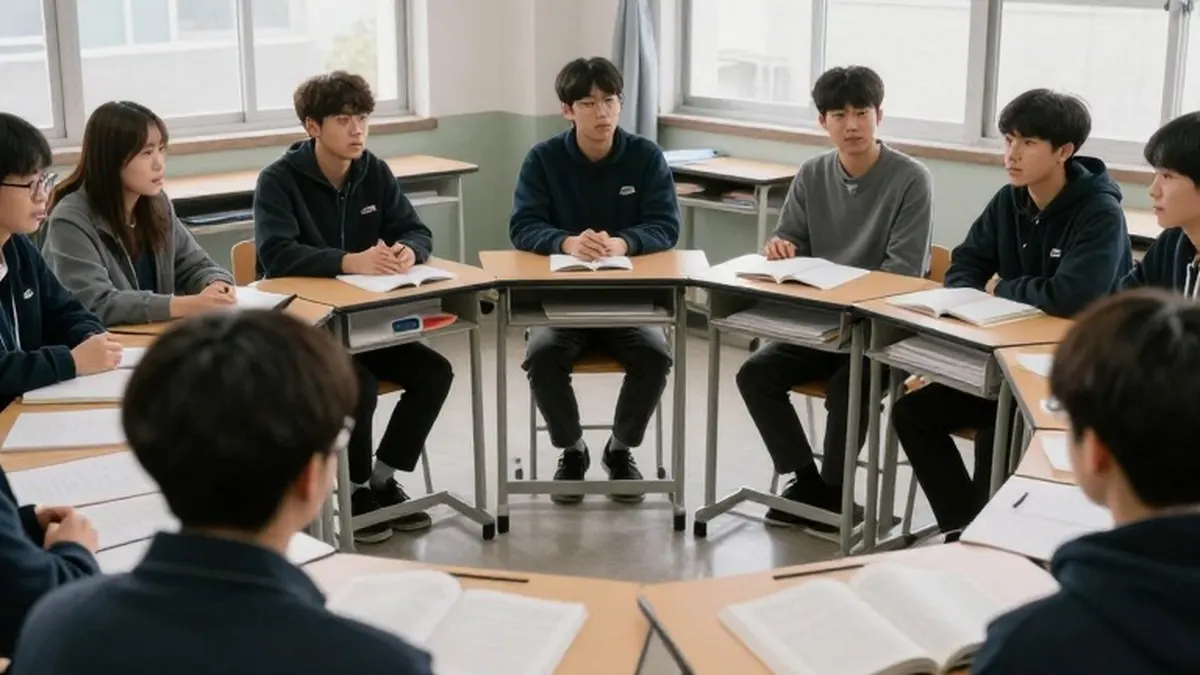
In Chuncheon, South Korea, a classroom conversation about Mary Shelley's Frankenstein leads elementary school students to consider another question: whether artificial intelligence is human. The discussion at Toegye public elementary school reflects a growing effort to give students more opportunities to read, debate and think independently in an education system shaped by intense competition.
The school has adopted the Great Books approach used by St. John's College, whose main campus is in Annapolis, Maryland. Teachers guide conversations rather than deliver lectures. The model has no majors or elective courses, and students work through questions using assigned readings, their own reasoning and discussions with classmates instead of consulting outside sources such as the internet.
For Toegye student Ma Yeonwoo, that exchange is part of the appeal. He says hearing classmates debate produces more ideas than listening only to a teacher. During the Frankenstein discussion, he suggests the creature could be considered a human without a soul. But he rejects the idea that AI is human, reasoning that people created it and that intelligence does not give it creativity.
The initiative comes amid concerns about changes in South Korean education. International assessments including PISA have recorded declining reading skills since COVID, following decades of strong performance by South Korean and other East Asian students compared with Americans. Meanwhile, OECD figures show that 51% of South Korean students report using AI chatbots for studying at least weekly. Competition for university admission creates pressure reaching down to pre-K, with many families choosing cram schools for an advantage or foreign schools to leave the system.
Lee Yonghwa, an English language and literature professor at Incheon National University, co-founded South Korea's first Great Books program in 2019. He says test preparation leaves students little room for reading and reflection. He also worries that reliance on AI to gather information and ideas is weakening their ability to memorize facts. Without independent reasoning, he argues, students cannot assess the quality of AI-generated results.
Chuncheon Mayor Yook Dong-han says his own experience of the education system's limitations helped motivate him to pursue a different approach. The city, about 50 miles east of Seoul, formed an academic partnership with St. John's College in 2025 to promote Great Books learning. According to Lee, 120 college students and about 770 younger students across South Korea now participate, with 40 teachers in training. Yook says student interest has surpassed his expectations.
Readings include Aristotle, Shakespeare, Euclid and Korean writers such as Nobel laureate Han Kang. At one Chuncheon high school, students studying Martin Luther King Jr.'s 1963 Letter from Birmingham Jail debated just and unjust laws and when citizens should obey them. Lee says students connected the letter to South Korea's experience in 2024, when citizens and lawmakers defeated former President Yoon Suk Yeol's attempt to impose martial law.