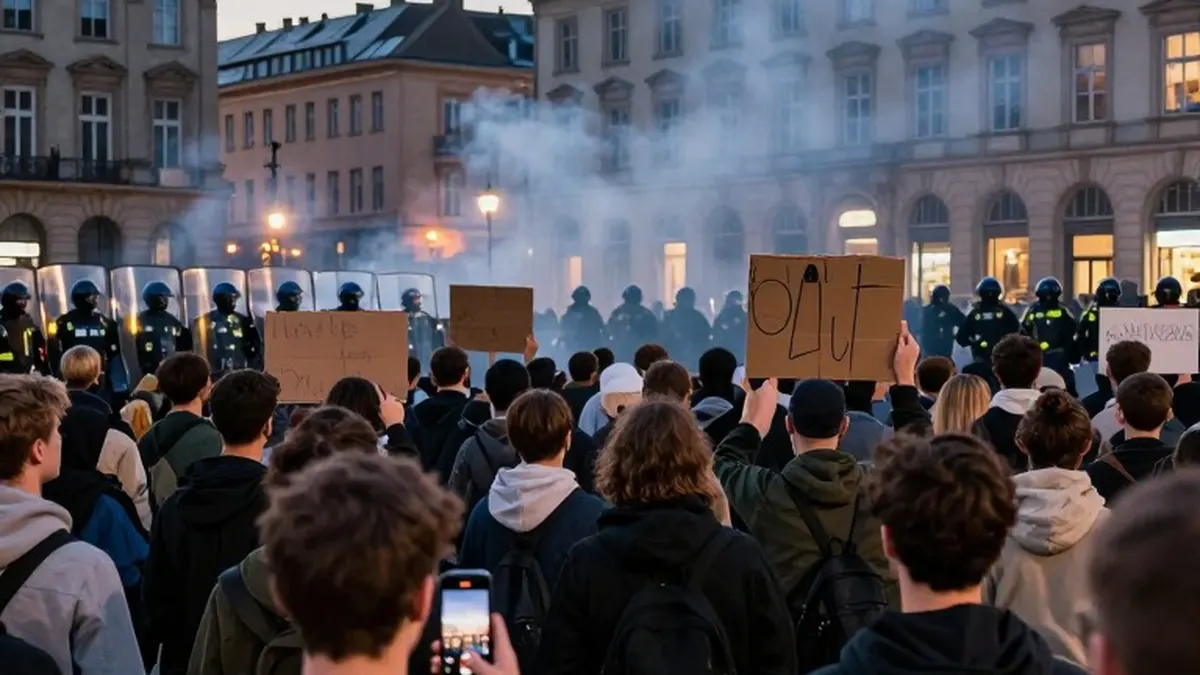
Young people have taken to the streets in cities across Europe, from the suburbs of Paris to the squares of Belgrade, in a wave of protests led largely by Generation Z. Their demands differ from place to place but often overlap: run-down school facilities, a perceived lack of economic opportunity, the cost of living, corruption, housing, and a feeling that nobody is listening.
Some of the demonstrations have turned violent. In France alone, thousands of shops have been damaged or looted in recent weeks, and police have used stun grenades and water cannons. In Brussels, 19-year-old student Maya Gourdel has been writing slogans such as "If we burn, you burn with us!", a line from the film "The Hunger Games" that youth movements around the world have adopted as a symbol.
The most dramatic result came in Serbia this weekend. Student-led protests, which ran for nearly two years against perceived corruption and creeping authoritarianism, culminated in the toppling of long-time leader Aleksandar Vucic in an election. Student protester Stasa Piletic described a sense of relief and freedom on waking up. "I feel that we finally moved from protests to responsibility," Piletic said.
Elsewhere, the grievances are practical. Chiara, a 21-year-old student in Milan, said Italian schools lack enough teachers and have crumbling buildings, and that graduates face underpaid work and expensive housing far from their home cities. In a suburb north of Paris, 17-year-old Bilal Narjissi said his school has staff shortages and once had rats, and that students were evacuated last year when a roof collapsed on the courtyard. Nobody was hurt, he said.
The numbers help explain the mood. A European Union survey published in 2025 found that rising prices and the cost of living worry 40% of people aged 16 to 30. Of the 92.7 million people in the EU at risk of poverty or social exclusion in 2025, the highest risk, 26.3%, was among those aged 18 to 24, compared with 18.8% among adults aged 65 or over.
Many young people also resent bearing the financial weight of an older generation that tends to vote in greater numbers. The OFCE think tank says people over 60 make up a quarter of France's population but own 60% of its wealth. French pensions are the largest public expense, on track to reach 14% of economic output. A French government report in October said pension spending rose by 2.5 percentage points of GDP between 2000 and 2023 while education spending fell by 0.5 points, and that 32% of the education ministry's budget goes toward pensions.
Gourdel, who is protesting for better school conditions in Belgium, said peaceful efforts went unnoticed. "It's only when people started to burn trash or that kind of stuff that the media and cameras started showing us," she said. The unrest is still spreading. A demonstration is planned in Germany this weekend over the cost of living, inequality, war and the state of schools, and student-led protests against Prime Minister Edi Rama's government have engulfed Tirana and other Albanian cities.
Albanian architecture student Xyke Kurti said the prime minister spent 130 days not listening to students, and that many young Albanians see their future outside the country. In Serbia, the students now face the hard task of governing, something neither they nor their candidates have done before. Protester Luka Stojakovic dismissed that concern: "We have seen where people with political experience have brought us."