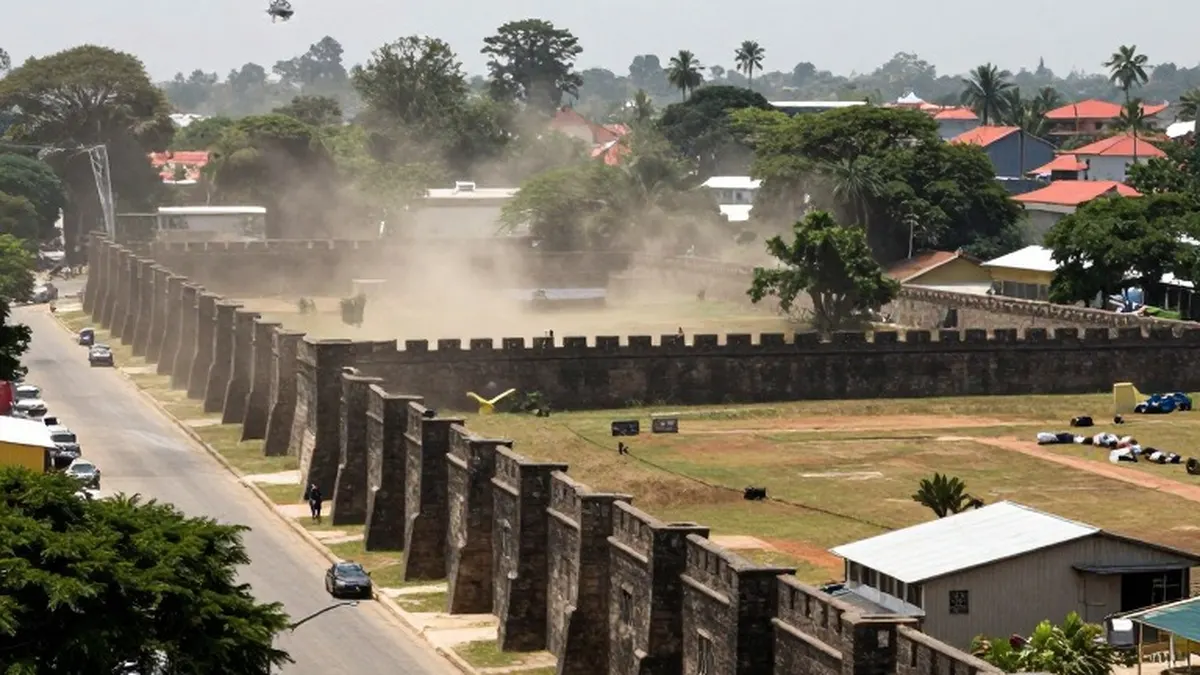
El Salvador's President Nayib Bukele says his country's military has destroyed the headquarters of Haiti's 400 Mawozo gang in an assault involving ground forces and helicopters outside Port-au-Prince. The operation marks El Salvador's first military strike on a Haitian target since it sent more than 2,000 soldiers to the country in October to rescue four missing Salvadoran technicians.
In a post on X on Tuesday, Bukele said troops had destroyed both the gang's headquarters and the home of its leader, known as Lanmò San Jou. He claimed most gang members escaped without putting up a fight. Footage accompanying the announcement showed helicopters firing at a large compound as dozens of people ran from the property.
The site was reportedly in Croix-des-Bouquets, a suburb that serves as a stronghold for the gang. The BBC could not verify the footage or establish whether the compound was the group's headquarters. Authorities have not confirmed the scale of the destruction, and some Haitians have questioned whether the buildings were destroyed or damaged. Reports from several media outlets that up to 20 people died also remain unconfirmed.
According to the Miami Herald, gang leader Wilson "Lanmò San Jou" Joseph was absent when the attack took place. The newspaper, citing several sources, also reported that Haiti's National Police drone task force participated in the operation with support from Salvadoran soldiers. Haitian Prime Minister Alix Didier Fils-Aimé subsequently thanked the Salvadoran military for its commitment to combating gangs.
Fils-Aimé said Haiti and El Salvador would continue cooperating with the UN-backed Gang Suppression Force, or GSF, to recover territory and re-establish state authority. The four missing Salvadorans were air force technicians serving with that multinational force, which was initially led by troops from Chad. They were abducted at gunpoint while buying food in October. Bukele has pledged to recover them alive and threatened continuing military pressure unless they are released.
The Salvadoran deployment has drawn criticism over whether all its troops operate under the GSF's command. Those concerns have prompted questions about the legitimacy and legality of their operations in Haiti. Amnesty International has called on both governments to ensure Salvadoran military operations comply with international human rights law.
The strike apparently followed an exchange on X in which a user encouraged Bukele to attack the compound. Bukele responded by asking for its precise location and promising to destroy it. That response has since been removed, apparently because it breached the platform's rules.
Haiti's largest criminal organisation, 400 Mawozo, is associated with kidnapping, extortion, murder and weapons trafficking. Armed gangs control much of Port-au-Prince and areas beyond the capital. The United Nations says at least 5,700 people were killed or injured in gang violence or operations against gangs between 1 January and 11 September this year.
Bukele has promised to replicate in Haiti the sharp reductions in gang violence recorded during his crackdown in El Salvador. Human rights organisations, however, have challenged the legality of that campaign, citing repeated extensions of emergency measures, conditions for detainees in the country's high-security mega-prison and mass trials of suspected gang members.