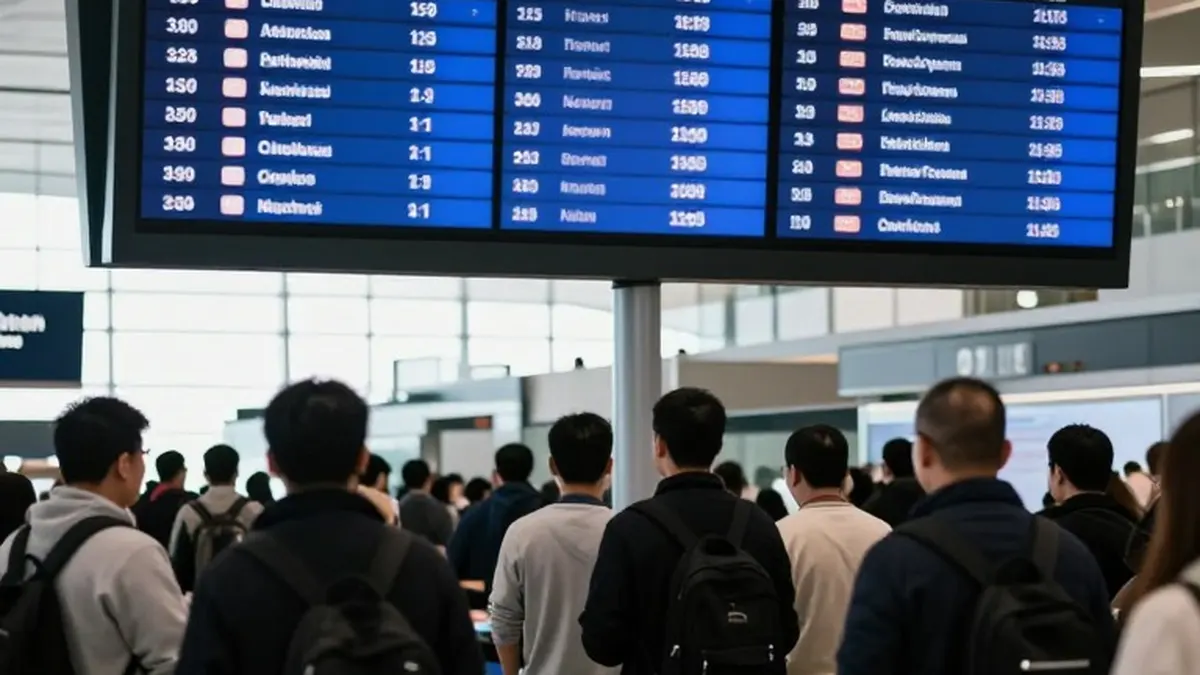
The United States experienced a significant aviation disruption last Friday when the Federal Aviation Administration grounded all domestic flights for nearly four hours. This event marked only the second time since the September 11, 2001 attacks that such a comprehensive order was issued. The outage resulted in the cancellation of more than 9,000 flights and left an estimated 1.5 million passengers stranded across the country.
Officials attributed the widespread disruption to a failed software upgrade. Routers responsible for communicating with aircraft in mid-flight ceased to function, preventing pilots from using their standard communication frequencies. As of Sunday, authorities were still working to restore the system to normal operations. Transportation Secretary Sean Duffy told CBS News that the agency expected to reach full capacity by the following day, though he acknowledged that delays would persist.
The incident has intensified scrutiny regarding the state of the FAA’s infrastructure and whether the ground stop was preventable. While President Donald Trump has cited a lack of funding from Congress as a primary cause, critics argue that billions of dollars have already been allocated for necessary upgrades. They contend that the execution of these projects has lagged behind the financial commitments made by lawmakers.
Democratic lawmakers have further questioned the administration’s choice of contractors for the installation work. Representative Rosa DeLauro stated in a Sunday release that the FAA has received historical levels of investment over the past two years. She emphasized that Congress has demonstrated a willingness to modernize systems and support the workforce, but noted the need for a competent partner at the Department of Transportation to ensure sustainable and transparent execution.
Secretary Duffy indicated that investigations into the malfunction are ongoing. He described the issue as originating at a remote FAA location where workers from the defense contractor L3Harris were replacing aging copper wire with fiber optic lines. A router reportedly began malfunctioning during this process, sending out 1,000 login attempts to the FAA system every four or five seconds, which overloaded the entire network.
In a Sunday interview with NBC’s Meet the Press, Duffy stopped short of placing full blame on L3Harris. He noted that the investigation must determine whether the issue was a faulty installation by the contractor or a defect in the router itself. However, he expressed a preference to move away from L3Harris, which owns a significant portion of the FAA’s telecommunications infrastructure, while acknowledging that he cannot cancel the network the agency currently operates on.
L3Harris, formed in 2019 through a merger, has been involved with the FAA network since 2002. Friday’s incident was not the first time the company’s systems were linked to flight delays during upgrades. In November 2009, a smaller outage in Los Angeles required flight plans to be entered manually, delaying over 800 flights. In a statement following the recent grounding, L3Harris said it was supporting the FAA’s probe and had already replaced 70 percent of the system’s copper wire.
Critics point out that many issues with the FAA’s telecommunications systems predate L3Harris’s involvement and stem from aging infrastructure. The agency has long aimed to replace roughly 5,170 lengths of copper wiring dating back to the 1960s. A September report by the Government Accountability Office highlighted that air traffic controllers were using obsolete hardware, including 1980s screens and floppy disk drives. The agency had even been forced to seek replacement parts on online marketplaces like eBay.
The Government Accountability Office also noted the continued use of paper flight strips, a practice that has led to dangerous situations. In August 2023, a printer jam at San Diego International airport contributed to a near-collision between a Southwest Airlines aircraft and a Cessna jet. The report found that out of 138 systems the FAA relies on, 51 were unsustainable and another 54 were potentially unsustainable due to aging technology. Fifty-eight of these systems had a critical impact on air traffic safety.
In September, the accountability office reported that the FAA had failed to meet at least four of its 11 recommendations for modernizing air traffic systems. The agency has 11,389 individual upgrade projects on its agenda and has struggled to coordinate these repairs. Funding remains a contentious issue, as the FAA’s budget is not mandated by law. Although Congress allocated $12.5 billion for upgrades in 2025, the administration has committed to spending only $4 billion, with approximately $1 billion spent so far. Secretary Duffy has argued that the FAA now needs at least $50 billion, a sum Democrats have criticized as a ransom without a clear delivery plan.