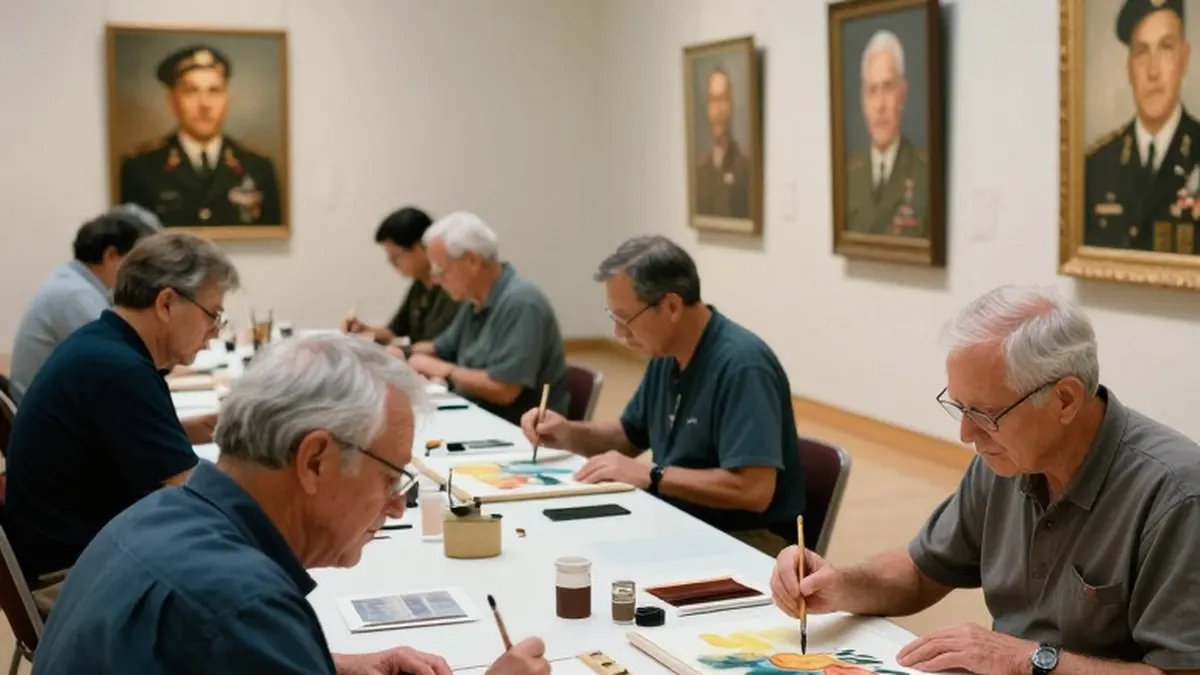
The USS Yorktown museum in Charleston Harbor served as the backdrop for a recent gathering of thirty veterans who participated in a special art class. This event, held on the Saturday before Veterans Day, marked the fifth consecutive year that artist Mary Whyte has hosted such a session at the site. Dozens of additional participants joined the event remotely from other locations across the country. Whyte organized the class to address the isolation often felt by service members, believing that artistic expression fosters a deeper connection with other veterans, the broader community, and oneself.
The initiative stems from Whyte's realization that something was missing during her years of traveling the nation to create life-size watercolor portraits of fifty veterans in fifty states. The resulting exhibition, titled "We the People," has toured the United States since 2019. Its most recent stop was the Grohmann Museum in Milwaukee, where Whyte presented the work to local veterans during a free class in May. The seven-year process of completing these portraits led Whyte to the conclusion that her artistic skills could be used to do good, particularly for those she considers the nation's greatest patriots.
To formalize this mission, Whyte established the Patriot Art Foundation. She cited a conversation with a Vietnam veteran who told her that drawing was the only activity that silenced the voices in his head. Whyte relates to this experience, noting that artists often enter a different mental state while painting. This understanding drives her efforts to provide a safe space for veterans to express themselves without fear of criticism, offering only encouragement instead.
For Carissa DiPietro, an Army veteran who joined in 1999, the painting class provided a vital outlet. DiPietro shared her story of being assaulted by her recruiter on her first day of service and the subsequent murder of her five-year-old daughter by her ex-husband, who was also a service member, two weeks before the attacks on September 11. For years, she suppressed these traumas until she discovered art. She described painting as a liberating way to acknowledge that her experiences were not okay, allowing her to process grief safely in the company of fellow veterans.
Whyte challenges participants with specific prompts, such as painting their combat boots, which she refers to as watercolor boot camp. She explains that boots serve as a real self-portrait, reflecting the weathering and stories of where they have been. Navy veteran Jeffry Peterson, who served on warships in the Pacific during the 1970s, found deep emotional resonance in this exercise. He noted that the boots often represent the presence of fallen comrades and described the feeling they evoke as a welcome home.
Beyond in-person events, the foundation offers online resources, including video tutorials and a weekly virtual art muster for camaraderie and tips. Whyte envisions a future where a Great Veteran Paint-Out takes place simultaneously across the country on the Saturday closest to Veterans Day. She hopes this nationwide event, accompanied by flying flags, will clearly communicate that the country is grateful for the service of its veterans.
Whyte emphasized the national responsibility toward those who have served, stating that no veteran should be homeless or hungry after providing safety and a home for the nation. When asked what the country owes its veterans, she replied that in many ways, the nation owes them its lives.