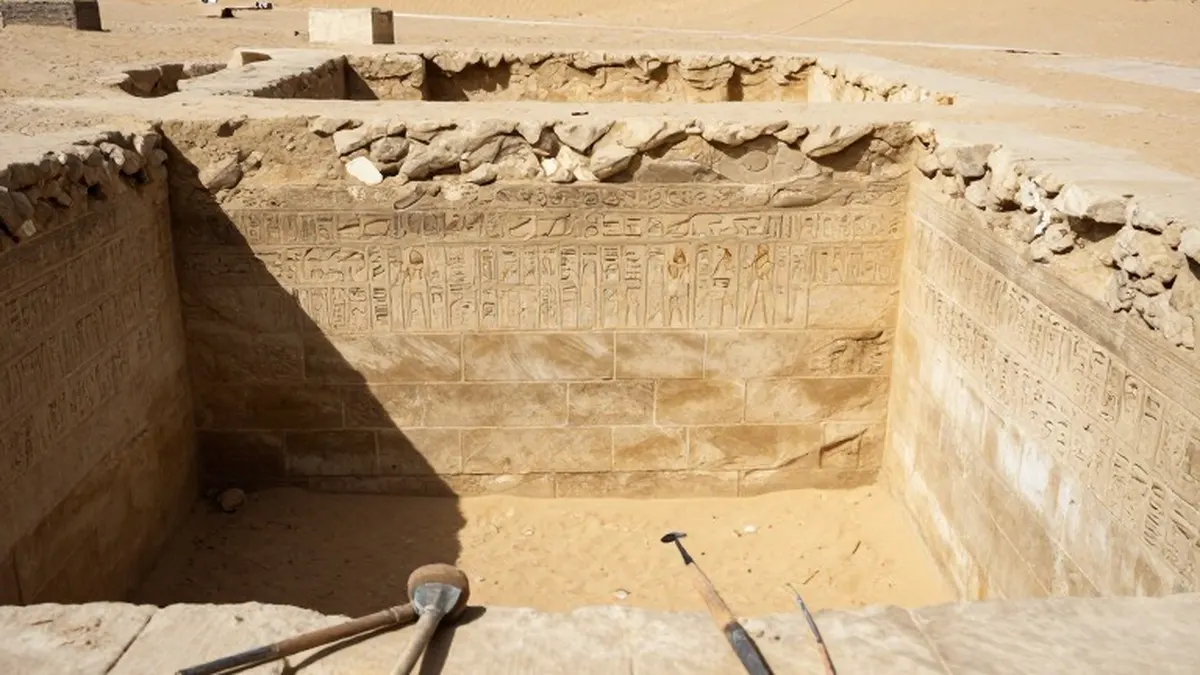
The Egyptian Ministry of Tourism and Antiquities announced earlier this week that archaeologists have successfully rediscovered the tombs of two high-ranking officials from ancient Egypt. Located in the Saqqara necropolis, these burial sites belong to an official named Sabu and his son, Ptahshepses. The discovery represents a significant recovery of Old Kingdom heritage that had been lost to the sands of time for nearly two centuries.
The tomb of Sabu is situated to the north of his son's burial site. It measures approximately 54 by 28 meters and is estimated to have originally stood about five meters high. Alongside the main tomb structures, the excavation team uncovered the offering chapel of Sabu's wife, Iykhet-nefret, for the first time. The team also located the burial chamber of Ptahshepses, where they found his limestone sarcophagus.
These specific tombs were originally identified by the French archaeologist Auguste Mariette between 1858 and 1860. Mariette, who later founded the Egyptian Antiquities Service, conducted limited excavations at the site. However, his work lacked comprehensive documentation, and the structures subsequently became buried under sand. This led to renewed efforts in recent years to locate and study the sites, with the current excavation led by the Czech Institute of Egyptology.
Dr. Miroslav Bárta, who heads the Czech archaeological mission, explained that the team used satellite imagery and field surveys to relocate the tombs. He highlighted the discovery of Iykhet-nefret's offering chapel as a particularly notable find. The chapel features a false door decorated with scenes showing the woman alongside her husband and their two sons, Ptahshepses and Ranefer.
Bárta also noted architectural similarities between the sites and royal structures. The exterior facades of Sabu's tomb mimic those found on royal palaces. Additionally, the offering chapel contains well-preserved relief carvings. These depictions show Sabu and Ptahshepses supervising processions of individuals carrying offerings, providing insight into the funerary practices of the era.
Mohamed Abdel-Badie, head of the Egyptian Antiquities Sector at the Supreme Council of Antiquities, provided details on the discovery of Ptahshepses' burial chamber. The chamber was found on the eastern side of the tomb by the Czech team. Historical records indicate that Ptahshepses held high-ranking positions during the reigns of four Fifth Dynasty pharaohs: Sahure, Neferirkare, Raneferef, and Nyuserre.
According to archaeological studies cited by Abdel-Badie, Ptahshepses is considered the first official outside the royal family to marry an Egyptian princess. This marriage reflects the high social standing he enjoyed during that period. He is believed to have wed Princess Khamaat, who was the daughter of Pharaoh Userkaf, the founder of the Fifth Dynasty.
Despite the tomb having been looted of many of its valuables, Dr. Mohamed Mujahid reported that the mummy of Ptahshepses remained untouched. An analysis of the remains suggests that Ptahshepses died at an age older than 60. This finding aligns with historical records regarding his long life and career in the royal administration.
Sherif Fathy, the Minister of Tourism and Antiquities, praised the work of the Czech mission. He stated that the findings help reveal more details about the religious and social life of the period. The discoveries also provide valuable information regarding funerary architecture during the Old Kingdom, enriching the understanding of ancient Egyptian civilization.