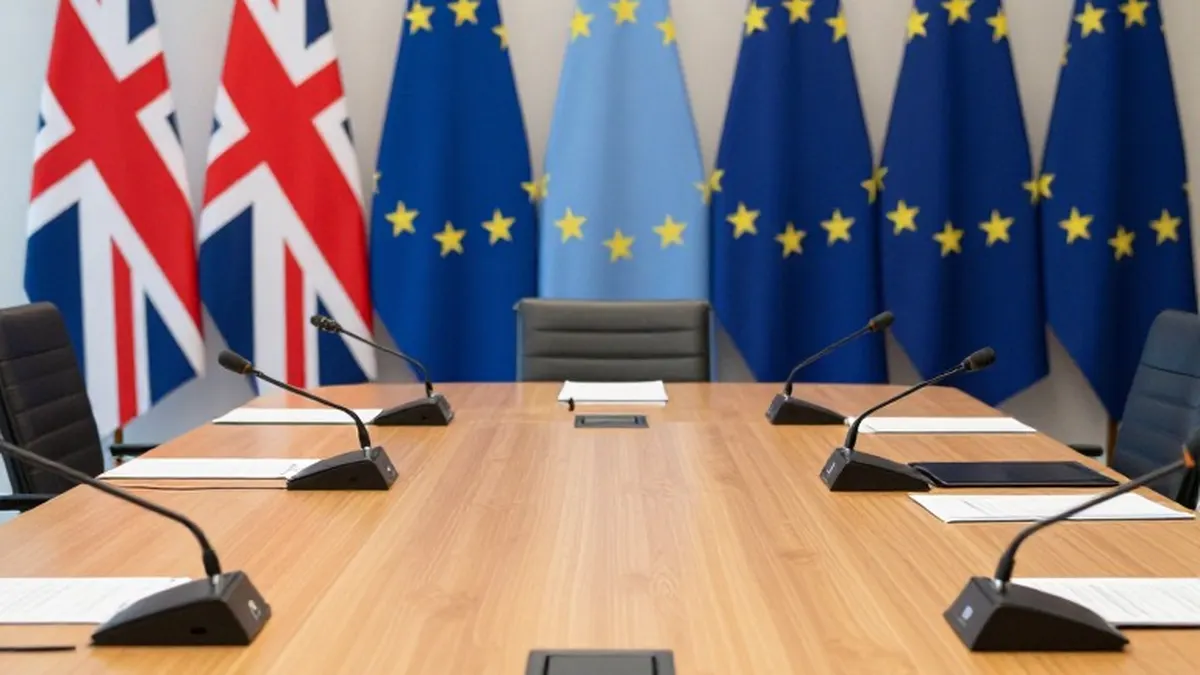
Prime Minister Andy Burnham is set to announce on Monday that the United Kingdom’s departure from the European Union has not delivered the promised results. He intends to reveal plans to sign a new agreement with the bloc, marking the latest in a series of recent statements where he has criticized the current Brexit arrangements. This declaration follows his comments at the Welsh Labour conference on Saturday, where he stated that the nation has lost more than it gained through leaving the EU.
The Prime Minister is scheduled to meet with European leaders at a summit later this week. During these discussions, he aims to secure agreements that he believes could increase the UK's Gross Domestic Product by 0.4 percent, a figure equivalent to approximately 17 billion pounds. The proposed areas of cooperation include food and farming standards, emissions trading mechanisms, and a new youth mobility scheme.
At the Lord Mayor’s banquet in the City of London, Burnham is expected to argue that the promise made by former Prime Minister Boris Johnson to take back control was not fulfilled. He will contend that the country was left with a needlessly hard exit from the EU, which created unnecessary barriers for businesses and damaged the nation's economic potential. Burnham plans to use a metaphor comparing the situation to the Emperor’s New Clothes, suggesting that the obvious truth has been ignored. He will state that the Brexit deal provided to the country has failed and that the government has lost more than it gained.
The Prime Minister will outline three specific conditions for signing the new agreement with the EU. First, the deal must be consistent with the Labour Party manifesto and the government’s established red lines. Second, it must improve upon the current Brexit deal and bring it closer to what the public believed they were voting for in 2016. Third, the agreement must pass the so-called Makerfield test, ensuring it delivers real and tangible improvements in people's everyday lives.
Burnham is expected to describe the new approach as a win-win situation. He will emphasize that the UK is adopting a constructive and positive stance, moving away from an adversarial relationship. He will argue that this new path involves coming together to confront shared challenges rather than continuing to burn bridges.
However, details of the negotiations have raised questions about the extent of the UK's future influence. Hamish Falconer, the EU relations minister, told the BBC on Sunday that while the UK would have a voice in the room under the new deal, it would not hold a vote on EU food policies. This distinction highlights the limited decision-making power the UK will retain in certain regulatory areas.
Falconer also indicated that an exit clause could be included in the agreement. This clause would allow for a reversal of the closer alignment if a future UK government wished to change direction. He explained that the EU is worried about the possibility of a future Reform or Conservative government undoing the agreement, making such a safeguard necessary for European partners.
According to the BBC, the inclusion of this exit clause stems from EU concerns regarding costs. Specifically, the European Union is worried about the potential expense of having to rebuild facilities for border food safety checks that were originally put in place following the initial Brexit transition.
The announcement has drawn a sharp response from Boris Johnson, the former Conservative prime minister who resigned in 2022 over the Partygate scandal. Johnson stated that Britain would absolutely vote for Brexit again if Burnham forced another vote on the issue. He told the Telegraph that escalating the Brexit issue should not be the political priority of the current administration.
Johnson criticized the strategy, suggesting that Burnham would impale himself and his party on this point. He argued that the Prime Minister needs to move off this issue because he will not win, adding that the reality is that people are not fools.