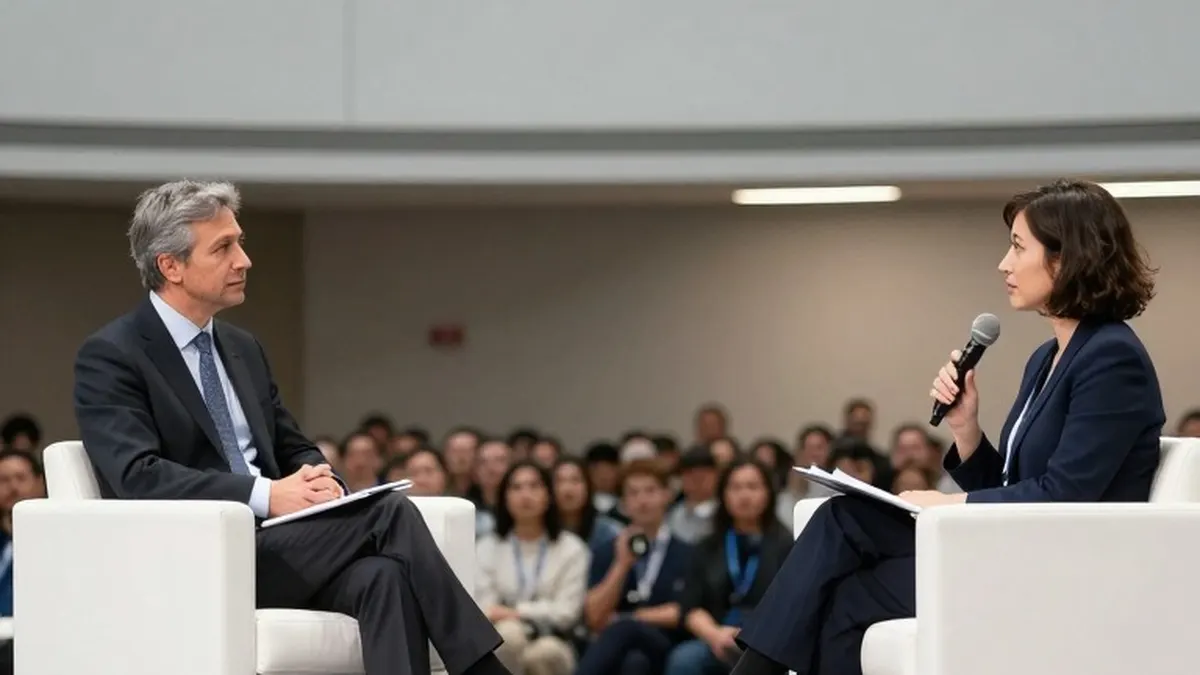
Hollywood's evolving relationship with artificial intelligence took center stage at the Web Summit in Lisbon on Thursday. Duncan Crabtree-Ireland, the national executive director and CEO of SAG-AFTRA, joined Dan Neely, co-founder and CEO of the AI licensing platform Vermillio, for a panel discussion. Moderated by Stewart Clarke of Deadline, the conversation addressed performers' rights, the potential of the NO FAKES Act, and strategies for coexisting with generative AI technologies.
Crabtree-Ireland acknowledged a tension within the union regarding the pace of technological adoption. While many members prefer the industry to slow down or halt AI integration, he noted that the majority accept its inevitability. When asked to estimate the portion of SAG-AFTRA's 160,000 members who would prefer AI to be completely blocked, he suggested the figure is likely between 10 percent and 15 percent. "I hear from them every day, and they are angry that we aren't," he said, highlighting the ongoing internal debate.
Despite this dissent, Crabtree-Ireland emphasized that the union has reached a collective agreement on three foundational principles for AI adoption in entertainment: consent, control, and compensation. He argued that when a person's image is used, these elements must be present. The union remains motivated by the belief that the human spark of creativity is unique and cannot be fully replicated by machines trained on existing data.
Reflecting on the 2023 strike, Crabtree-Ireland cited a picket sign from a writer that read, "ChatGPT doesn't have childhood trauma." He used this to illustrate his point that while AI can mimic the human condition, it does not possess the lived experience that drives authentic creative work. Many performers view AI as a tool for augmentation rather than a replacement, valuing the act of creation itself despite the difficulties of an artistic career.
Dan Neely presented his company's approach to managing these rights through technology. Vermillio has developed detection tools to identify unauthorized uses of digital likenesses. The platform also offers a "guardrails" product that allows creators to define specific permissions, such as what can and cannot be produced using their data. The system ingests content from major intellectual property holders, including studios, music labels, and book publishers.
A significant challenge in this space is the ambiguity of digital replicas. Neely explained that their metrics attempt to quantify the degree of similarity, such as determining if a generated voice is 30 percent one person and 30 percent another. He noted that the industry expects greater clarity on these technical definitions within the next 12 months. Crabtree-Ireland added that SAG-AFTRA applies a simpler standard: if a digital creation is perceived as a specific person's voice or look, it is considered a replica.
The CEO referenced the case of Scarlett Johansson, who threatened legal action against OpenAI for allegedly imitating her voice without a license. He stated that OpenAI ultimately removed the feature, though the company did not formally admit to using her voice. This incident underscores the difficulty of keeping pace with rapid technological advancements in the audiovisual world.
Neely identified another major driver of AI usage as the reliance on established fandoms. Rather than creating unique content that stands on its own, many developers attach new projects to existing fame and recognition. By using an actor's name, image, or voice, creators hope to leverage that pre-existing audience to drive engagement. This dynamic, he argued, is why issues related to digital likeness are so prevalent in the current market.
The Web Summit, which ran from November 9 to 12, featured various discussions on the intersection of technology and media. The panel highlighted the ongoing efforts by industry leaders to establish frameworks that protect artists while allowing for innovation in the digital age.