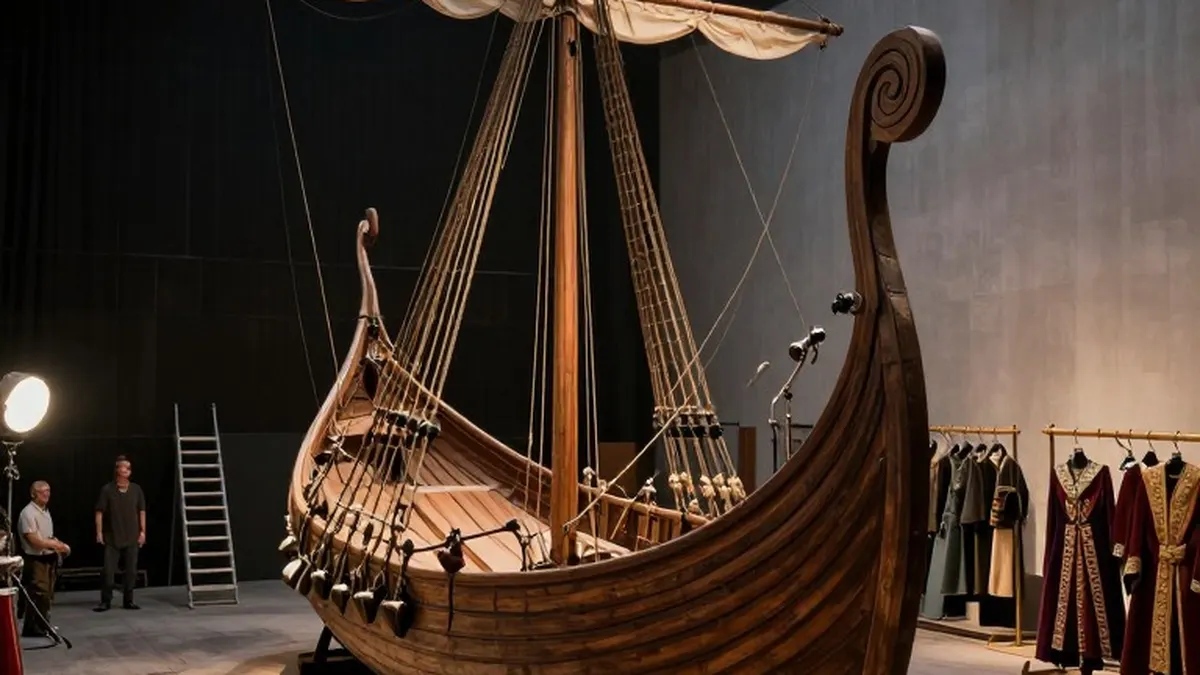
When veteran sound mixer Willie Burton needed to capture creaking oars and lapping waves for the many seafaring scenes in The Odyssey, he planted microphones around a 115-foot wooden Viking ship, grabbed his gear and raincoat, and climbed into the hold. Before shooting aboard the vessel, its Swedish captain had a warning for the actors and production workers sailing with his crew.
"He said that everything on this ship would kill you," Burton recalled, speaking to a packed theater on Tuesday at the premiere of the documentary Behind the Scenes of The Odyssey. "The crew said, 'No one survives the hold.'"
There are far less dramatic ways to supply sound to a movie. But Burton was one of 10 craftspeople from The Odyssey, joined by star Matt Damon and producer Emma Thomas, who turned out on the Universal lot this week to explain how they built an ancient Greek epic for 2026 audiences under the defiantly analog direction of Christopher Nolan. At a moment when much of the movie industry is adopting AI tools, the film's awards campaign is leaning hard into its handcrafted nature.
Nolan is hardly alone in that pitch. Directors Phil Lord and Chris Miller have talked up their use of practical sets over green screens on Project Hail Mary. Olivia Wilde has explained why she paid out of her own pocket to shoot The Invite on 35 mm film rather than digitally. Laika CEO Travis Knight has described the stop-motion techniques in Wildwood as antithetical to AI, and Denis Villeneuve has spoken of the "artisanal" way he shot Dune: Part III, relying on natural light and custom-made IMAX lenses.
Awards season is always a time for touting craft and technique, but this year's emphasis on handmade filmmaking carries a note of wistfulness. It arrives amid studio consolidation and cost-cutting that have made the adoption of AI tools feel virtually inevitable to many in the industry.
The 75-minute Odyssey documentary, which arrives alongside the film's home entertainment release on Nov. 17, underscores how demanding the $250 million production was, showcasing remote locations in Italy, Greece, Morocco and Iceland. An exhibit accompanying the premiere highlighted some of the 5,300 handmade costumes from designer Ellen Mirojnick, antique swords, bows and axes used by actors and stunt performers, and the bronze gong and ancient lyre played by musicians on composer Ludwig Göransson's score. As Damon puts it in the film, "I don't know how long we're gonna get to make movies this way."
Elsewhere in Hollywood this week, Skydance had a whirlwind stretch marked by a leadership shake-up and its first post-merger earnings report. DC Studios heads James Gunn and Peter Safran were ousted and will be replaced by former Marvel Studios executive Jeremy Latcham. Chief David Ellison told investors the company, carrying more than $80 billion in debt, must streamline costs, doubled down on AI and announced a Paramount+ and HBO Max bundle for early 2027. Shares fell about 2% to $8.50 on Tuesday. On Wednesday, Ellison, Jeffrey Katzenberg, Gal Gadot, Vin Diesel, Jerry Bruckheimer and HBO chief Casey Bloys gathered at the Beverly Wilshire Hotel to honor Skydance co-CEO Ynon Kreiz with the Simon Wiesenthal Center's 2026 Humanitarian Award.
Also released Tuesday was Daddy Issues, Sofia Franklyn's tell-all memoir about the end of her business relationship and friendship with Alex Cooper, who went on to host their hit podcast Call Her Daddy solo after their 2020 split. Among Franklyn's claims is that Cooper negotiated a $20,000 raise for herself behind her back while the show was at Barstool Sports. Cooper has not publicly responded, while Barstool's Dave Portnoy denied Franklyn's implication that his relationship with Cooper was more than professional, telling The Toast podcast, "I have no relationship with Sofia. None. I hate her guts."